
EnforceAuth, the AI Security Fabric, today announced Evidence IQ, a new evidence layer for AI agent security. It records the authorization decisions made for AI agents as tamper-evident evidence, so a company can show why an agent was allowed to act, whose authority it acted under, and what changed afterward.
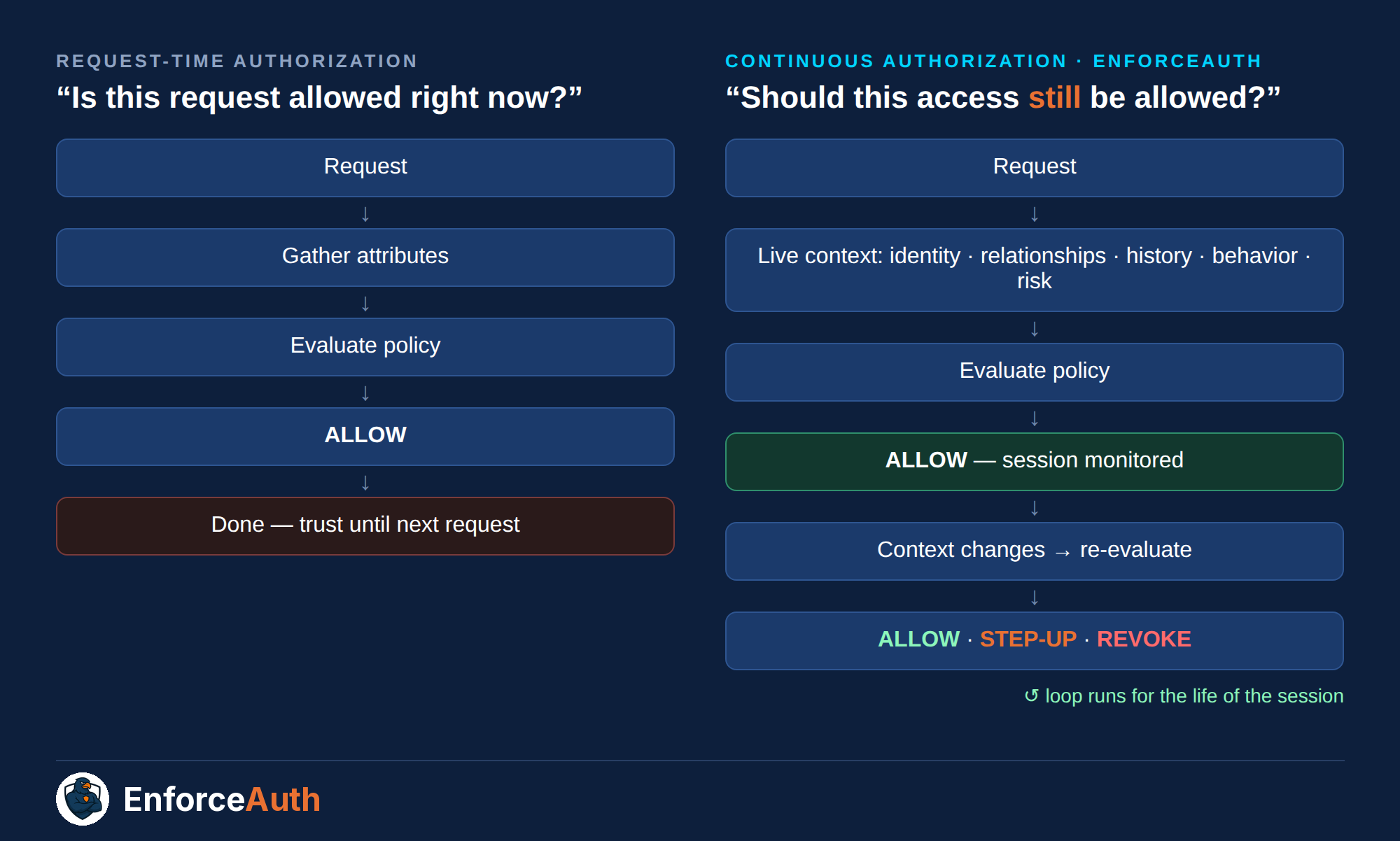
“AI safety controls what an agent says. AI security controls what it is allowed to do,” said Mark Rogge, founder and CEO of EnforceAuth. “An agent can be polite, pass every content guardrail and still move data it should never touch. Polite AI is not secure AI. Authorization has always asked whether a request is allowed right now. Evidence IQ answers the question auditors and regulators now ask: why did we say yes?”
Enterprises believe they are covered
In Gravitee’s April 2026 survey of 750 technology leaders, 91.8% said they were confident in their visibility into AI agents. Mean monitoring coverage of deployed agents was 52%, and 54% of organizations had experienced or suspected an AI agent security or data privacy incident in the past 12 months.
That gap is where AI safety stops and AI security starts. EnforceAuth calls it the Authorization Gap: the distance between what an agent is permitted to do and what it should be allowed to do given everything around it.
Consider an illustrative agent that reads a customer record, pulls financial data, queries HR information, downloads 4,000 customer records and calls an unfamiliar external API. Judged one request at a time, every step can pass. Together, they look like data theft.
What Evidence IQ does
- Rebuilds any past decision: identity, delegation chain, data classification, prior behavior, risk signals and the exact policy rule that fired.
- Traces authority to a human: authority can narrow from agent to agent. It can never grow.
- Tests policy against history: replay a proposed policy on real past decisions before it goes live.
- Reacts after ALLOW: when context changes, access is re-evaluated immediately: deny, step up, revoke or quarantine.
Evidence IQ is not a SIEM, an identity provider or a policy engine and does not claim to be the only runtime authorization control. Its focus is the evidence: what was decided, why, and whether it can be proven later. SIEM and behavior analytics alert, and people act later. Policy engines evaluate rules but not the history behind them. Evidence IQ records the decision with that context and can act on it.
Decisions are evaluated locally at the enforcement point, with no live graph lookup in the request path. Evidence IQ is part of the EnforceAuth platform. It works with existing identity providers, IGA, SIEM and AI agent frameworks, and runs in SaaS, customer cloud, on-premises, hybrid and air-gapped environments. It governs the next action. It cannot undo one already completed, so it works best with short-lived credentials and enforcement at the tool gateway.
NIST’s National Cybersecurity Center of Excellence published a concept paper in February 2026 on identity and authorization for AI agents. EU AI Act obligations for high-risk systems, including logging and human oversight, apply from Dec. 2, 2027. DORA has applied to EU financial entities since January 2025.
Availability: Evidence IQ will be available by the end of the fourth quarter of 2026.
Resources
Read the AI agent security paper
Next week, EnforceAuth publishes its Regulatory Evidence Crosswalk.
About EnforceAuth
EnforceAuth is the AI Security Fabric: unified, continuous authorization across applications, infrastructure, data and AI workloads, for human and non-human identities alike. Built on policy-as-code, EnforceAuth enforces who and what can do what, in real time, with every decision explainable and auditable. EnforceAuth was founded by Mark Rogge, former CRO of Styra, with earlier go-to-market leadership at GitLab and Weights & Biases. The company is headquartered in San Diego, California.
Some capabilities described may be in development or on the roadmap. Evidence IQ will be available by the end of the fourth quarter of 2026.
About EnforceAuth
EnforceAuth decides what people, services, and AI agents may do at action time. Verdict covers high-impact agent actions. Evidence IQ keeps the record behind every decision.