
Request-time authorization forgets, sees attributes instead of relationships, and stops watching after ALLOW. AI agents expose all three.
This paper describes the architecture behind EvidenceIQ, the new evidence layer for AI agent security that EnforceAuth announced on October 8, 2026.
Executive Summary
For decades, authorization has asked one narrow question: “Is this request allowed right now?”
That question was built for people logging into applications. It breaks down in an enterprise where AI agents act on their own, hand work to other agents, chain tools together, and keep running for hours or days. Every one of those steps can pass a permission check while the overall pattern is something no one would ever approve.
This is the Authorization Gap: the distance between what an identity is technically permitted to do and what it should be allowed to do given everything happening around it. AI agents are widening that gap faster than any access-review cycle can close it.
EnforceAuth closes it by asking a larger question:
“Given who this is, who it acts for, what it has already done, how it is connected, and what has changed since we last checked, should this access still be allowed?”
Answering that question is the job of EnforceAuth's authorization context layer, a core capability of the EnforceAuth AI Security Fabric. It keeps a living, versioned model of how every identity, agent, workload and resource in the enterprise is connected. It remembers what has happened. And it re-evaluates access the moment reality changes, not at the next login.
This paper covers:
- The problem: three structural blind spots in request-time authorization, and how they line up with the most critical agentic AI risks identified by OWASP.
- The architecture: four layers, and two paths that keep decisions fast while context stays deep.
- Seven capabilities: memory, topology, continuous invalidation, delegation chains, decision reconstruction, behavioral intelligence, and policy replay.
- How enforcement actually works: where decisions are enforced, how access is revoked mid-session, and what “step-up” means for an agent that can’t answer an MFA prompt.
- Trust in the system itself: keeping policy in charge, resisting manipulation, and protecting the sensitive data the context graph holds.
- How to adopt it: a staged path from observation to enforcement, plus the questions to ask of any authorization approach.
The Difference In One Line
Policy engines know the rules. Identity systems know who you are. Security tools know what happened.
EnforceAuth knows how everything is connected, how that has changed, and what should be allowed now.
1. The Authorization Gap Has a Time Dimension
Almost every authorization system in production evaluates some version of the same formula:
Subject + Action + Resource + Context → Decision
A request arrives. Attributes are gathered. Policy is evaluated. ALLOW or DENY comes back, and the system moves on. The next request starts from zero. That model has three blind spots:
- It forgets. Each request is judged on its own. The system may log the history, but the decision never uses it.
- It sees attributes, not relationships. It knows a user is in the Finance group. It does not know that the user delegated to an agent, which spun up a second agent, which is now using a shared credential to reach a restricted database.
- It stops watching after ALLOW. Access stays granted until a token expires or the next request arrives, even if the identity, the resource or the risk picture changed seconds later.
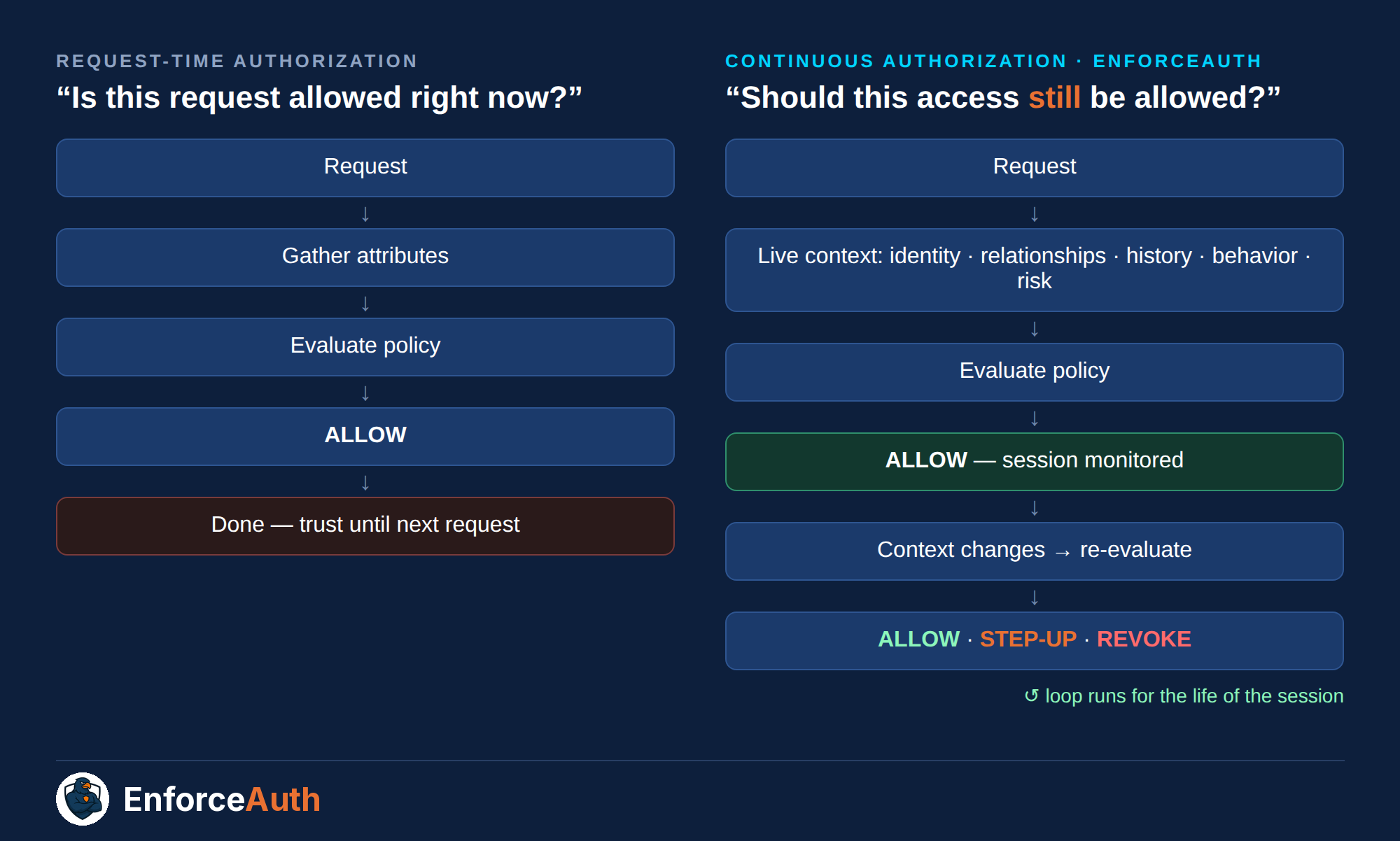
Each blind spot is about time: what happened before the request, what the relationships looked like at that moment, and what changes afterward. Closing the Authorization Gap means authorization has to remember the past, understand the present, and keep watching.
2. What Agents Change: The Threat Model
Identity and access management was built around employees with a manager, a department and a fairly predictable workday. AI agents call tools and APIs across many systems, pick up new context as they work, delegate to other agents, act on borrowed credentials, and run far longer than any human session.
They are also multiplying. EnforceAuth research puts the ratio of non-human to human identities in the enterprise at 82 to 1, and most of those identities have no policy that reflects what they actually do.
Every step allowed. The sequence is a breach.
Consider an agent that, over one afternoon:
- Reads a customer record
- Pulls financial data
- Queries HR information
- Downloads 4,000 customer records
- Calls an unfamiliar external API
- Tries to reach data in another tenant
Evaluated one at a time, each action might pass. The agent holds the permissions and the requests are well-formed. But the sequence looks like data being gathered and sent out, and a system that judges each request on its own will never see it.
The Politeness Trap
This is the Politeness Trap. An agent can follow every rule, pass every content guardrail and answer every prompt courteously, and still move data it should never touch. AI safety controls what an agent says. AI security controls what it is allowed to do.
Polite AI is not secure AI.
Mapped to the OWASP Top 10 for Agentic Applications
The OWASP Gen AI Security Project published its Top 10 for Agentic Applications in December 2025. Authorization cannot address every risk on that list. Code execution sandboxing, for example, is a runtime concern. But it is the control point for many of the most damaging ones:
3. Introducing EnforceAuth's Authorization Context Layer
EnforceAuth's authorization context layer is built into the EnforceAuth AI Security Fabric. It changes the flow from a one-time check to a continuous loop:
Request → Current Context + Relationships + History + Behavior + Risk + Policy → Decision → Continuously Monitor → Re-evaluate When Reality Changes
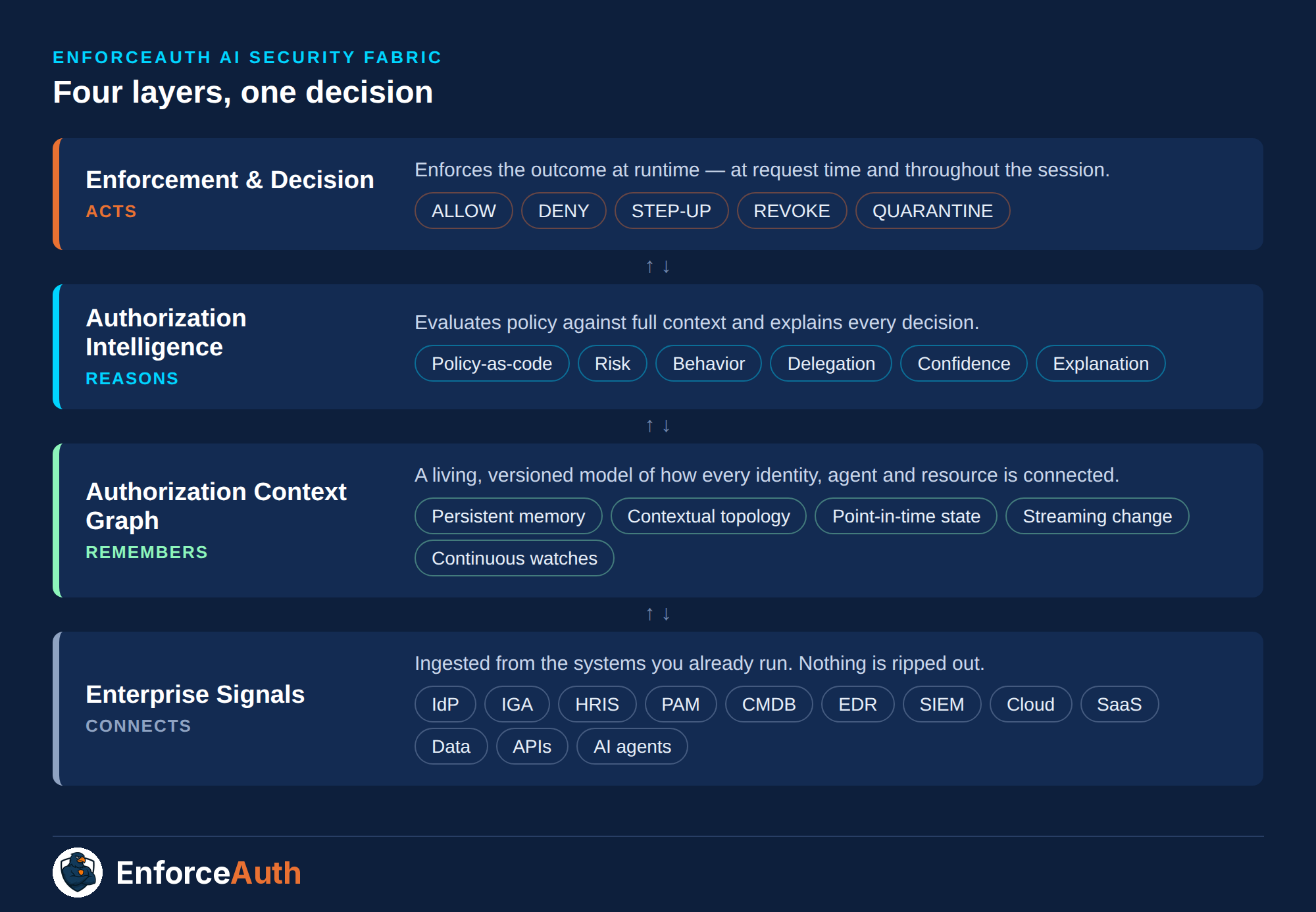
- Enterprise Signals come from systems already in place: identity providers, IGA, HRIS, PAM, CMDB, EDR, SIEM, cloud, SaaS, data platforms, APIs and AI agent frameworks. Nothing has to be ripped out.
- The Authorization Context Graph turns those signals into one connected, versioned model of who and what exists, how they relate, and how that has changed over time.
- Authorization Intelligence evaluates policy-as-code against that context, adds risk, behavior and delegation reasoning, and explains every decision.
- Enforcement & Decision acts on the result at runtime: allow, deny, step-up, revoke or quarantine.
Two paths: fast where it must be, deep where it can be
Authorization sits in the critical path of every request, so a richer context model cannot mean a slower one. EnforceAuth separates the work into two paths.
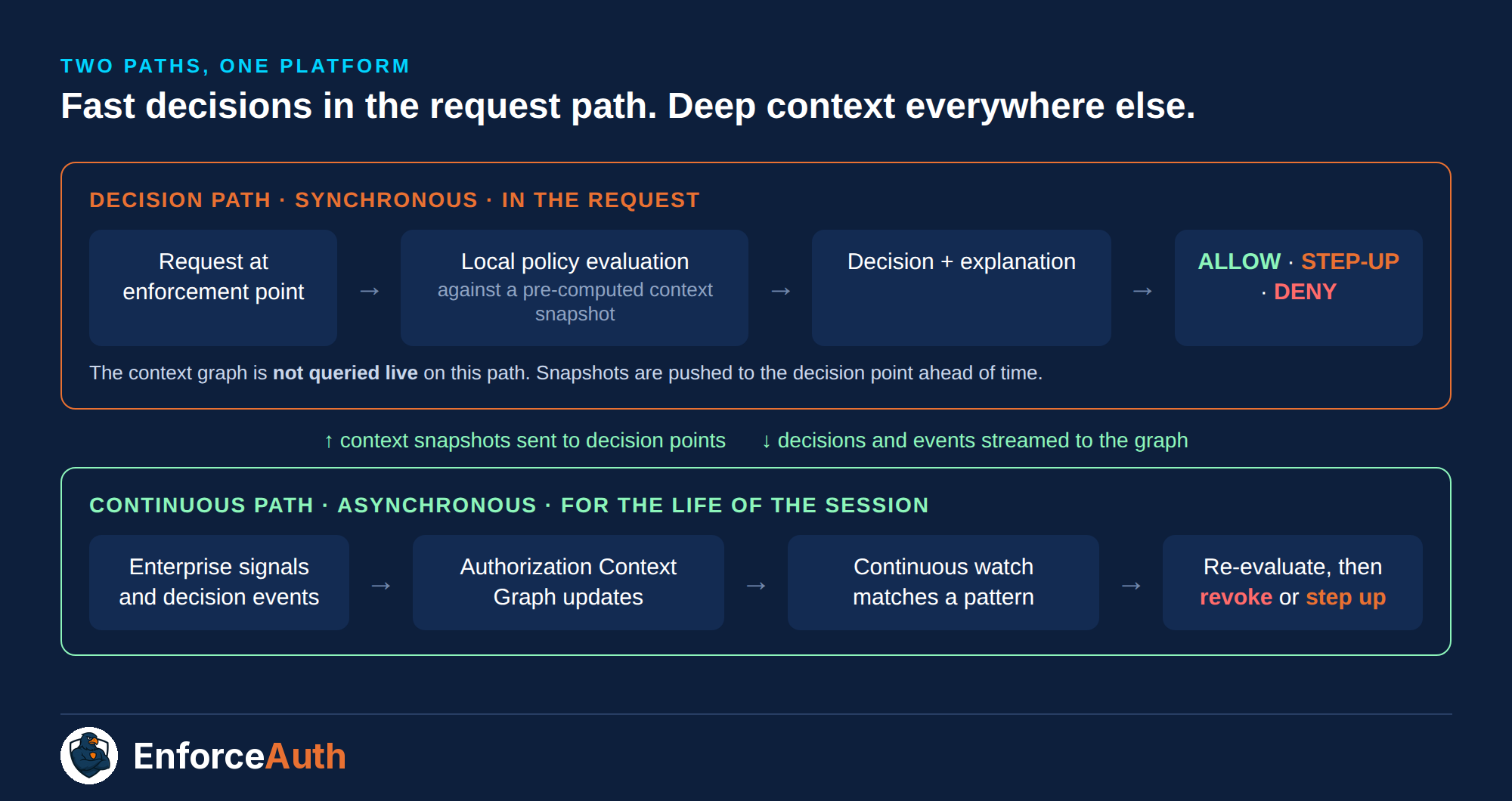
- The decision path runs synchronously at the enforcement point. Policy is evaluated locally against a context snapshot that was prepared ahead of time, so there is no live graph traversal and no dependency on a remote system per request.
- The continuous path runs in the background. It takes in signals and decision events, updates the context graph, watches for patterns that matter, and pushes both refreshed context and invalidations back to the enforcement points.
Designed for failure, freshness and conflict
Any context-driven system has to answer three uncomfortable questions. EnforceAuth answers them in policy, not in fine print.
4. Seven Capabilities That Change the Decision
Each capability answers a question that request-time authorization cannot.
01. Authorization Memory
What has this identity already done, and does this request still make sense given that?
EnforceAuth keeps the evolving history of identities, relationships and access patterns, so policy can reason over the whole arc rather than the latest request:
Identity → History → Relationships → Previous Access → Delegations → Behavior → Current Request → Policy
In the six-step scenario from Section 2, the sixth request is judged in light of the first five, which is the only way to see it for what it is.
02. Contextual Topology
How is this identity connected to this resource, and is that path acceptable?
An enterprise is a network, not a list of attributes. EnforceAuth models the relationships among humans, organizations, agents and agent instances, models, services, workloads, APIs, credentials, devices, sessions, roles, groups, tenants, entitlements, delegations, approvals, datasets, classifications, geographies and risk events. Policy can then evaluate the path, not just its two endpoints:
Analyst → delegated Agent X → invokes Service Y → uses Credential Z → accesses Database B → contains Restricted data
Each hop may be legitimate on its own. Together they may form a route to restricted data that no policy author ever intended. In EnforceAuth, the path itself is authorization context.
03. Continuous Authorization & Invalidation
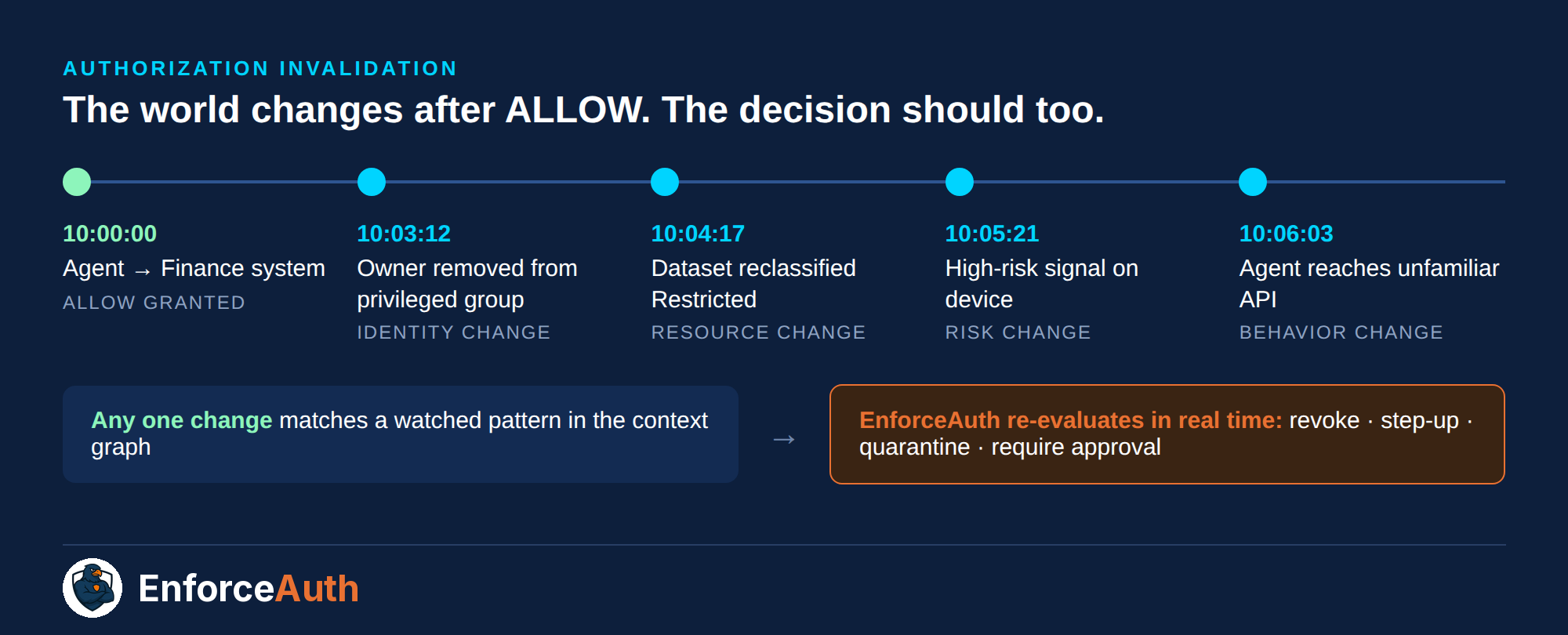
Has something happened that makes an earlier ALLOW no longer valid?
EnforceAuth places continuous watches on the patterns that matter to active authorizations. When an identity, resource, risk, behavior, delegation or policy change affects one of them, EnforceAuth re-evaluates immediately and acts.
04. Delegation-Chain Authorization
Is there still a valid path of authority from the originating human to this action?
In agent-to-agent systems, “Does Agent C have permission X?” is the wrong question. Agent C may hold that permission only because Agent B created it, acting for Agent A, which a person delegated for a specific purpose, tenant and time window.
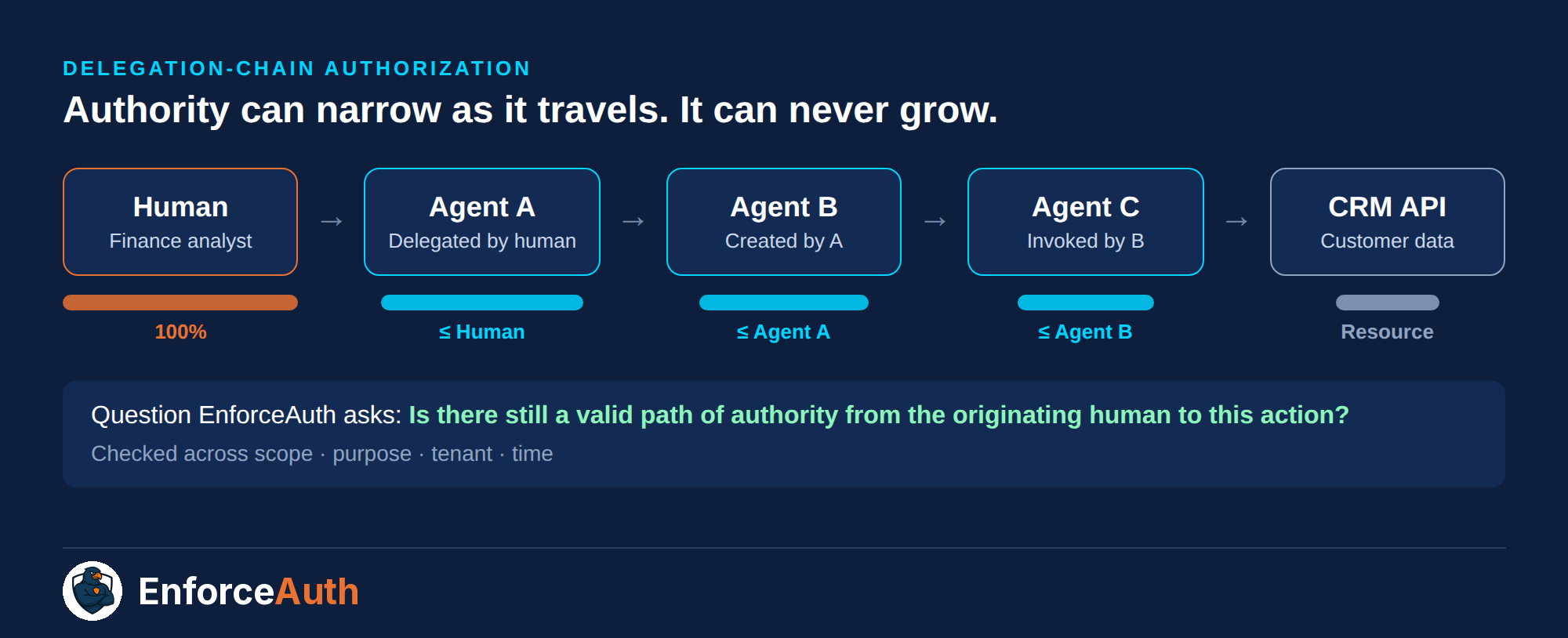
Agent C ≤ Agent B ≤ Agent A ≤ Human
If the person’s access changes, the purpose expires, or any link breaks, every downstream agent is re-evaluated automatically. EnforceAuth is designed to work with emerging delegation standards such as OAuth 2.0 Token Exchange (RFC 8693) actor claims, rather than inventing a proprietary chain format.
05. Point-in-Time Decision Reconstruction
Why exactly did we allow this transaction at 2:37:14 PM on March 17?
A conventional log records the request, the policy and the result. EnforceAuth can rebuild the entire authorization state around a decision as it existed at that moment:
Audit, incident response, forensics, regulatory evidence and policy debugging stop being log-stitching projects and become direct questions with direct answers.
06. Behavioral & Graph Intelligence
Is this activity consistent with this identity’s purpose and history?
The relationships themselves have changed, and EnforceAuth factors that into authorization confidence. Because the context graph is a structured model of the enterprise, it is also a natural foundation for graph analytics and machine learning. EnforceAuth’s roadmap builds on it for authorization anomaly detection, access-path risk scoring, agent behavior models, and permission right-sizing. The rules for how those signals are governed are covered in Section 6.
07. Policy Simulation & Replay
What would this new policy have done over the last 30 days?
Because the context graph is versioned, a proposed policy can be replayed against real historical decisions before it goes live. Teams can see exactly which requests it would have denied, which agents it would have stopped, and which legitimate work it would have broken.
This turns authorization change from a leap of faith into an engineering practice. Policies are proposed in a pull request, tested against reality, reviewed, and then promoted. It is also the mechanism behind the staged adoption path in Section 12.
5. How Enforcement Actually Works
A decision only matters if something enforces it. “Revoke” and “step-up” are easy to put on a diagram. Here is what they mean in practice.
Where decisions are enforced
How access is revoked mid-session
When the continuous path invalidates an authorization, EnforceAuth acts through three mechanisms together:
- Push to enforcement points. Invalidations reach every EnforceAuth decision point, so the very next action in the session is denied or stepped up.
- Signal the identity layer. EnforceAuth is designed to exchange security events using the OpenID Shared Signals Framework and Continuous Access Evaluation Profile (CAEP), which became final specifications in 2025. That lets identity providers and applications end sessions and revoke tokens on the same event.
- Keep credentials short-lived. Agents should run on short-lived, narrowly scoped credentials, so that what EnforceAuth invalidates cannot quietly live on elsewhere.
An Honest Boundary
Continuous authorization governs the next action. It cannot undo an action that has already completed. That is why it works best alongside short-lived credentials and enforcement at the tool gateway, where it can stop a risky sequence before the damaging step instead of after it.
What “step-up” means for an agent
A person can answer an MFA prompt. An agent cannot. For agents, EnforceAuth treats step-up as human-in-the-loop approval: the action is paused and routed to the person at the root of the delegation chain, or to a designated approver, with the full context and explanation attached. Approval grants a narrow, time-boxed exception that is recorded in the graph, not a standing permission.
6. Keeping Policy in Charge
Richer context is only useful if the decisions it drives stay predictable, explainable and hard to manipulate.
Policy-as-code, with context as an input
EnforceAuth is built on open policy-as-code. Context from the graph reaches policy as structured data, and every rule stays readable, versioned, tested and reviewed like any other code. An illustrative agent policy, written here in plain English:
Illustrative policy (plain English, not product code)
Deny by default.
Allow an agent action only if an unbroken chain of authority reaches a human, and every link in that chain is active.
Authority never expands: the action must fall within the scope the chain delegated.
Delegation is time-boxed: the action must happen before the delegation expires.
Restricted data requires a recorded human approval.
Every decision returns an explanation: which rule fired, which context it relied on, and where that context came from.
Behavioral signals advise before they decide
Behavioral and graph signals are inputs to policy, never replacements for it. They are introduced in stages:
- Observe: signals are calculated and recorded, but they affect nothing.
- Recommend: signals raise alerts and suggest policy changes, and people review them.
- Enforce: after replay has shown acceptable accuracy, signals drive step-up or deny for specific, well-understood patterns.
Confidence thresholds are explicit and per-policy, and every behavioral decision can be overridden and audited. That keeps false positives from becoming friction that teams learn to route around.
Resisting manipulation
A context-driven system becomes a target in its own right. EnforceAuth is designed against the obvious attacks:
- Slow baseline drift. An attacker who escalates gradually can train a purely learned baseline to accept abuse. EnforceAuth anchors agent baselines to declared purpose and delegated scope, which do not drift, as well as observed behavior.
- Signal poisoning. Every signal carries its source, and sources carry trust levels. Low-trust or unverified signals can raise scrutiny, but they cannot grant access.
- Context injection through the agent. What an agent says about itself is never treated as authoritative context. Identity, purpose and delegation come from the graph, not from the prompt.
7. One Agent, One Afternoon
An illustrative walkthrough shows how the pieces work together. A finance analyst delegates a reconciliation task to a procurement agent for the rest of the day.
No single request in this story was out of bounds on its own. What stopped it was purpose, sequence, path and a human-rooted chain of authority working together.
8. Trust in the Context Layer
A model that knows how every identity, agent and resource is connected is powerful. It is also sensitive. EnforceAuth treats the context graph as a crown-jewel system.
9. Where EnforceAuth Fits
The fair question from any architect is: “Isn’t this just X?” Here is how EnforceAuth's authorization context layer relates to the approaches it is most often compared with.
EnforceAuth is not a SIEM, not an EDR, not an identity provider and not a full IAM suite. It works alongside all of them, consuming their signals and turning them into authorization decisions that hold up over time.
Most of the authorization market competes on one question: “How do I evaluate policy?” That matters, but an engine isn’t the car. EnforceAuth competes on two bigger questions:
- How do I know enough about the world to make the right decision?
- How do I know yesterday’s ALLOW should still be ALLOW right now?
10. Regulatory Alignment
Regulators are moving from “show me the policy” to “show me the decision.” EnforceAuth's authorization context layer produces the evidence those frameworks ask for. It supports compliance programs and does not replace them.
11. Business Outcomes and How to Measure Them
Buyers don’t buy context graphs. They buy outcomes, and outcomes should be measurable.
1. Deploy AI agents with confidence
Every agent action traces to a valid, human-rooted chain of authority and is checked against what the agent has already done.
Outcome: AI initiatives move from pilot to production without an open-ended security exception.
2. Shrink the blast radius
A compromised credential doesn’t stay valid until it expires, a privilege change doesn’t wait for the next login, and a reclassified dataset doesn’t wait for a policy sync.
Outcome: The window between a risk appearing and access responding shrinks from a token’s lifetime toward the next action.
3. Reduce authorization risk
Decisions use rich, continuously updated context instead of stale attributes.
Outcome: Fewer inappropriate access decisions, and standing privilege that shrinks over time.
4. Decision evidence for audits
Show the identity, chain, classification, context, policy and world state behind any decision.
Outcome: Faster audits and stronger evidence for regulated environments.
5. Faster investigations
Who accessed what, under whose authority, from where, and what happened next, all in one queryable model.
Outcome: Investigations shift from log-stitching to direct questions.
6. Lower integration complexity
Context scattered across a dozen systems is normalized once into the Authorization Context Graph.
Outcome: Fewer brittle point integrations, and policies that stop re-resolving every system on every request.
Metrics that matter
12. Getting Started
Continuous authorization should be adopted the way it operates: by observing first and enforcing where the evidence is strongest.
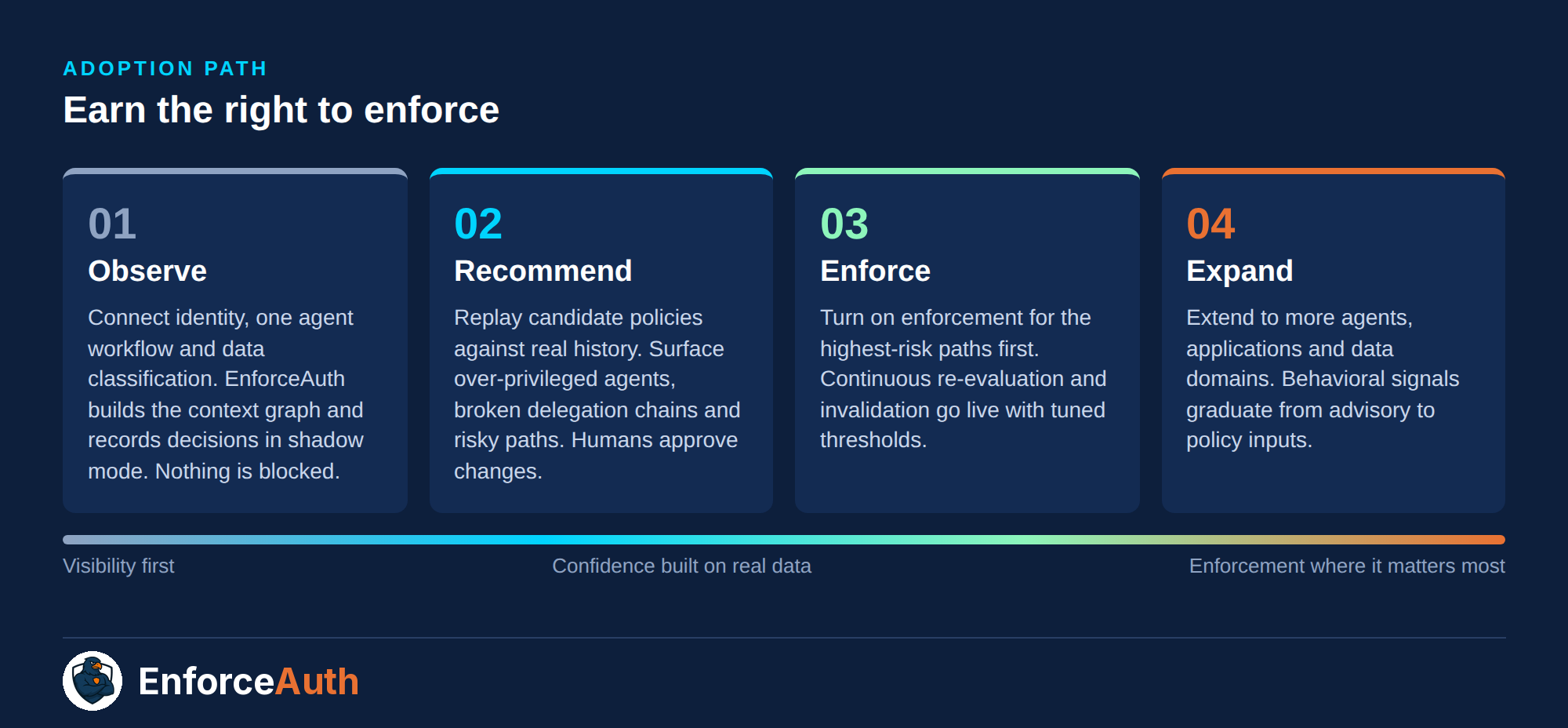
The fastest first step is a single, high-value agent workflow. Connect the identity provider, the agent or tool gateway, and data classification, and let EnforceAuth build the context graph in shadow mode. Within that one workflow, teams see real delegation chains, real over-privilege and real risky paths before anything is blocked.
Questions to ask of any authorization approach
- Can it tell me, for any agent action, which human’s authority it ultimately rests on?
- If a person is offboarded right now, how long until every agent acting for them loses access?
- Does it make decisions after ALLOW, or only at request time?
- Can it reconstruct the full context of a decision from six months ago?
- Can I test a policy change against real history before I enforce it?
- What happens to decisions when its context sources are down or stale?
- How does it keep an agent’s own claims about itself from influencing its access?
The Bottom Line
EnforceAuth makes authorization decisions using the living context of the enterprise, not just static permissions.
Persistent memory. Historical context. Real-time topology. Continuous decisions.
An AI agent shouldn’t be authorized based only on what it can do. EnforceAuth decides what it should be allowed to do based on who delegated its authority, what it has already done, what it is trying to do, what it is connected to, and what has changed.
The Authorization Gap widens every day that agents act on stale, one-time decisions. Closing it takes authorization that remembers, understands how everything is connected, and keeps asking whether access should still be allowed. That is what EnforceAuth is building.
Next step
See EnforceAuth applied to your own agent workflows.
Request a technical briefing: Contact EnforceAuth
About EnforceAuth
EnforceAuth is the AI Security Fabric: unified, continuous authorization across applications, infrastructure, data and AI workloads, for human and non-human identities alike. Built on policy-as-code, EnforceAuth enforces who and what can do what, in real time, with every decision explainable and auditable. EnforceAuth was founded by Mark Rogge, former CRO of Styra, with earlier go-to-market leadership at GitLab and Weights & Biases. The company is headquartered in San Diego, California.
This paper describes EnforceAuth’s product architecture and direction. Some capabilities described may be in development or on the roadmap. EvidenceIQ will be available by the end of the fourth quarter of 2026. References to third-party standards and frameworks do not imply certification or endorsement.
Glossary
About EnforceAuth
EnforceAuth is the OPA/Rego authorization control plane. The customer's OPA decides what people, services, and AI agents may do at action time. Verdict covers high-impact agent actions. EvidenceIQ keeps the record behind every decision.