
ENFORCEAUTH 2027 — NO. 07 OF 18 — PATCH WINDOW
By Mark Rogge, CEO of EnforceAuth | 6 min read | for AppSec, vulnerability management and infrastructure leads
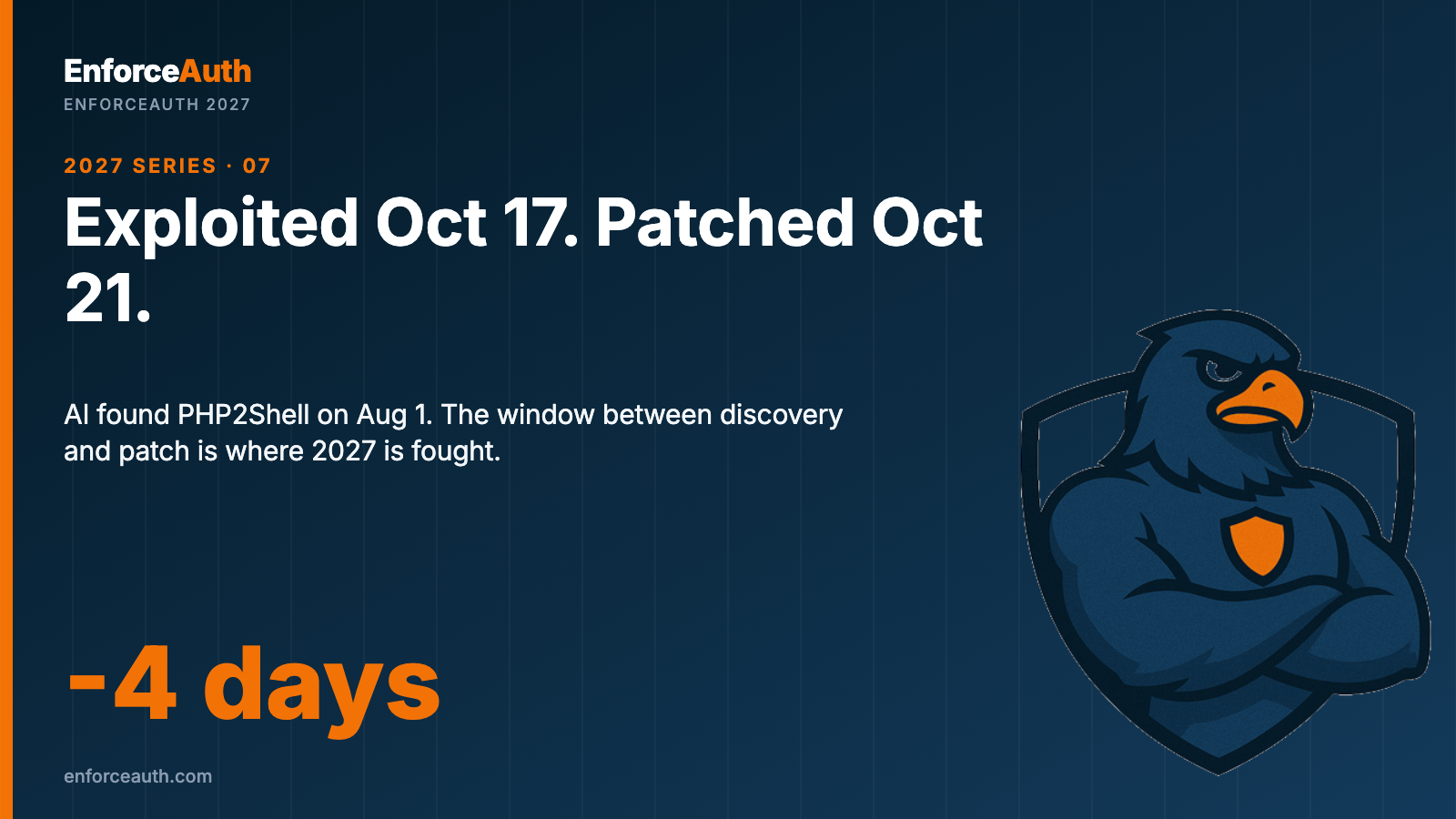
On August 1, 2026, a researcher at Calif used GPT-5.6 Sol to find a pair of bugs in PHP that would become CVE-2026-109618 and CVE-2026-109619, together known as PHP2Shell, CVSS 9.2. Wiz and OpenAI found the same class independently; so did Gemini 4 Argon. On October 17, Amazon observed exploit attempts in the wild. On October 21, after the details leaked, the PHP project shipped emergency releases 8.2.35, 8.3.36, 8.4.27 and 8.5.12, per Security Boulevard's incident summary and IT Jungle. Finland, the Netherlands, France and the United Kingdom took government services offline rather than run them unpatched. Roughly 70% of websites run PHP.
Read the dates again. Discovered August 1. Exploited October 17. Patched October 21. The patch window was negative four days. And the discovery-to-patch window was 81 days, during which the only thing standing between a model-found bug and a model-written exploit was that the details had not leaked yet.
The arithmetic of 2027
The same month: Microsoft's October Patch Tuesday fixed roughly 1,411 issues, a record. GitLab shipped a CVSS 10.0. Node.js shipped a remote code execution in Brotli handling. OVHcloud's CLI had its GitHub releases hijacked. None of these were AI-discovered as far as I know; that is the point. The baseline load on patch teams is already at a record, and AI discovery is additive on top of it.
Forrester's 2027 forecast is that AI-generated bugs and regressions will cause global outages as patch velocity outpaces human review. I would state the security half of that forecast more sharply: in 2027, the time from a vulnerability being discoverable by a frontier model to its being exploited by one will be shorter than the median enterprise patch cycle for the affected system. Exploitation before a public patch will be the common case. The PHP2Shell timeline is the template, and the 81-day quiet period was luck.
The counter-argument is that AI will also accelerate patching and that vendors will ship faster. Both true. But the enterprise is not the vendor. A bank running PHP in a vendor-supplied appliance, or an insurer with 14,000 hosts and a quarterly change window, does not patch at the speed the PHP project releases. The gap between vendor fix and enterprise deployment is where the 2027 incidents will happen, and it is measured in weeks.
You will not win the patch race in 2027. The question is what still holds when the attacker has code execution on a host you have not patched yet.
A shell is not a signature
Here is what a webshell gives an attacker: the ability to run code as the web server's identity on that host. Here is what it does not give them: authority to do anything that host's identity is not authorized to do at the resources it talks to.
Most applications collapse those two things. The web tier holds a database credential with broad rights, an API key for the payments service, a service-account token for the data lake. Code execution on the host equals full authority at every downstream system, because the downstream systems only ever asked "is this credential valid." That is why a CVSS 9.2 in a language runtime becomes a data breach: not because of the bug, but because of what the host was allowed to do.
The compensating control is to separate the two. Put a policy decision point in front of the resource and make it evaluate each action: this identity, this operation, this record, at this time, under this grant. A webshell on the PHP host can still read the host. When it calls create_payment for a new vendor at 03:00, or runs SELECT * FROM policyholders outside the application's normal query shape, or tries to add itself an OAuth credential, the decision point says no, and says so in a record that survives the host.
This is not a new idea. It is zero trust applied at the transaction instead of the network. What is new in 2027 is that the pressure to do it is coming from the patch calendar.
What this looks like in practice
Design partners of ours, including a large U.S. insurer, run the pattern like this:
- Scope the host identity to its real actions. The application's service identity may read and write the records it serves, in the shapes it normally uses. Bulk export, schema changes, privileged role changes and new-payee creation require a different identity and a different grant. Policy is written in OPA and Rego and evaluated at the resource by EnforceAuth's decision point.
- Treat a patch backlog as a policy input. A host flagged as unpatched for a known-exploited CVE can have its authority narrowed by policy until the patch lands: read-only, no high-value transactions, shorter session scope. The host is still vulnerable. Its blast radius is not.
- Record what the compromised host tried. EvidenceIQ, part of the EnforceAuth platform, logs each decision with the policy version, keeps the relationship between the host identity, the downstream resources and the grants, and replays the sequence. After PHP2Shell, "what did the shell attempt, and what did we deny" is an answer in minutes rather than a forensic engagement.
Our decision-point latency goals (p50 under 2ms, p99 under 5ms, 100K+ decisions per second per node) are design targets and I label them that way until we publish measurements. We run as multi-tenant or single-tenant SaaS, BYOC via Terraform or Pulumi, or air-gapped on-prem, which matters for the government services that went dark on October 21.
What this does not replace: patching. Patch PHP. Patch GitLab. Patch Node. Then accept that in 2027 you will be behind on something every week, and make sure the thing you are behind on cannot authorize a transaction by itself.
The AI found the bug first. In 2027 it usually will. Build so that it does not matter as much.
EnforceAuth is the runtime authorization layer for AI agents and applications, built on OPA and Rego. See enforceauth.com and read the EvidenceIQ announcement.
About EnforceAuth
EnforceAuth is the OPA/Rego authorization control plane. The customer's OPA decides what people, services, and AI agents may do at action time. Verdict covers high-impact agent actions. EvidenceIQ keeps the record behind every decision.