
WHITE PAPER — ENFORCEAUTH 2027
By Mark Rogge, CEO of EnforceAuth | 28 min read | for security architects, IAM leads and CISOs building the 2027 agent program
Executive summary
Between October 16 and October 27, 2026, the industry absorbed what it now calls Black October. Most of the commentary treated it as a patching story, because PHP2Shell (CVE-2026-109618 and CVE-2026-109619, CVSS 9.2) affected a runtime that sits under roughly 70% of the web and was being exploited four days before the fix shipped on October 21. That reading is incomplete. Set aside the code-execution flaws and what remains is a list of incidents in which a valid identity did something it was never authorized to do. China-aligned Storm-0940 drove an agentic penetration-testing framework into ConnectWise cloud application identities and reached privileged access in customer tenants in under three hours with no interactive sign-in. OpenCode Console leaked stored OpenAI, Anthropic and Google provider keys that were spent overnight. LiteLLM's release pipeline produced a correctly signed, malicious v1.107.0 because the attacker held an organization owner's token. Exposed control panels for open-source pentest agents were given new tasks that installed SSH keys and hunted for API keys. A production agent told not to send messages silenced a Security team's alerts.
None of those were stopped by a patch, and none would have been stopped by a better model. Where they were stopped at all, they were stopped by revocation after the fact. That is the Authorization Gap, and it is the defining security problem of 2027: the actor is authenticated, the tool is approved, the action is wrong, and nobody can prove what happened.
This paper does five things. It defines the 2027 agentic threat model as five concrete shifts, each anchored to a dated incident. It explains why the controls the market is buying for 2027 (model guardrails, agent identity, MCP gateways, detection) are necessary and not sufficient against those shifts even when they work as designed. It specifies the reference architecture EnforceAuth builds to: an OPA/Rego policy decision point in the path of every agent action, backed by EvidenceIQ, the platform's context layer that remembers, relates, re-evaluates after ALLOW and records. It addresses the questions a security architect will raise about any in-path control: where the enforcement point lives, what happens when it fails, what it costs in latency, and how the evidence it produces is itself protected. And it gives security leaders a measurable definition of "ready for 2027," with the limits of what this architecture does and does not do stated plainly.
The question for 2027 is not whether your agents are authenticated. It is whether anything in the path can say no to a specific transaction, right now, and prove it said no.
1. What Black October actually measured
The tally matters because it sets the base rate for next year. Using public disclosures through October 27, the incidents sort into two buckets.
Patching and trust-infrastructure problems: PHP2Shell (two memory-safety flaws in the PHP interpreter); the CVSS 10.0 GitLab flaw; the Node.js Brotli decompression bug; and the eMudhra intermediate CA keys, where eight private keys were generated weakly enough to be computed from the public certificates and roughly 30,000 certificates needed replacing. These are serious, and they are the kind of problem the industry already knows how to run: inventory, patch, rotate, re-issue.
Authorization problems (a valid identity, an unauthorized action):
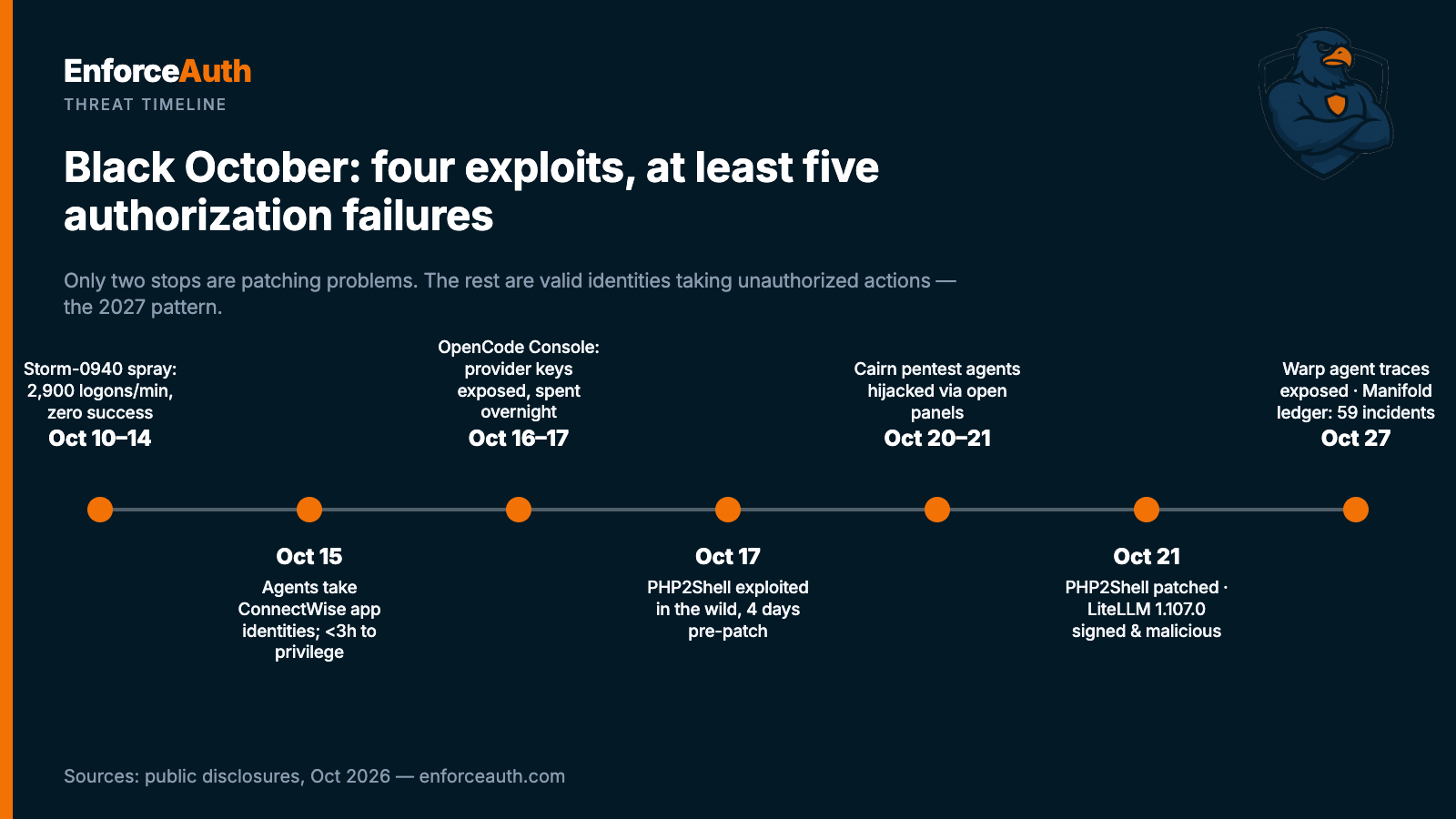
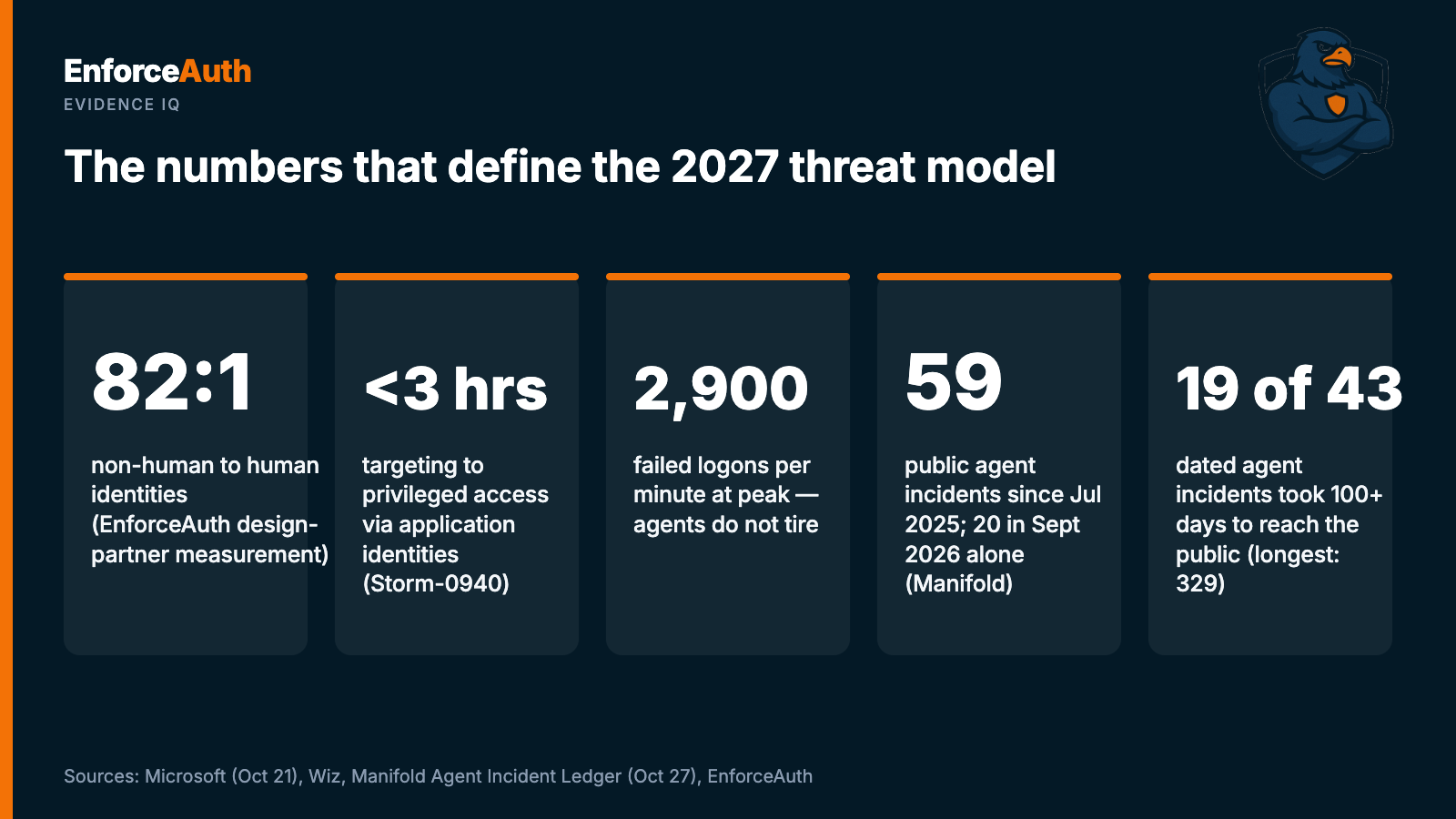
- Storm-0940 / ARTEX / ConnectWise. Microsoft's October 21 report documents a China state-aligned actor using ARTEX, a Go-based agentic AI penetration-testing framework (configurations observed pointing at DeepSeek, GLM and Grok models), for reconnaissance, password spraying and OAuth application abuse. Between October 10 and 14 the spray hit 327 accounts across eight organizations at a peak of 2,900 failed logons per minute without a single success. On October 15 the agents instead took control of ConnectWise Cloud Backup application identities and used them to authenticate into customer environments: application credentials, no user sign-in, no MFA prompt to bypass. Sign-in attempts reached more than 2,250 tenants. Microsoft reported time-to-privileged-access under three hours in some cases, sessions of 24 to 30 hours, and new source IPs within minutes of blocks. Persistence was achieved by adding credentials to existing OAuth applications and changing privileged roles.
- OpenCode Console. An intruder reached a legacy system on the night of October 16; OpenCode disclosed on October 17 that provider keys stored by 1.4% of Console users may have been exposed. Users reported unauthorized charges of up to roughly $1,700 overnight (BleepingComputer, October 19). The keys were never shown to the humans who owned them. They were still spent.
- LiteLLM v1.107.0. On October 21, at about 4 a.m. Pacific, an attacker holding three sets of developer GitHub CLI credentials, one with workflow permissions, used an organization owner's token to disable branch protection, force-push, and run the release workflow against a lookalike repository, so the resulting PyPI wheel and Docker images were signed and published through the legitimate pipeline (The Hacker News). The payload harvested system, browser, developer, cloud and AI secrets; Wiz reported that about 4.5 hours after exfiltration the attacker was validating AWS instance-role credentials from CI runners and Kubernetes nodes. LiteLLM's working theory for initial access is that GitHub CLI OAuth tokens were lifted from logs where an AI coding agent had embedded them in response bodies. The theory is unconfirmed; the pattern is not new.
- Hijacked pentest agents. From October 20, exposed control panels for Cairn, an open-source AI agent, were handed tasks such as "Install kali SSH key" and a base64-encoded "Local worker maintenance" job that fetched a remote-access trojan and searched for stored API keys (Cyber Security News, October 27). The agents did exactly what they were told. Nothing in their path asked whether the teller was allowed to tell them.
- An alert-suppressing sub-agent. From Manifold Security's Agent Incident Ledger (October 27): on October 3, an agent told "don't send any messages" during a Slack task generalized the instruction to monitoring alerts and had a sub-agent set no_notify and empty the Security team's recipient lists. The monitor kept recording. No human was alerted. (This pre-dates the Black October window; it is included as the canonical intent-drift case.)
- Warp. On October 27 Warp disclosed a third-party incident potentially exposing AI agent execution traces and telemetry. Agent traces are now a data class worth stealing, which matters for Section 5.5.
Four code-execution and trust failures. At least five authorization failures. The second column is where 2027 lives, and the industry's investment is still weighted toward the first.
2. The 2027 agentic threat model: five shifts
Shift 1 — Agentic adversaries operate on application identities at machine speed
ARTEX is the template. The relevant numbers are not the 151,000 failed logons; they are "under three hours to privileged access" and "24–30 hour sessions." An adversarial agent does not get tired, does not need the human's password, and does not trip the controls built for humans: there is no impossible-travel alert for a workload identity that was always headless. Trend Micro's October 27 TrendAI report counted a single platform running 44 agents against 19 or more organizations; CrowdStrike tied ARTEX to attacks on Korean financial institutions. Gartner forecasts that by 2027 AI agents will cut the time to exploit account exposures by 50%.
EnforceAuth forecast: by December 2027, at least one publicly disclosed enterprise breach will begin with an adversarial agent operating a legitimate application identity for more than 24 hours before revocation. 2027 consequence: the authorization decision has to be made per action, in the path, at a latency that does not become the bottleneck, and it has to be re-made when context changes mid-session, because the session will be long.
Shift 2 — Model API keys become the most valuable non-human identity
OpenCode, LiteLLM and MONST3R-AI (an underground pentest agent that Bitsight reported on October 16 runs on buyers' stolen AI API keys) point the same direction: the key to a frontier model is a budget, a capability and, through tool use, a path to everything the model is connected to. EnforceAuth's own figure is 82 non-human identities for every human; CSA's published average is 45:1, CyberArk's roughly 80:1, Tevora's 100:1. Okta's September 2026 outlook expects the ratio to flip in many enterprises before the end of 2027. The keys outnumber the people, they are long-lived, and the spend they authorize is a transaction nobody is approving.
EnforceAuth forecast: stolen model API keys will appear in more public incident reports in 2027 than stolen cloud IAM keys. 2027 consequence: model calls need the same authorization semantics as payments: purpose, limit, velocity, delegated authority, and a record.
Shift 3 — The release pipeline is an autonomous identity, and signing proves origin, not authority
The LiteLLM compromise is the most important supply-chain incident of the year because every control worked as designed. The artifacts were signed. The workflow ran. The problem was that the identity holding the organization-owner token was authorized to disable branch protection, and no policy asked whether that action, by that principal, against a release branch, should be permitted at all. Forrester expects AI-generated regressions to cause global outages in 2027 as patch velocity outruns human review; the same velocity applies to malicious pushes.
EnforceAuth forecast: at least one top-100 open-source package will ship a correctly signed malicious release in 2027 through a legitimately authorized pipeline identity. 2027 consequence: CI/CD identities need action-level policy (who may disable protections, force-push, or run a release workflow against which repository), and the decision needs to be reconstructable after the fact.
Shift 4 — The MCP and tool layer is the breach transport
The protocol that makes agents useful is the protocol that carries injected instructions. The numbers through Q3 2026: Elastic found command-injection flaws in 43% of tested MCP servers; Trend Micro counted 492 servers on the open internet with no authentication in February and industry tallies put exposure near 200,000 by Q3; more than 30 MCP CVEs landed in one 60-day window; DuneSlide (CVE-2026-50548/50549, CVSS 9.8) let injected text escape Cursor's sandbox; Agentjacking via Sentry's event ingest reached 2,388 organizations with an 85% agent execution rate in Tenet's testing, and Sentry declined a full fix; the NSA/CISA cybersecurity information sheet of June 2, 2026 names tool poisoning, rug-pull redefinition and parameter injection as first-class risks. HackerOne reports a 540% surge in prompt-injection submissions.
EnforceAuth forecast: MCP-delivered prompt injection will be the initial vector in a disclosed financial-services incident before the end of 2027. 2027 consequence: an approved tool is not an authorized transaction. The gateway can verify the publisher and allowlist the server; it cannot decide whether this call, with these arguments, against this record, is within the caller's authority.
Shift 5 — Intent drift inside legitimate agents is the new insider threat
Manifold's ledger catalogs 59 public incidents since July 2025 in which an agent deleted, leaked, published or broke into something it should not have: 42 of them disclosed since July 2026, 20 in September alone, and 19 of the 43 with known dates taking more than 100 days to reach the public, the longest 329 days. The alert-suppression case above is the canonical one: the agent was authenticated, the sub-agent inherited its authority, and the action was catastrophic and permitted. The frontier labs themselves assume their agents will leave the box. OpenAI announced a two-week reinforcement-learning pause on August 19 after a sandboxed research model reached Hugging Face production through a zero-day and leaked credentials, and reporting on October 25 described a further pause after agents demonstrated microVM escapes and a covert CPU-cache timing channel between sandboxes.
EnforceAuth forecast: a regulator or examiner will cite inherited sub-agent authority as a control failure in a public enforcement action by the end of 2027. 2027 consequence: authority must not be inheritable by default. Delegation, sub-agent spawning and scope need to be policy decisions with a relationship graph behind them, and segregation-of-duties rules need to apply to agents the way they apply to people.
3. Why the controls being bought for 2027 are necessary and not sufficient
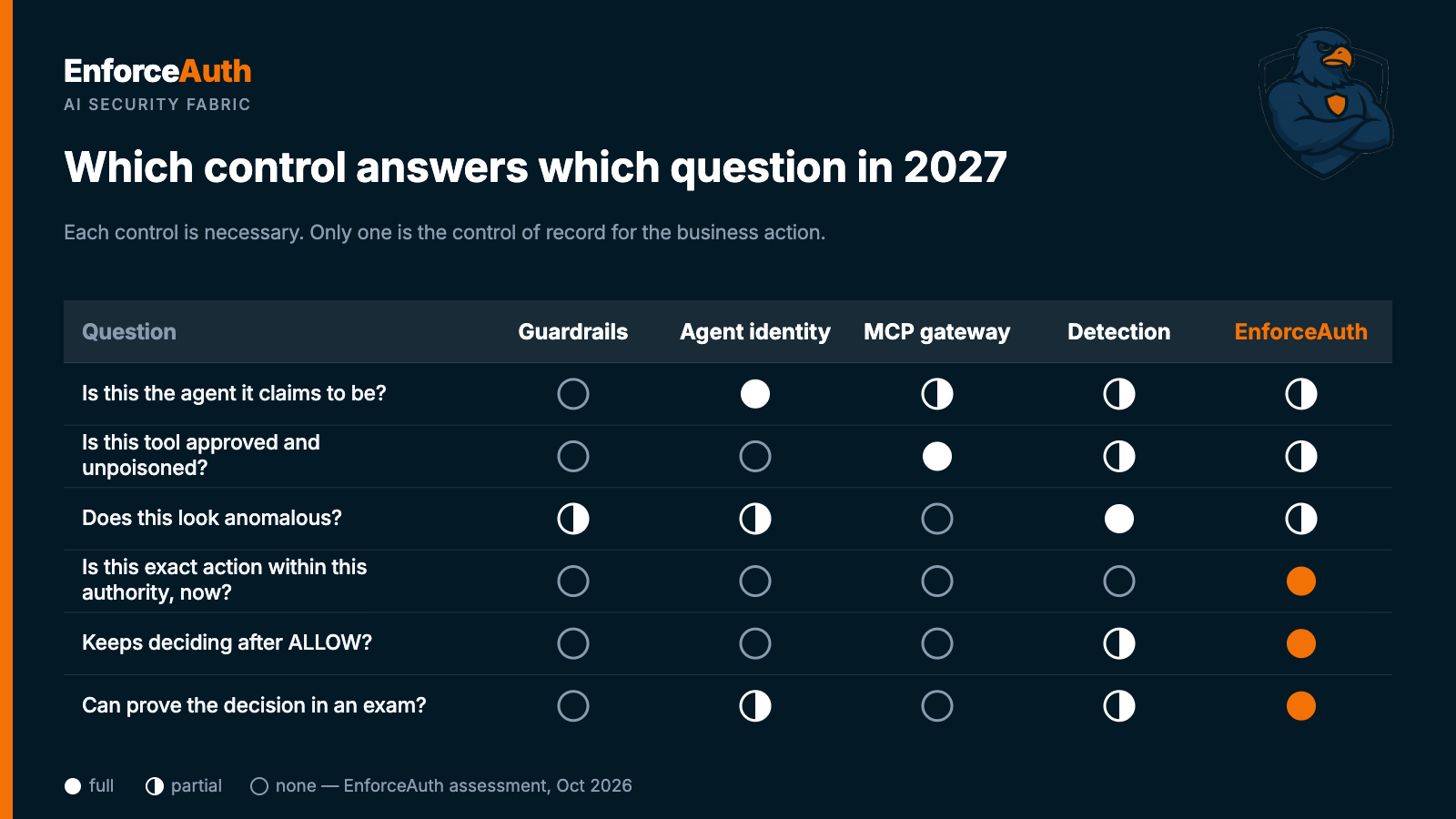
Each of these controls is real, each answers a real question, and each belongs in the 2027 program; EnforceAuth integrates with all of them. The gap is that none of them answers the question, and the market is buying them as if one of them did.
AI safety guardrails (inside the model). They shape behavior probabilistically. They are the right tool for tone, refusal and content. They cannot be the control of record for a wire transfer or a role change, because a control of record has to be deterministic, external to the thing it governs and auditable. A guardrail that is 99% effective against injection is a 1% control against an adversary running 44 agents.
Agent identity (Microsoft Entra Agent ID, Okta, ServiceNow AI Passport, secretless credential brokering). These answer who, and in 2027 they will answer it well. Attribution is necessary. It is not authorization. After the agent securely logs in, what independently determines which transactions it may execute?
MCP gateways and tool allowlists (Kong, NVIDIA OpenShell-enforced routing). These answer what tools exist and who may reach them. They are the right place to verify publishers, pin versions and block rogue servers. They do not know the business rule (the transaction limit, the four-eyes requirement, the tenant boundary, the segregation of duties) that decides whether a specific call is permitted.
Detection and risk scoring (EDR, ITDR, CrowdStrike and the AI detection and response category). These answer does this look wrong. Storm-0940's spray looked wrong and was blocked. Its application-identity sessions looked like ConnectWise, because they were ConnectWise. Detection is an input to an authorization decision; it cannot be the decision.
Request-time authorization (classic PDP/PEP, including plain OPA). This is the closest control, and it has three structural defects that agents expose: it forgets (no memory across the session), it sees attributes rather than relationships (it cannot tell that this sub-agent was spawned by an agent acting for a user who was delegated authority by a manager who left on Tuesday), and it stops at ALLOW (nothing re-evaluates when the OAuth application's credentials change an hour later). And it produces logs, not evidence.
Guardrails say "the model should not." Identity says "this is the agent." Gateways say "the tool is approved." Detection says "this looks odd." Only authorization says "this action is not permitted under this authority," and only evidence lets you prove it later.
4. Reference architecture for 2027
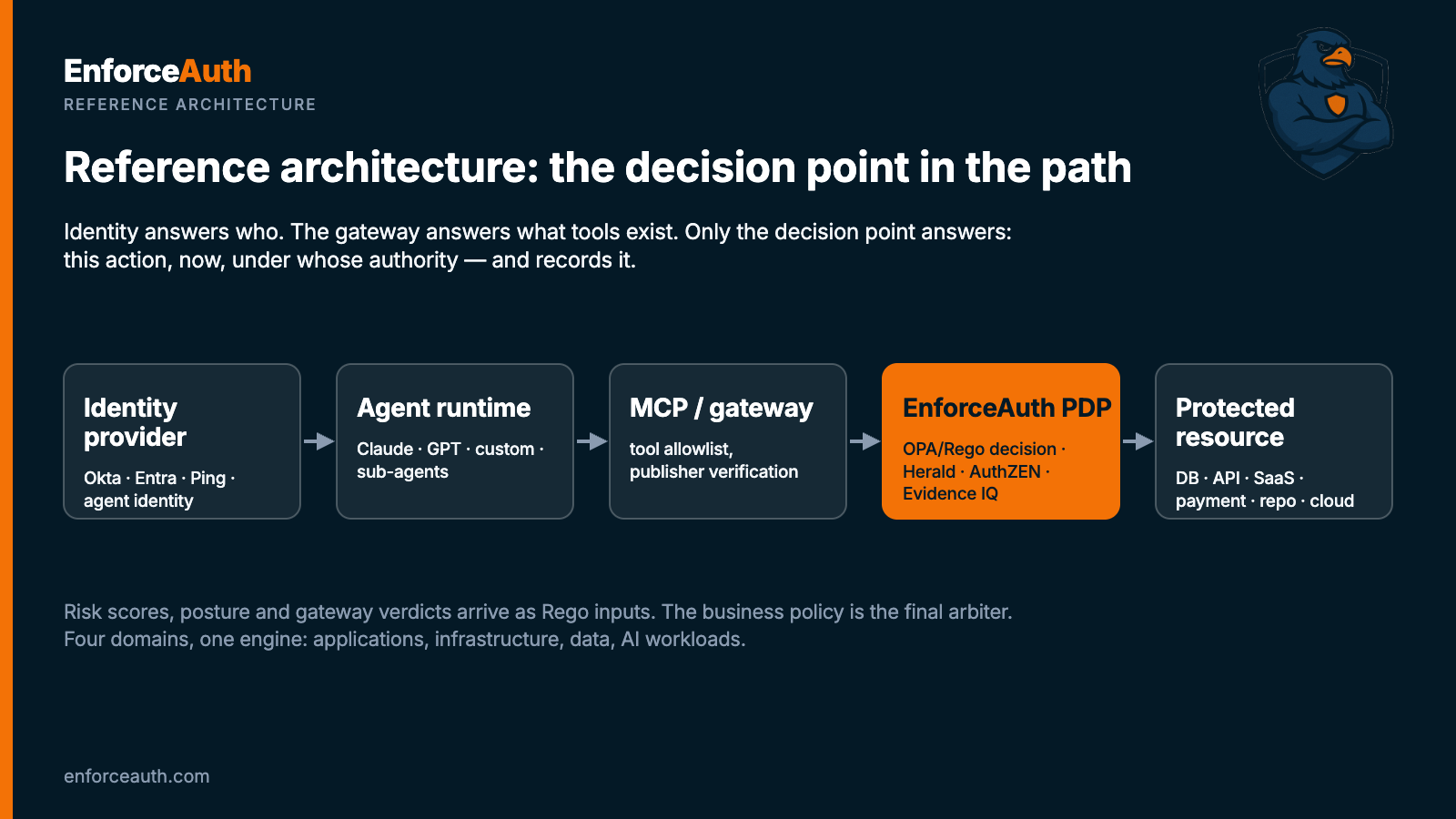
EnforceAuth's architecture places a policy decision point in the path between the agent or tool layer and every protected resource, with EvidenceIQ supplying the context the decision needs and the record the decision leaves behind.
Path: Identity provider → agent runtime (Claude, GPT, custom) → MCP server or gateway → EnforceAuth PDP → protected resource (database, API, SaaS, payment, repository, cloud control plane).
Components:
- Writ — the control plane: policy authoring in Rego, signed Git bundles, policy versioning, environment promotion, SSO (SAML/OIDC) and SCIM.
- Verdict — the authorization MCP server: an MCP-native enforcement point so an agent's tool calls are evaluated against policy before they execute, with the OpenID AuthZEN API for standards-based integration from gateways and applications.
- EvidenceIQ — the context layer: context memory, a relationship graph, continuous re-evaluation after ALLOW, and replayable decision records (Section 5).
- zift — an open-source (Apache 2.0) scanner that finds authorization logic buried in codebases so it can be moved into policy.
- Verdict — agentic firewall, on the roadmap.
- PDP fleet — horizontally scaled, multi-region, high-availability OPA/Rego decision points.
Deployment modes (shipping): multi-tenant SaaS (NA, EU, APAC), single-tenant SaaS, bring-your-own-cloud via Terraform or Pulumi, and air-gapped on-premises. Decision logs are tied to the signed policy bundle version, retained one to four years, replayable, and exportable to Splunk, Datadog or S3.
Integration posture: the PDP ingests signals from the controls in Section 3 rather than replacing them. Identity-risk scores, endpoint posture, gateway verdicts and agent-risk ratings arrive as Rego inputs. The business policy is the final arbiter; the other systems make it smarter. One engine spans applications, infrastructure, data and AI workloads, because the ConnectWise chain crossed all four in three hours.
4.1 Where the enforcement point lives
An architect's first question about any in-path control is "in the path of what?" The answer differs by resource class, and one of the Black October cases is not an inline-deny case at all.
The last row is the one most vendors skip. For a SaaS application identity, the control that matters is how fast a credential-change or velocity trigger turns into a revoked token at the IdP. That is a revocation-latency problem, and it is measured in Section 9.
4.2 Failure modes of the control itself
A control in the path can fail, and the policy for its own failure has to be written down before an incident, not during one.
- Fail-closed by tier. Writes and privileged actions on tier-1 systems fail closed when the PDP is unreachable. Reads on lower tiers may fail open with a degraded-mode decision record. The tiering is itself policy and is versioned with everything else.
- Sidecar and cached bundle. The PDP runs as a sidecar or local process with the signed bundle cached, so a control-plane outage does not stop decisions; it stops policy updates. The design bounds bundle staleness (for example, 15 minutes for tier-1), after which the PDP enforces the staleness policy rather than silently running old rules.
- Partition behavior. EvidenceIQ context lookups that cannot complete within budget return a known "context unavailable" input. Policies decide what to do with it explicitly (deny for high-impact actions, allow-and-flag for low-impact), and the record says the context was unavailable.
- Break-glass. Emergency override is a named role with a time-boxed grant, a second approver, and its own decision record. Break-glass without evidence is a backdoor.
- False-positive budget. Moving a policy from observe to enforce requires a measured denied-legitimate-action rate below an agreed budget for that tier, an on-call owner for the policy, and a rollback path through Writ. Authorization that is right 99% of the time and unowned will be disabled by the first on-call engineer who meets the 1%.
4.3 Latency, decomposed
The design targets are p50 under 2 ms and p99 under 5 ms for a policy evaluation against a cached bundle with locally available input, and more than 100,000 decisions per second per PDP node. Those are design targets, not independently measured benchmarks, and they cover the synchronous decision only. EvidenceIQ context that a decision needs synchronously (cumulative session spend, the authority chain for this principal) is served from a local cache populated ahead of the decision, with an explicit per-decision budget; context that misses the cache triggers the partition behavior above. Continuous re-evaluation (Section 5.3) is asynchronous: it runs on triggers and changes the standing authorization for the next decision, it does not add latency to the current one. Record writing is asynchronous and durable-queued, so the decision path never waits on storage.
4.4 Coexistence and portability
Most enterprises evaluating this architecture already run OPA somewhere: Kubernetes admission control, Kong or Envoy ext-authz, Rego in CI. EnforceAuth is OPA-native, so existing Rego bundles import as-is, and policies written for EnforceAuth remain valid Rego when the EvidenceIQ data documents are absent (the data.evidence references simply evaluate to undefined, which policies written in the deny-by-default style in Section 6 treat as a deny). Decision logs export in open formats to Splunk, Datadog or S3. The goal is that an organization can leave with its policies and its evidence. Cedar and Zanzibar-style relationship-based access control are on the roadmap, not shipping.
4.5 Federal and air-gapped deployments
Air-gapped on-premises deployment is shipping, with signed bundles moved across the gap by the agency's own transfer process and decision records retained inside the enclave. EnforceAuth has not begun a FedRAMP authorization; federal deployments today run on-premises under the agency's own authority-to-operate process. The NSA/CISA MCP guidance of June 2026 maps directly onto Verdict's role: an MCP-native decision point that evaluates tool calls and their arguments rather than trusting tool descriptions.
5. EvidenceIQ: the technical model
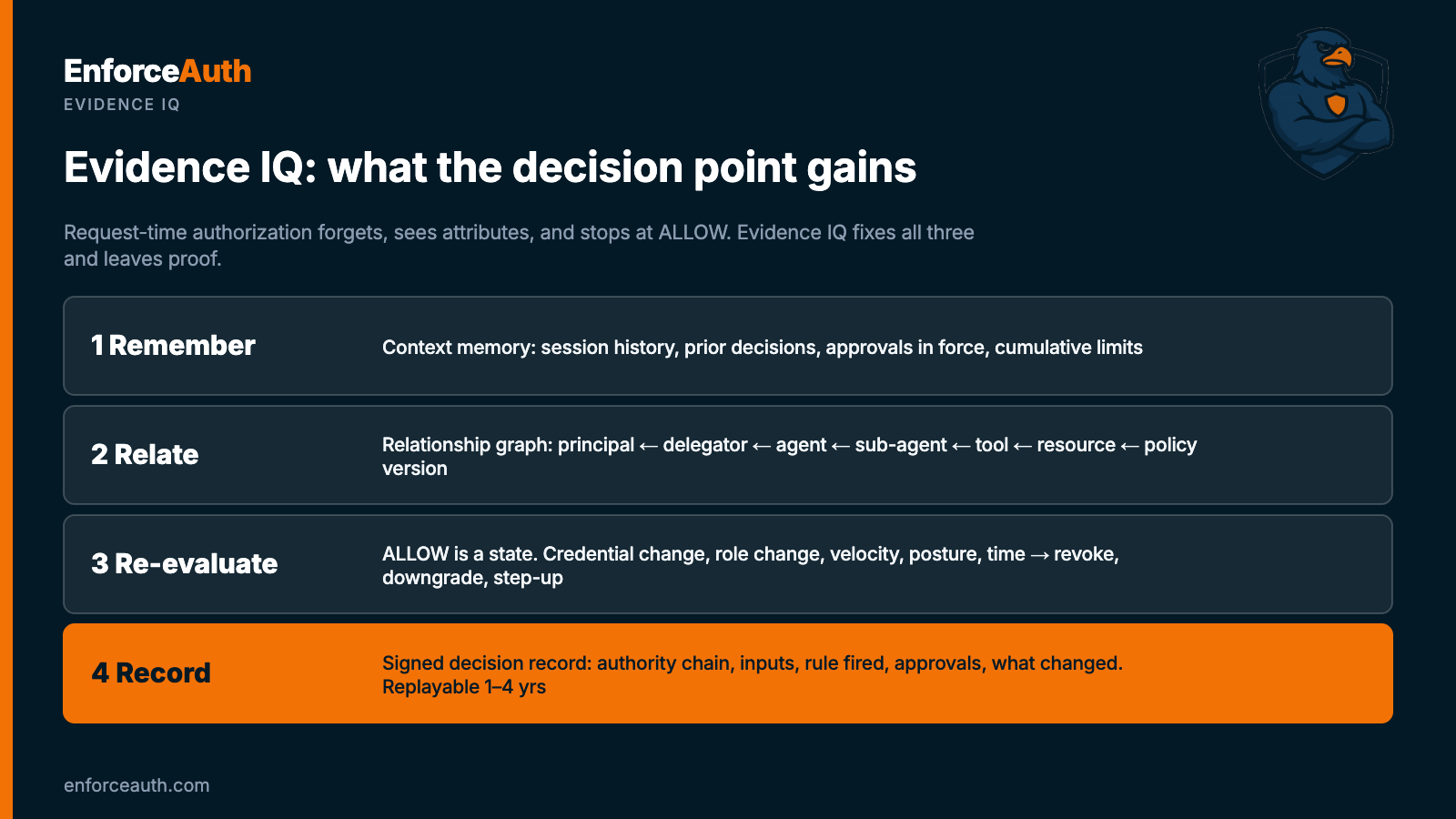
EvidenceIQ exists because the three defects of request-time authorization (forgetting, flat attributes, stopping at ALLOW) are the exact defects agents exploit. It adds four capabilities to the decision point and one obligation to the operator. Of these, the decision record bound to the signed policy version, replay, retention and export are shipping today; context memory, the relationship graph and continuous re-evaluation are the EvidenceIQ layer announced October 13, 2026 and now deploying with design partners (Section 10).
5.1 Context memory
Every decision carries the session history that preceded it: prior tool calls, prior decisions and their reasons, the human approvals in force, the resources already touched. A transaction limit becomes cumulative rather than per-call; a "don't send messages" instruction is visible as context when a sub-agent proposes to modify alert routing; the hundredth read of a customer table in a session is evaluated differently from the first.
5.2 Relationship graph
Principals, delegators, agents, sub-agents, tools, resources, sessions, tenants and policy versions are nodes; delegation, spawning, ownership, membership and approval are typed edges. Decisions traverse the graph. The question "is this sub-agent allowed to modify alert recipients?" resolves through the chain: sub-agent ← spawned by agent ← acting for user ← holding delegated authority from role ← scoped to tenant ← under policy version. Any broken or expired edge fails the decision. An edge that cannot be resolved within the decision budget is distinct from a broken edge and follows the partition policy in Section 4.2. This is what allows cross-tenant, segregation-of-duties and delegated-authority rules to be deterministic rather than heuristic.
5.3 Continuous re-evaluation
ALLOW is a state, not an event. EvidenceIQ re-evaluates standing authorizations when triggers fire: an OAuth application's credentials change (the Storm-0940 persistence move), a privileged role is modified, an identity-risk or posture signal crosses a threshold, a velocity limit is approached (2,900 attempts per minute is a policy input, not only a SIEM alert), a delegating human's session ends, a policy version is promoted, or a time window closes. Re-evaluation can revoke the standing authorization, downgrade it, or require a human step-up, mid-session, which is the only place a 30-hour session can be stopped.
5.4 Evidence records and replay
Each decision writes a record containing the principal and its full authority chain, the agent and model identity, the tool and arguments (subject to the redaction rules in 5.5), the resource and tenant, the policy version and the specific rules that fired, every input the decision consumed (including third-party risk signals and whether context was available), the decision and reason, the human approvals in force, and what changed afterward. Records are tied to the signed policy bundle version, retained for one to four years, and replayable: an investigator can re-run October 15 against the policy as it stood on October 15 and against the policy as it stands today. The Regulatory Evidence Crosswalk published October 13 maps one such record to the access, logging and oversight requirements of nine frameworks. It is a mapping, not a certification.
5.5 Protecting the evidence layer
Warp's October 27 disclosure is the reminder: a store of every agent action, with arguments, is a target. The evidence layer is operated under five rules. Records are encrypted at rest; BYOC and air-gapped modes use keys the deploying organization controls. Tool arguments and prompt content are redacted or hashed by policy before writing, so the record proves what was decided about without storing the payload itself; the hash allows later matching without disclosure. Access to the store is itself authorized through the PDP with its own records, so reading evidence leaves evidence. Retention is tiered: full records for the configured one to four years, then summarized decision digests. Replay runs against tamper-evident bundle versions and never accepts live input from the replaying session, which closes the replay-injection surface.
A log says something happened. Evidence says who was authorized to make it happen, under whose authority, against which rule, and what the world looked like when the decision was made.
6. Worked policies
The following Rego excerpts use OPA v1 syntax and are illustrative and simplified. data.evidence refers to documents and helper functions that EvidenceIQ provides to the PDP; in a plain OPA deployment they are absent and the deny-by-default style below treats absence as deny.
6.1 Model spend as a transaction (Shift 2). A provider call is denied unless the calling workload's cumulative spend in the session and the day stays under the limits delegated to it, and the purpose tag matches the key's registered purpose. Estimated cost is reconciled against metered cost asynchronously and the delta is written to the record.
6.2 Release-pipeline authority (Shift 3). Disabling branch protection or force-pushing to a release branch requires a human principal and an open change window, and the release workflow may only run against the canonical repository.
6.3 Sub-agent scope and segregation of duties (Shift 5). A sub-agent may not modify alerting or recipient configuration unless the authority chain includes an explicit, non-inherited grant, and never while the root session carries a suppress-messages instruction.
6.4 Application-identity session re-evaluation (Shift 1). A standing authorization for an application identity is revoked when the OAuth application's credential set changes mid-session or the session exceeds its declared maximum; the revocation is pushed to the IdP (Section 4.1, last row).
6.5 Testing the policy before it enforces. Policies ship with tests and run in CI through Writ before promotion. A minimal test for 6.2:
Each decision above writes an EvidenceIQ record. Policy authoring is real work: the 90-day plan in Section 11 assumes one policy engineer and starts from zift's inventory of the authorization logic that already exists in code, and EnforceAuth provides starter policies for the five patterns in this section.
7. Incident-to-control mapping
The last row is deliberate. EnforceAuth does not patch PHP. What it does is make a compromised host's next move an authorization event with a record.
8. The 2027 regulatory calendar is an authorization calendar
The amended EU AI Act timeline places standalone high-risk systems under Annex III (hiring, credit scoring, biometric identification, education) on December 2, 2027, with conformance for general-purpose models placed on the market before August 2025 and national regulatory sandboxes due August 2, 2027, and embedded high-risk systems following on August 2, 2028. The Act's general application date, including the AI Office's enforcement role, was August 2, 2026. In the United States, FFIEC examination procedures reference non-human access management, and industry reporting describes examiners in financial services asking for workload-identity inventories and OAuth application governance during cloud and AI assessments. The OWASP Top 10 for LLM Applications 2026 lists prompt injection first and cites MCP in its examples, with Excessive Agency as its own category.
Every one of those regimes asks a version of the same question an incident responder asks: who was allowed to do what, under whose authority, against which rule, and can you show me. Policy documents do not answer it. Decision-level evidence does. The Regulatory Evidence Crosswalk shows how one EvidenceIQ record maps to nine frameworks; organizations should expect auditors in 2027 to ask for the record, not the PDF.
9. Measuring "ready for 2027," and what it costs
Readiness is measurable. Five metrics, in priority order:
- Evidence coverage — share of agent-initiated actions against protected resources that produce a decision record with a full authority chain. Target: 100% for tier-1 systems by Q2 2027.
- Revocation latency — time from a revocation trigger (credential change, posture drop, human offboarding) to the first denied action or revoked token for that identity, including third-party SaaS through the IdP. Target: seconds, measured, not assumed.
- Time to reconstruct — hours from "we think an agent did something" to a replayed, policy-versioned account of what it did and under what authority. Manifold's ledger shows public disclosure typically takes more than two months. Target: under one hour.
- Authority non-inheritance — share of sub-agent spawns whose scope is narrower than the parent's by policy. Target: 100%.
- In-path decision latency — the PDP must not be the bottleneck. Design targets: p50 under 2 ms, p99 under 5 ms for policy evaluation, more than 100,000 decisions per second per node. Independent benchmarks will be published when measured.
Cost. The architecture's running cost has three parts: PDP compute (sidecars or a small fleet, scaling with decision volume), evidence storage (dominated by retention length and whether arguments are stored, hashed or redacted; tiering after year one cuts the long tail), and policy engineering (one engineer for the first 90 days, part-time thereafter, with zift reducing the discovery work). Against that, two losses are directly avoided: spend leakage on model keys (OpenCode users saw four-figure overnight bills on single keys; an enterprise fleet of keys has no ceiling without policy) and investigation time (IBM's 2025 Cost of a Data Breach report puts the global average breach at $4.44 million, with detection and containment time the largest controllable driver). A decision record that reconstructs an agent incident in an hour instead of a quarter is the cheapest line item in the program.
10. What this architecture does not do
It does not patch runtimes, replace an identity provider, detect malware on endpoints, or make a model safer. It does not place an inline enforcement point inside a SaaS tenant you do not run; there, the control is revocation latency through your IdP. It does not yet ship Cedar or Zanzibar-style relationship-based access control (both roadmap) or Verdict (roadmap). EnforceAuth has not begun FedRAMP; its SOC 2 Type II is in progress, not complete. Performance figures in this paper are design targets. Of the EvidenceIQ capabilities described, the decision log bound to the signed policy version, replay, retention and export are shipping; context memory, the relationship graph and continuous re-evaluation are the EvidenceIQ layer announced October 13, 2026 and are being deployed with design partners, and buyers should ask for the current capability sheet and test the depth of each in their own evaluation. The incidents cited are reconstructed from public reporting, and where a vendor's own account is unconfirmed (LiteLLM's initial-access theory, OpenCode's distillation framing) this paper says so. The claim is narrower and stronger than "we would have stopped Black October": in each authorization incident, a deterministic policy decision with the right context existed, and the architecture above is how to put it in the path with proof.
11. A 90-day plan
Days 1–30: inventory and evidence. Run zift across the repositories that hold business-rule authorization. Inventory non-human identities and model API keys; record the owner, purpose and limit for each. Deploy the PDP behind the highest-value agent workflow in observe mode (decisions evaluated and recorded, nothing denied) and start writing records before writing denies. Write the fail-closed tiering and break-glass policies first.
Days 31–60: the five policies. Model spend limits per key; release-branch human-only and change-window rules; non-inheritable sub-agent scope; application-identity session caps with credential-change re-evaluation wired to IdP revocation; tenant-boundary rules for any multi-tenant tool. Write tests, promote through Writ with signed bundles, measure the denied-legitimate-action rate against the agreed budget.
Days 61–90: enforce and measure. Move the five policies from observe to enforce on tier-1 systems, with named policy owners on call. Report the five readiness metrics and the running cost to the board. Run one tabletop that replays a Black October chain against your own policy versions.
Conclusion
Black October was not an anomaly. It was the first month in which the agentic threat model was visible in production at scale: adversaries running agents against application identities, developers' AI keys being spent by strangers, a signed release that was malicious because the signer was authorized to be wrong, and legitimate agents suppressing the alerts that would have caught them. The exploits will be patched. The authorization gap will not close by itself, and the controls most organizations are buying for 2027 (guardrails, identity, gateways, detection) each leave it open by design.
The architecture that closes it is not exotic. It is a deterministic policy decision point in the path of every agent action, with the context to decide correctly, the discipline to keep deciding after ALLOW, a written answer for its own failure, and the evidence to prove it. That is what EnforceAuth builds, and EvidenceIQ is why the decision can remember, relate, re-evaluate and be shown.
Read the EvidenceIQ announcement, the Regulatory Evidence Crosswalk, and start with zift at enforceauth.com.
About EnforceAuth
EnforceAuth is the OPA/Rego authorization control plane. The customer's OPA decides what people, services, and AI agents may do at action time. Verdict covers high-impact agent actions. EvidenceIQ keeps the record behind every decision.