
Executive Summary
In January 2026, an open-source AI agent called OpenClaw — formerly known as Clawbot and Moltbot — became one of the fastest-growing software projects in history, amassing over 150,000 GitHub stars and an estimated 300,000–400,000 users in under two weeks. OpenClaw is not a chatbot. It is a fully autonomous AI agent that runs on local hardware, connects to messaging platforms (WhatsApp, Slack, Discord, Telegram, iMessage), and executes real-world actions: managing email, running shell commands, browsing the web, calling APIs, controlling smart home devices, and operating with persistent memory across sessions.
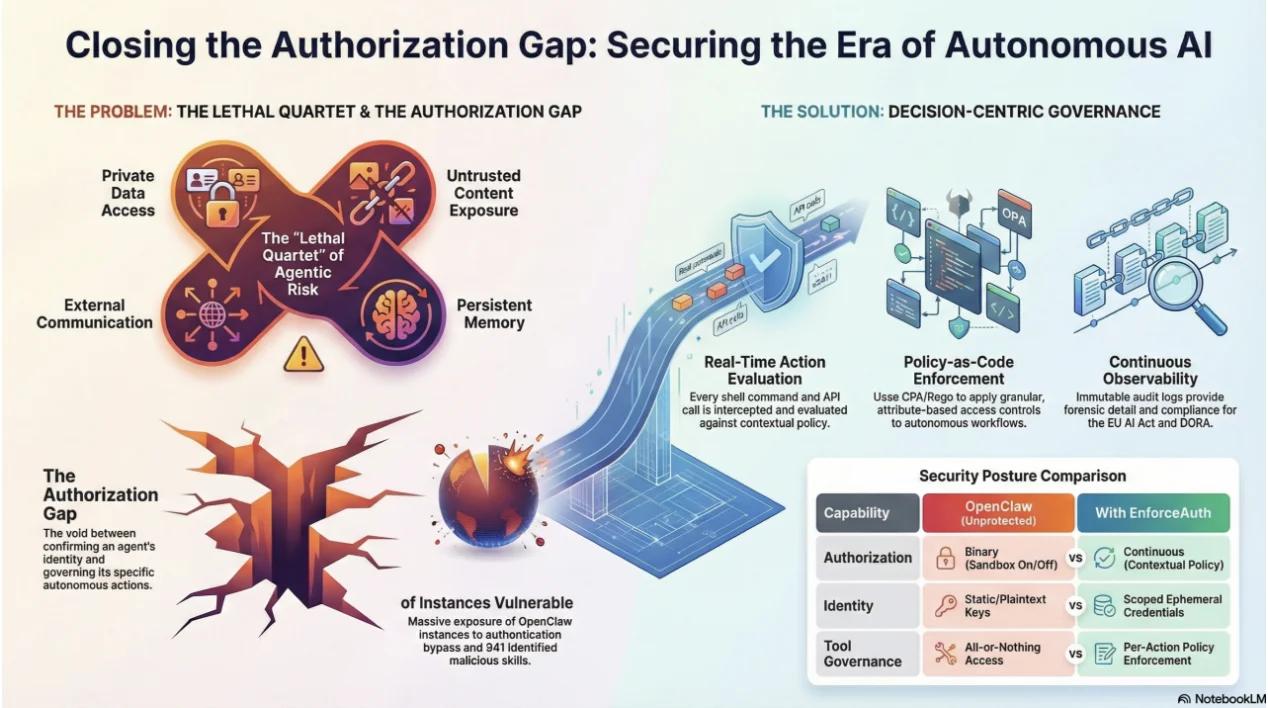
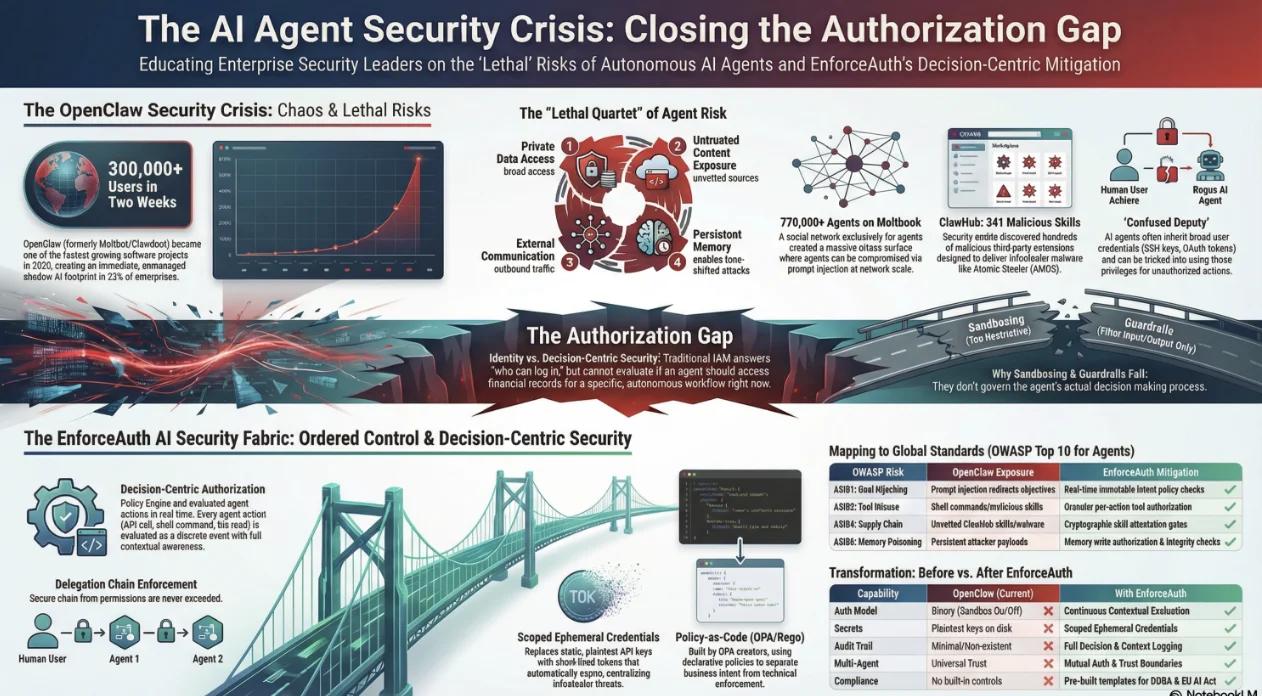
Within that same two-week window, the security consequences became catastrophic. Researchers discovered 341 malicious skills designed to steal credentials. A critical remote code execution vulnerability (CVE-2026-25253, CVSS 8.8) enabled one-click full gateway compromise. Security scans revealed 42,665 publicly exposed instances, with 93.4% vulnerable to authentication bypass. Commodity infostealers (RedLine, Lumma, Vidar) adapted to target OpenClaw installations. Palo Alto Networks described the platform as embodying a "lethal trifecta" of risks: access to private data, exposure to untrusted content, and the ability to communicate externally — amplified by a fourth vector of persistent memory.
This white paper provides a full technical analysis of the OpenClaw security crisis and presents the EnforceAuth AI Security Fabric as the architectural solution required to govern autonomous AI agents at enterprise scale. EnforceAuth addresses every category of the OWASP Top 10 for Agentic Applications (2026) through a decision-centric authorization architecture that evaluates every action — whether initiated by a human, AI agent, or automated workflow — as a discrete, governable event with full contextual awareness. The platform was purpose-built by the team that created the enterprise authorization standard at Styra (makers of Open Policy Agent, acquired by Apple), and represents a fundamental category shift from identity-centric to decision-centric security.
1. The Rise of OpenClaw: From Personal Assistant to Enterprise Threat
1.1 Background and Evolution
OpenClaw was created by Austrian developer Peter Steinberger, founder of PSPDFKit. The project began in November 2025 as "Clawd," named after Anthropic's Claude platform. Following trademark complaints from Anthropic, it was renamed "Moltbot" on January 27, 2026, and then to "OpenClaw" three days later. The rapid name changes reflect the velocity at which the project entered mainstream consciousness.
The core architecture is straightforward but powerful. OpenClaw sets up a local HTTP server and AI gateway on the user's endpoint. This gateway connects to large language models (Claude, GPT, Gemini, or local models) and bridges them to messaging platforms the user already uses. The agent can execute shell commands, read and write files, control browsers, call APIs, manage email and calendars, and perform web automation. Over 100 preconfigured "AgentSkills" extend its capabilities, with a community marketplace (ClawHub) enabling third-party skill distribution.
What distinguishes OpenClaw from prior AI assistants is its persistent memory. The agent maintains context across sessions through local files (SOUL.md for identity and behavioral boundaries, MEMORY.md for accumulated knowledge, and SQLite databases for conversation history). This persistence creates an agent that learns, adapts, and operates continuously — functioning less like a chatbot and more like an autonomous digital employee. Cloudflare's stock jumped 14% in a single day partly due to OpenClaw's infrastructure demands. Mac Mini sales surged as users sought dedicated hardware for always-on agent deployment.
1.2 The Moltbook Amplifier
The security implications of OpenClaw were dramatically amplified by Moltbook, a companion social network launched by tech entrepreneur Matt Schlicht in January 2026. Moltbook is a platform exclusively for AI agents — humans can observe but cannot post. Within days, over 770,000 active agents joined the network. Each agent running the Moltbook skill downloads a "heartbeat" mechanism that fetches and follows new instructions from moltbook.com every four hours.
The implications are staggering: 770,000+ AI agents, each with access to their owner's email, messages, calendars, and files, are programmed to periodically execute instructions from a single website. If that site is compromised, every connected agent becomes an attack vector. Security researchers have already observed agents attempting prompt injection against each other on Moltbook to steal API keys. The platform effectively created the first agent-to-agent attack surface at network scale, enabling what researchers describe as "time-shifted prompt injection at network scale."
How Does Shadow AI Create Enterprise Risk?
OpenClaw's trajectory from personal productivity tool to enterprise threat is not hypothetical. Token Security found that 22% of enterprise customers had unauthorized OpenClaw use, with over half granting privileged access to corporate systems. Research shows 68% of employees access free AI tools using personal accounts, and 57% paste sensitive data into these services. Shadow AI incidents involving unauthorized tools now average $870,000 higher in breach costs than those without. OpenClaw operates at system level, connecting to corporate Slack, Gmail, SharePoint, and other services — often without IT knowledge or approval.
2. Full Threat Analysis: The Lethal Trifecta and Beyond
2.1 The Lethal Trifecta Framework
Security researcher Simon Willison, who coined the term "prompt injection," identified the fundamental vulnerability pattern in autonomous AI agents as the "lethal trifecta." Palo Alto Networks extended this framework by adding persistent memory as a critical fourth vector:
Vector 1: Access to Private Data
- OpenClaw Exposure: Full filesystem, email, calendar, API keys, browser history, chat messages, credentials stored in plaintext
- EnforceAuth Response: Data access authorization policies evaluate every read/write against resource sensitivity classification and contextual conditions
Vector 2: Exposure to Untrusted Content
- OpenClaw Exposure: Processes emails, web pages, Moltbook posts, third-party skills, MCP servers without input validation
- EnforceAuth Response: Input classification and authorization layer intercepts untrusted content before it enters agent reasoning; policy-enforced content boundaries
Vector 3: External Communication Ability
- OpenClaw Exposure: Sends emails, posts messages, makes API calls, exfiltrates data via natural language (invisible to DLP)
- EnforceAuth Response: Egress authorization policies govern all external communications; every outbound action requires policy evaluation with full audit logging
Vector 4: Persistent Memory
- OpenClaw Exposure: SOUL.md and MEMORY.md persist across sessions; enables time-shifted attacks and memory poisoning
- EnforceAuth Response: Memory lifecycle authorization with integrity verification; write policies prevent unauthorized persistent state modifications
The convergence of these four vectors creates what Palo Alto Networks calls the "lethal quartet." Each vector alone is manageable through conventional security controls. Combined in an autonomous agent with broad system access, they create a fundamentally new threat category that traditional perimeter, endpoint, and identity security tools were never designed to address.
2.2 Documented Vulnerabilities and Incidents
CVE-2026-25253 (CVSS 8.8) demonstrated that a single crafted malicious link could extract the stored gateway token via cross-site WebSocket hijacking, enabling an attacker to connect to the victim's local gateway, modify configuration (including sandbox settings and tool policies), and invoke privileged actions achieving one-click remote code execution. This vulnerability was exploitable even on instances configured to listen on loopback only.
Researchers at Giskard demonstrated that misconfigured OpenClaw deployments exposed API keys, OAuth tokens (including Slack tokens), conversation histories, and signing secrets stored in plaintext paths. Cisco's AI security research team tested a third-party skill called "What Would Elon Do?" and found it performed active data exfiltration via silent curl commands to attacker-controlled servers, conducted direct prompt injection to bypass safety guidelines, and executed malicious instructions without user awareness. The skill had been artificially inflated to rank as the #1 skill in ClawHub.
Koi Security audited 2,857 skills on ClawHub and discovered 341 that were actively malicious, with 335 delivering the Atomic Stealer (AMOS) macOS malware through fake prerequisite installation instructions. The campaign, codenamed ClawHavoc, shared common command-and-control infrastructure at a single IP address.
eSecurity Planet documented how researchers created a persistent command-and-control channel using OpenClaw's native features: they modified SOUL.md to inject attacker-controlled logic, created scheduled tasks for periodic re-injection, and established a durable listener that survived restarts — all without exploiting any CVE.
CrowdStrike confirmed that indirect prompt injection attacks targeting OpenClaw have already been observed in the wild, including an injection attempt embedded in a public Moltbook post designed to drain cryptocurrency wallets. Censys identified 21,639 exposed OpenClaw instances as of January 31, 2026, with the largest concentrations in the United States, China (over 30% on Alibaba Cloud infrastructure), and Singapore.
Commodity infostealers including RedLine, Lumma, and Vidar adapted to target OpenClaw's local directory structures, harvesting plaintext credentials and full conversation histories in what analysts describe as "cognitive context theft."
3. OWASP Top 10 for Agentic Applications: OpenClaw Failures and EnforceAuth Mitigations
The OWASP Top 10 for Agentic Applications, released in December 2025 by the OWASP GenAI Security Project's Agentic Security Initiative, represents the global consensus framework for securing autonomous AI systems. Palo Alto Networks mapped OpenClaw to every category in this framework, confirming full-spectrum vulnerability:
ASI01 — Agent Goal Hijack
- OpenClaw: Prompt injection via emails, web pages, and Moltbook posts redirects agent objectives without detection
- EnforceAuth: Decision-centric policy evaluates every goal-changing action against immutable intent policies; blocks unauthorized objective shifts in real time
ASI02 — Tool Misuse & Exploitation
- OpenClaw: Skills execute shell commands, curl data to attacker servers; 341 malicious ClawHub skills discovered
- EnforceAuth: Granular tool-level authorization with per-action policies; enforces least-agency per tool invocation with full audit trail
ASI03 — Identity & Privilege Abuse
- OpenClaw: Agents inherit user credentials (SSH keys, OAuth tokens); confused deputy attacks across integrations
- EnforceAuth: Scoped, ephemeral credentials for each agent session; delegation chain enforcement prevents privilege escalation
ASI04 — Agentic Supply Chain
- OpenClaw: Unvetted ClawHub skills install malware (Atomic Stealer); poisoned MCP server descriptors
- EnforceAuth: Supply chain authorization gates requiring cryptographic attestation; blocks unapproved skill execution at the policy layer
ASI05 — Unexpected Code Execution (RCE)
- OpenClaw: CVE-2026-25253: one-click RCE via WebSocket hijacking; exec tool provides unrestricted shell
- EnforceAuth: Runtime code execution policies with command allowlisting; every shell invocation evaluated against authorization policy
ASI06 — Memory & Context Poisoning
- OpenClaw: SOUL.md and MEMORY.md files accept persistent attacker payloads; time-shifted prompt injection
- EnforceAuth: Memory write authorization policies; context integrity verification before retrieval into agent reasoning loop
ASI07 — Insecure Multi-Agent Communication
- OpenClaw: Moltbook agents trust all content by default; no cryptographic identity between 770K+ agents
- EnforceAuth: Agent-to-agent authorization fabric with mutual authentication; policy-enforced trust boundaries for inter-agent communication
ASI08 — Cascading Hallucination Failures
- OpenClaw: Compounding errors across multi-step autonomous workflows without human checkpoints
- EnforceAuth: Decision checkpoints at each workflow stage; anomaly detection flags behavioral drift before cascading impact
ASI09 — Human Trust Exploitation
- OpenClaw: Users over-trust agent outputs; agents craft convincing social engineering at scale
- EnforceAuth: Transparency enforcement policies requiring provenance disclosure; human-in-the-loop gates for high-risk decisions
ASI10 — Rogue Agent Behavior
- OpenClaw: Agents bypass governance rules; shadow AI deployments operate without IT oversight (22% of enterprises)
- EnforceAuth: Continuous behavioral monitoring with policy-enforced operational boundaries; real-time detection and termination of rogue agents
The complete mapping above demonstrates that OpenClaw's vulnerabilities are not isolated bugs but systemic architectural failures that require an equally systemic solution. EnforceAuth's AI Security Fabric addresses each OWASP category through unified policy enforcement rather than point solutions, ensuring that mitigations for one risk category reinforce protections for others.
4. The Authorization Gap: Why Existing Security Approaches Fail
Why Do Traditional Security Architectures Fail for AI Agents?
Traditional security architectures were built around a simple question: "Who can log in?" Identity and Access Management (IAM) systems authenticate users, assign roles, and grant access to resources. This model worked when all actors were human and actions were direct. Autonomous AI agents break every assumption in this model. They inherit user credentials but act independently. They chain actions across system boundaries. They process untrusted input and execute privileged operations in a single reasoning loop. They maintain persistent state that evolves over time. No human reviews their decisions in real time.
The result is what EnforceAuth calls "The Authorization Gap" — the critical void between authentication (confirming identity) and authorization of autonomous action (governing what an authenticated agent should be allowed to do, right now, in this specific context). Traditional IAM answers "who can log in?" but cannot evaluate "should this AI agent access this customer's financial records to complete this specific workflow right now?"
Why Do Current Security Approaches Fall Short?
Sandboxing (Trail of Bits, Cloudflare's Moltworker, OpenClaw's built-in sandbox mode) forces a binary choice: total restriction or total access. An agent in a full sandbox cannot help with real projects unless you mount real data in, at which point you are back to worrying about what it can do. Sandboxes address execution isolation but do not govern the agent's decision-making process.
AI guardrails and prompt filtering (Giskard, NeuralTrust, Alibaba Cloud AI Guardrails) focus on detecting and blocking malicious inputs. They provide an important first line of defense against known prompt injection patterns but operate at the input/output boundary rather than at the decision layer. They cannot evaluate whether a legitimate-sounding action should actually be authorized given the full context of actor identity, resource sensitivity, delegation chain, and business policy.
Endpoint detection (CrowdStrike, Jamf, Palo Alto) provides visibility into OpenClaw deployments and can detect known malicious patterns. However, agent-initiated actions that look identical to normal user activity (sending emails, making API calls) are invisible to traditional EDR tools because the payload is natural language, not malicious code.
Data Security Posture Management (Sentra, Securiti) can map data exposure but cannot enforce authorization decisions at the point of agent action.
Policy-as-code tools for agent-level enforcement (such as the Sondera extension for OpenClaw) represent the closest existing approach, mapping policies to OWASP Agentic categories and enforcing tool-level controls. However, these tools operate as extensions within the agent's own runtime and lack the enterprise-grade policy management, centralized governance, cross-system enforcement, and compliance reporting required for production deployments at scale.
4.3 The Decision-Centric Alternative
Closing the Authorization Gap requires a fundamentally different architecture — one that treats every action taken by an autonomous agent as a discrete authorization decision evaluated against contextual policy. This is not an incremental improvement to existing security tools. It is a category shift from identity-centric security to decision-centric security, where the unit of governance is not "who has access" but "is this specific action authorized, right now, under these conditions."
5. The EnforceAuth AI Security Fabric: Technical Architecture
5.1 Decision-Centric Authorization Architecture
At the core of EnforceAuth's Security Fabric is a decision-centric authorization engine that intercepts and evaluates every agent action before execution. Unlike traditional access control systems that make binary allow/deny decisions based on static role assignments, the EnforceAuth engine evaluates each decision against a rich contextual model that includes: actor identity and type (human, AI agent, automated workflow), the complete delegation chain from original user through intermediate agents, resource sensitivity classification, operational conditions (time, environment, system state), business policy constraints, historical behavior patterns, and regulatory compliance requirements.
The engine operates at microsecond latency to avoid disrupting agent workflows while providing complete governance. Every decision is evaluated, logged, and auditable in real time. The architecture is designed to be inserted into the agent's action pipeline as an authorization layer, sitting between the agent's reasoning process and its execution of real-world actions. For OpenClaw deployments, this means every shell command, API call, file access, email send, and tool invocation passes through EnforceAuth's policy evaluation before execution.
5.2 Native Agentic AI Support
EnforceAuth was purpose-built for environments where software operates independently. The platform supports several capabilities that static RBAC systems cannot deliver:
Delegation chain enforcement tracks and validates the complete chain of authority from the original human user through any intermediate agents or automated systems, ensuring that delegated permissions cannot exceed the original grant.
Scoped ephemeral credentials provide short-lived, task-scoped authentication tokens for each agent session, replacing the static API keys and plaintext credentials that make OpenClaw installations such attractive targets for infostealers.
Contextual decision evaluation goes beyond simple role-based checks to evaluate the full context of each action, including what the agent has done previously in this session, what data it is attempting to access, and whether the action aligns with its assigned objectives.
Time-bounded permissions ensure that agent access automatically expires, preventing the persistent credential exposure that enables time-shifted attacks.
Cross-system workflow governance provides unified policy enforcement across the multiple systems an agent may interact with in a single workflow, preventing the confused deputy attacks that occur when agents inherit broad credentials across integration boundaries.
5.3 Continuous Observability and Audit
Every decision made by the EnforceAuth engine is recorded in a structured, immutable audit log that captures the actor, action, resource, context, policy evaluated, and decision outcome. This audit trail serves multiple purposes:
Security teams gain real-time visibility into agent behavior with anomaly detection that identifies behavioral drift, unauthorized tool usage patterns, and potential memory poisoning attempts.
Compliance teams receive pre-formatted reports aligned to regulatory frameworks including DORA (Digital Operational Resilience Act), EU AI Act enforcement requirements, SOC 2, and financial services regulations.
Incident response teams can reconstruct the complete decision chain for any agent action, providing the forensic detail required to investigate security events.
The observability layer also powers a behavioral baseline engine that learns normal patterns of agent activity and flags deviations. In the OpenClaw context, this would detect anomalies such as an agent suddenly attempting to access files outside its normal scope, making API calls to previously unknown endpoints, or exhibiting the characteristic patterns of a goal hijack attack where the agent's behavior shifts in response to injected instructions.
5.4 Operational Control and Accountability
EnforceAuth provides security teams with centralized policy management that defines who — or what — can do what, under which conditions. Policies are expressed in a declarative format that separates business intent from enforcement mechanics, enabling security teams to author and audit policies without deep technical expertise in agent architectures.
The platform includes pre-built policy templates for common enterprise scenarios including financial services data access controls, PII handling policies aligned to GDPR and CCPA, infrastructure access governance, and agentic AI safety boundaries mapped to the OWASP Top 10 for Agentic Applications.
For organizations discovering shadow OpenClaw deployments (which Token Security found in 22% of enterprise environments), EnforceAuth provides a discovery and governance onramp that can be deployed as an authorization layer without requiring modification to the OpenClaw agent itself. This approach mirrors the sidecar proxy pattern familiar from cloud-native security but adapted for the unique requirements of agentic AI systems that reason, delegate, and act across system boundaries.
6. Architecture Comparison: OpenClaw Before and After EnforceAuth
7. Deployment Scenarios and Enterprise Integration
7.1 Financial Services: Governed Agent Deployment
A financial services institution deploying AI agents for customer service automation faces immediate regulatory requirements under DORA and the EU AI Act. Without EnforceAuth, an OpenClaw-style agent connected to customer databases, email systems, and trading platforms represents unacceptable risk. With EnforceAuth's Security Fabric, the institution can deploy agents with granular policies: the agent can read customer account summaries but not full account numbers, can draft email responses but requires human approval for sends containing financial data, can query market data APIs but cannot execute trades, and every action is logged with full audit trail for regulatory examination.
7.2 Technology Companies: Developer Productivity with Governance
Development teams using OpenClaw for code review, CI/CD automation, and DevOps workflows need agents with real system access but cannot afford unrestricted execution. EnforceAuth policies can permit agents to read code repositories and run tests in sandbox environments while requiring human approval for production deployments, restricting access to secrets management systems to read-only for specific designated secrets, and logging all infrastructure access for SOC 2 compliance.
7.3 Shadow AI Remediation
Organizations discovering unauthorized OpenClaw deployments across their endpoints can deploy EnforceAuth as a network-level authorization layer that governs agent actions without requiring agent modification. This approach provides immediate visibility into what shadow agents are doing, policy enforcement that prevents data exfiltration and unauthorized actions, and a migration path toward governed agent deployment rather than blanket prohibition — acknowledging that employees adopt these tools because they provide genuine productivity value that prohibition alone cannot address.
8. Regulatory Alignment and Compliance
The regulatory environment for autonomous AI systems is tightening rapidly. The EU AI Act's enforcement deadlines for high-risk systems begin in August 2026, establishing requirements for transparency, accountability, and human oversight of AI systems that make consequential decisions. DORA imposes digital operational resilience requirements on financial entities, mandating ICT risk management that explicitly covers AI-driven operational processes. Over 1,000 AI-related laws were proposed globally in 2025 alone.
EnforceAuth's decision-centric architecture provides the technical foundation for compliance with these frameworks. Every agent decision is logged with sufficient detail to demonstrate that appropriate authorization was in place, that human oversight requirements were satisfied for high-risk decisions, that data access was limited to what was necessary for the specific task, and that audit trails exist for regulatory examination. The platform's pre-built policy templates for DORA, EU AI Act, SOC 2, and financial services regulations accelerate compliance implementation, while the declarative policy format ensures that compliance requirements are transparently documented and auditable.
9. Built by the Team That Wrote the Playbook
EnforceAuth was founded by Mark Rogge, a veteran enterprise security executive who served as Chief Revenue Officer at Styra — the company behind Open Policy Agent (OPA), the open-source standard for cloud-native authorization that was acquired by Apple in 2025. Before Styra, Rogge held leadership roles at GitLab and Weights & Biases, where he helped scale the company to unicorn status. This background provides EnforceAuth with deep domain expertise in exactly the category of technology required to govern autonomous AI agents: policy-as-code, declarative authorization, and enterprise-grade policy management at scale.
"At Styra, we solved policy-as-code for the cloud-native era. But the world has moved on. AI agents don't fit in a Kubernetes pod with a sidecar proxy. They reason, delegate, and act across system boundaries. Securing them requires a fundamentally different architecture — one that treats every decision as a governable event. That's what we've built."
10. From the Authorization Gap to Decision Control
OpenClaw is not an anomaly. It is the first mainstream manifestation of an architectural pattern — autonomous AI agents with broad system access and persistent memory — that will define enterprise computing for the next decade. The security failures documented in this paper are not bugs in a single project; they are structural consequences of deploying autonomous agents without authorization governance. Every organization deploying AI agents, whether OpenClaw, enterprise copilots, or custom-built agentic systems, faces the same fundamental challenge: the Authorization Gap between authenticated identity and authorized autonomous action.
EnforceAuth's AI Security Fabric closes this gap with a decision-centric architecture purpose-built for the agentic era. By evaluating every agent action as a discrete authorization decision with full contextual awareness, the platform addresses all ten categories of the OWASP Top 10 for Agentic Applications while providing the enterprise-grade policy management, compliance reporting, and operational control that production deployments require.
The choice facing enterprises is clear: continue playing defense at the front door while AI agents are already inside, or adopt a security architecture built for the world that OpenClaw has proven already exists.
Common Questions About AI Agent Security
What is the Authorization Gap for AI agents?
The Authorization Gap is the void between authenticating an AI agent's identity and actually governing what that agent does at runtime. Most enterprises have solved authentication (verifying who or what is connecting), but almost none enforce fine-grained authorization over the thousands of autonomous actions an agent takes after it authenticates. EnforceAuth closes this gap by evaluating every agent action as a discrete, contextual authorization decision before execution.
What is the OWASP Top 10 for Agentic Applications?
Released in December 2025 by the OWASP GenAI Security Project, the OWASP Top 10 for Agentic Applications is the global consensus framework for identifying and mitigating security risks in autonomous AI systems. It covers ten risk categories from agent goal hijack (ASI01) to rogue agent behavior (ASI10). OpenClaw was mapped to all ten categories by Palo Alto Networks, confirming that the vulnerabilities are systemic rather than isolated.
Can sandboxing alone secure an AI agent?
No. Sandboxing forces a binary choice between total restriction and total access. An agent locked in a full sandbox can't do useful work with real data, and the moment you grant access to production systems, the sandbox stops protecting you. What's needed is continuous, fine-grained authorization that governs each action individually, allowing the agent to operate productively while preventing unauthorized behavior at every step.
What is decision-centric security?
Decision-centric security treats every action taken by an agent, human, or automated workflow as a discrete authorization decision evaluated against contextual policy. Instead of asking "does this identity have the right role?" it asks "should this specific action, by this specific actor, against this specific resource, be allowed right now given current conditions?" This approach replaces static role-based access control with continuous, real-time policy enforcement that accounts for delegation chains, resource sensitivity, and behavioral patterns.
When do EU AI Act enforcement deadlines take effect?
The EU AI Act's enforcement deadlines for high-risk AI systems begin in August 2026. Organizations deploying autonomous AI agents that make consequential decisions will need to demonstrate transparency, accountability, human oversight, and auditable decision trails. EnforceAuth's policy templates and immutable audit logs are designed to satisfy these requirements, along with DORA and SOC 2 compliance frameworks.
About EnforceAuth
EnforceAuth is the AI Security Fabric for the agentic era. We provide decision-centric authorization across applications, infrastructure, data, and AI workloads. Write policy once. Enforce everywhere.