
Written by Mark Rogge, CEO & Founder, EnforceAuth
I spent years at Styra building and commercializing OPA — the open-source policy engine that became the de facto standard for policy-as-code authorization across the Fortune 500. Then Apple acqui-hired Styra.
I did not stay retired. I founded EnforceAuth because I watched the same structural mistake about to repeat itself — at ten times the scale, with AI agents as the vector, and almost nobody building the enforcement layer that was missing.
So when Okta ships a product to secure AI agents, I read every line of the architecture documentation. I watch the demos. I map exactly what it covers and what it does not.
And then I write this.
Okta for AI Agents goes generally available on April 30 — 23 days from now. It is a well-built product from an incumbent that has earned the right to be taken seriously. It will also leave the most consequential layer of AI agent security completely unaddressed.
That gap has a name. We have been calling it the Authorization Gap since before EnforceAuth shipped its first line of code. Okta’s announcement did not close it. In some ways, it made it more visible than ever.
What Okta Actually Built
Let us be precise, because imprecision here creates dangerous blind spots in how security teams evaluate their posture.
Okta for AI Agents is built around three questions: Where are my agents? What can they connect to? What can they do? Those are good questions. The implementation is real and competently executed.
Shadow AI Discovery
Okta can now detect when employees connect AI agents to enterprise applications without IT approval. It maps granted scopes, surfaces blast radius, and generates a remediation plan. Research shows 90% of AI usage in enterprises occurs through unauthorized personal accounts, with an average of 223 shadow AI incidents per month. For organizations running blind on shadow agents, this is genuinely valuable.
Universal Directory for Non-Human Identities
AI agents are now treated as first-class non-human identities in Okta’s directory — with defined lifecycles from onboarding to decommissioning. The right architectural foundation for the identity layer.
Agent Gateway
A centralized control plane for MCP connections. Agents interact with tools, APIs, and databases through this proxy. Credentials rotate automatically. Everything is logged for audit and observability.
Universal Logout
The kill switch. If an agent goes rogue, you revoke all access tokens immediately. Exactly the emergency override a security team needs when something breaks badly.
The Honest Assessment
Okta built solid identity management and authentication infrastructure for the AI era. Its 8,200-integration network makes this production-ready. We are not here to tell you it is bad. We are here to tell you it is the front door — and the front door is not the building.
What Happens in the 0.5 Seconds After Authentication?
Here is the scenario Okta’s product demonstrations do not address.
Your finance team deploys an AI agent to automate expense report analysis. It connects to your ERP, your expense management platform, and a production database that — because access was granted broadly during a POC six months ago — also contains a table with full compensation records for 12,000 employees.
Okta for AI Agents discovers the agent. Registers it. Issues it a token. Logs it in the Universal Directory with an assigned owner and baseline security policy.
The agent is now authenticated. It is a known, governed identity with a valid credential.
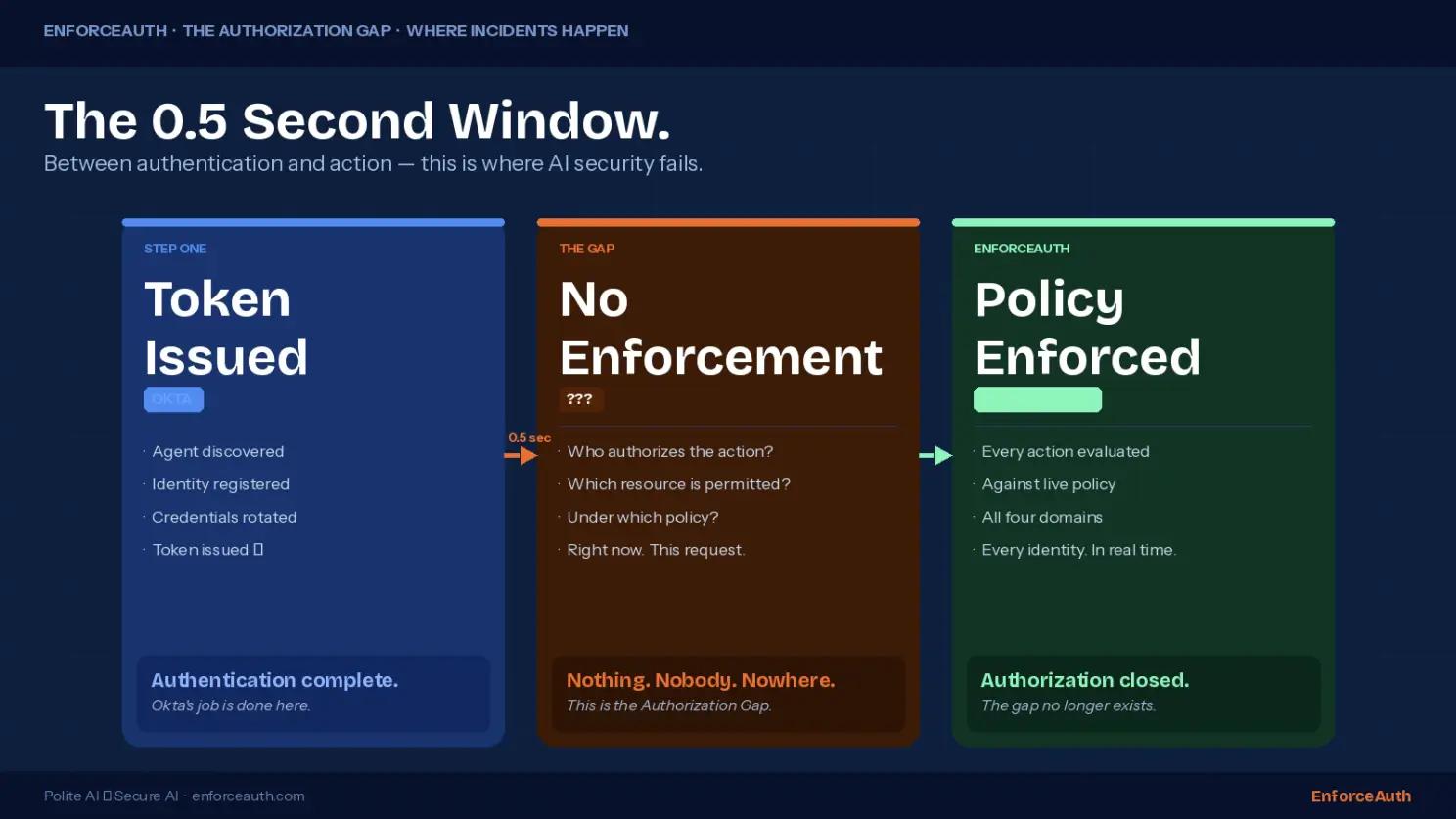
It then queries the compensation table. All 12,000 salary records. Because it has a valid Okta token, database access, and nothing in Okta’s architecture evaluates whether this specific query — at this specific moment, by this specific agent — is authorized.
Okta’s log records the access. Okta’s Universal Logout could have terminated the session — after the data was already retrieved. Nothing stopped the query from executing.
That is the Authorization Gap. It lives in the 0.5 seconds between ‘token issued’ and ‘action taken.’ It is where every meaningful AI security incident we have seen actually happens.
This is not hypothetical risk modeling. 88% of organizations have already experienced suspected or confirmed AI agent security incidents. Only 22% treat AI agents as independent, identity-bearing entities with governing policies.
And it gets structurally worse. There are, on average, 82 non-human identities for every human employee in a modern enterprise — service accounts, API keys, automated pipelines, and now AI agents. The vast majority have no runtime authorization policy governing what they are allowed to do. Okta just built a front door for all of them. The rooms inside remain ungoverned.
The Politeness Trap — Applied to Identity
There is a concept we introduced at EnforceAuth called the Politeness Trap.
Most organizations have invested heavily in making AI polite. Content guardrails, output filters, behavioral alignment, RLHF training. They have built sophisticated AI safety infrastructure. Their AI is thoughtful, measured, and appropriate.
Then they deploy that polite, safety-aligned agent into a production environment with broad OAuth scopes, static API keys, and permanent database access — and consider the security problem solved.
Polite AI is not secure AI. Safety and security are not the same problem. One governs what AI says. The other governs what AI does.
Okta for AI Agents has a version of this trap embedded in its framing. It treats agent security as an identity registration and credential management problem: are agents well-behaved, registered identities with known credentials? Yes. Good. But authorization is the continuous evaluation of whether this specific action, by this specific identity, against this specific resource, is permitted under policy — right now, at runtime, for every operation the agent performs.
A polite, well-registered, Okta-managed agent with a valid token can still cause a catastrophic authorization failure. Registration is not enforcement. A front door is not every door.
Authentication vs. Authorization: The Distinction That Changes Everything
This distinction matters more than almost anything else in enterprise AI security right now.
Authentication answers: Who are you? Are you a registered identity? Do you have a valid credential?
Authorization answers: What are you allowed to do? Specifically. Right now. For this action. Against this resource. Under this policy. Continuously.
Okta has always been exceptional at authentication. Okta for AI Agents extends that excellence to non-human identities. But authorization is not a feature of authentication. It is a separate enforcement layer operating at a fundamentally different level of granularity.
AI agents traverse hundreds of authorization decision points every minute — API calls, database queries, tool invocations, model interactions, infrastructure commands. Each one is a discrete authorization decision that must be evaluated against policy in real time.
Okta’s token tells the agent it can enter the building. EnforceAuth enforces every door inside — for every action, every identity, every time.
The Four Domains Okta Does Not Cover
Okta’s product architecture focuses on the application and API access layer. The Authorization Gap exists across all four layers of the enterprise stack.
Domain 1: Applications
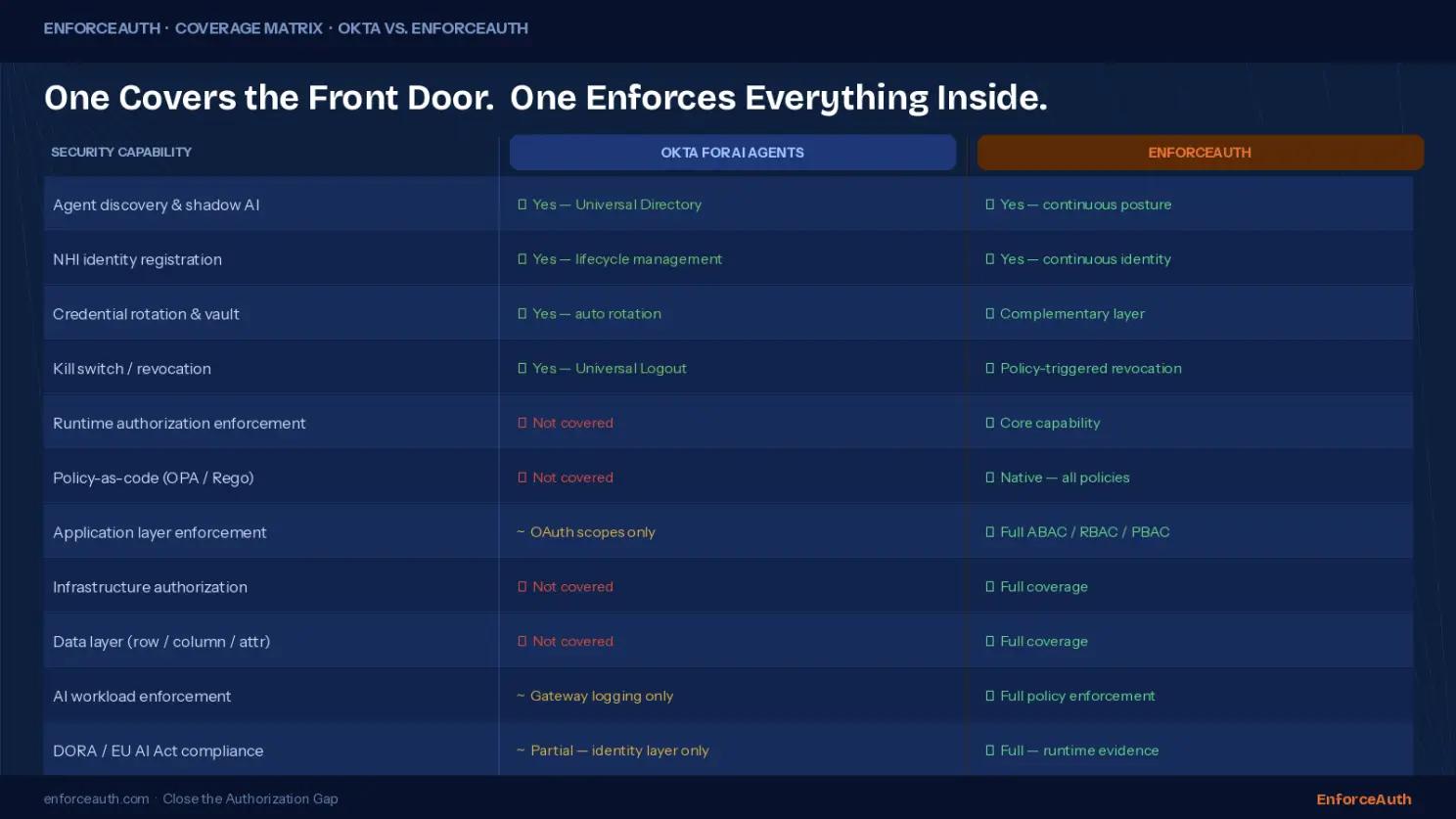
Every API call. Every record retrieved. Every SaaS action. Okta’s OAuth scopes define a coarse boundary. EnforceAuth enforces every action within that boundary — attribute-based access control evaluated at request time, against live policy, for every operation.
Domain 2: Infrastructure
Cloud resources, Kubernetes, secrets vaults, compute environments. AI agents interact with infrastructure at scale. Okta does not govern what agents do inside infrastructure environments. This layer is entirely outside Okta’s scope.
Domain 3: Data
Databases, data warehouses, regulated records, PII tables. An AI agent with database access can execute queries against tables it was never intended to touch. Authorization at the data layer requires row-level, column-level, and attribute-based controls. OAuth scopes cannot provide this.
Domain 4: AI Workloads
Model inference, tool invocations, prompt chains, inter-agent communications. Every tool call is an authorization decision. Okta’s Agent Gateway proxies MCP connections and logs them. It does not evaluate whether this specific tool invocation is permitted under your AI governance framework.
EnforceAuth’s Coverage
Unified, continuous authorization across all four domains — a single policy-as-code engine, enforced in real time, for every action by every identity, human and non-human. One fabric.
What Do DORA and the EU AI Act Actually Require?
For enterprises in regulated industries — financial services in particular — this is not an academic distinction.
DORA Article 9 requires that ICT risk management frameworks ensure continuous monitoring and control of ICT systems, including the access rights and authorization of all entities interacting with those systems. Not periodic snapshots. Not token issuance logs. Continuous authorization enforcement with auditable decision records produced in real time.
Okta’s audit trail shows what agents accessed and when. It does not show that each access was evaluated against policy at the moment it occurred — because no such evaluation exists in Okta’s architecture. When a DORA auditor asks for evidence of continuous authorization enforcement, access logs are a necessary but insufficient answer.
EnforceAuth produces the audit artifacts these frameworks require as a natural output of how policy-as-code authorization works. Every authorization decision is logged with the specific policy version that governed it. Every policy change is tracked. Every agent action is traceable to a specific rule, at a specific timestamp, under a specific policy state.
This Is Not a Competition. It Is a Stack.
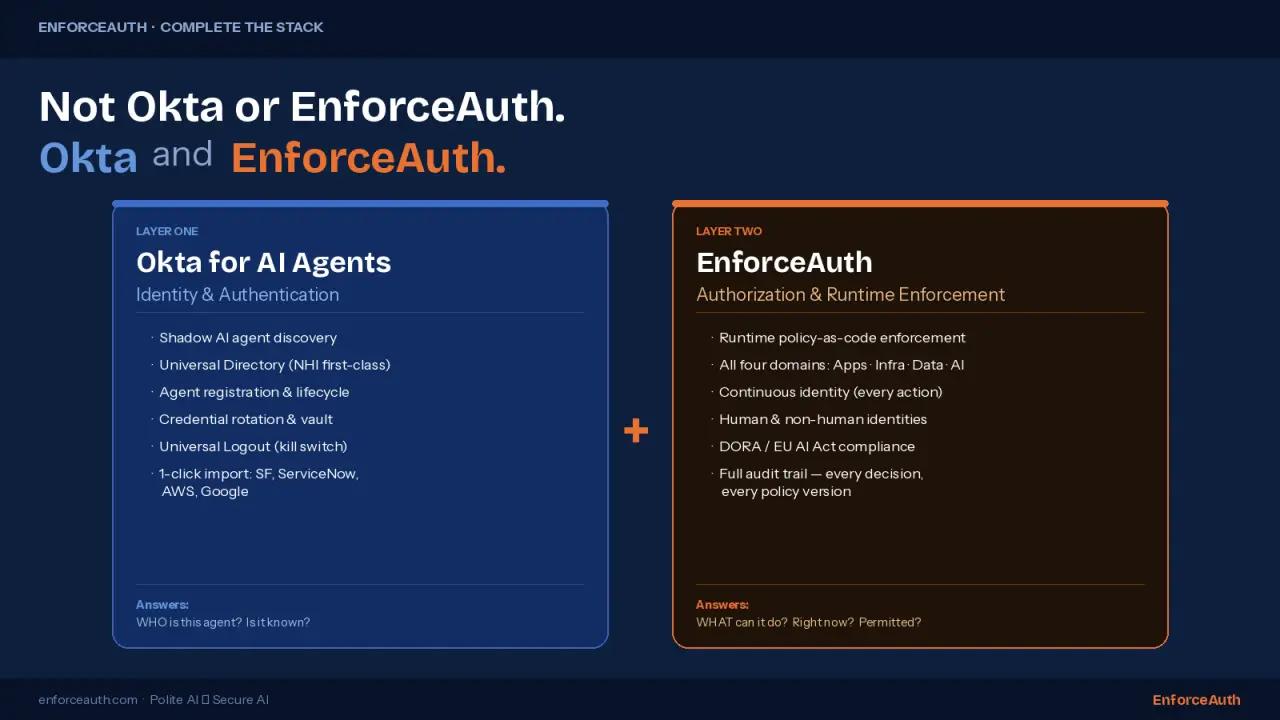
Okta for AI Agents and EnforceAuth are not competing products. They solve adjacent problems in adjacent layers of the same security stack.
Almost every enterprise in our pipeline already runs Okta. We would not have it any other way. The correct mental model:
- Okta: Okta handles the identity layer. Who is this agent? Is it registered? Does it have a valid credential? Can we revoke it?
- EnforceAuth: EnforceAuth handles the authorization layer. What is this agent allowed to do? Right now. For this action. Enforced continuously across all four domains.
In 23 days, Okta for AI Agents goes live across thousands of enterprise accounts. The moment the first token is issued to the first AI agent, the authorization question begins. That question does not answer itself.
What to Do Right Now
Step 1 — Cover the identity layer: Deploy Okta for AI Agents if you need shadow AI discovery, agent registration, credential rotation, and emergency revocation. A solid, production-ready product for the identity layer.
Step 2 — Audit your authorization surface: For every agent you register: What database tables can it access? What infrastructure can it touch? What actions can it take at runtime? If the answer is ‘whatever its OAuth scopes allow’ — you have an Authorization Gap.
Step 3 — Close the gap before the incident: Runtime authorization enforcement, policy-as-code governance, continuous identity verification, and four-domain coverage are what close the gap. One prevented authorization failure pays for years of continuous enforcement.
Request a Technical Assessment
We offer a 30-minute Authorization Gap mapping session — a structured walkthrough of your current agent environment against the four domains. No sales pitch. Just the map. Request yours at enforceauth.com.
The Verdict
Okta shipping Okta for AI Agents is one of the most strategically significant things to happen in enterprise security this year. It validates the category, activates dormant budget, and creates urgency in accounts that have been waiting for proof that the problem is real enough to fund.
When a 13-billion-dollar company enters a market, it does not just sell a product. It validates the category. It activates budget. It establishes the vocabulary the rest of the industry adopts.
Okta just gave us all of that. And then they stopped exactly where the harder problem begins.
The next question — what enforces what those agents actually do, in real time, across every layer of the enterprise stack — is the question EnforceAuth was built to answer. We could not have asked for a better market development partner.
The front door is covered.
Let us talk about everything inside the building.
Common Questions About Okta for AI Agents and the Authorization Gap
What is the Authorization Gap?
The Authorization Gap is the space between authenticating an identity and governing what that identity actually does at runtime. It lives in the 0.5 seconds between token issuance and action. Most enterprises have strong authentication through providers like Okta, but almost none enforce fine-grained, continuous authorization over the actions taken after login. For AI agents executing hundreds of autonomous actions per minute, this gap represents the primary unaddressed attack surface.
Does Okta for AI Agents include runtime authorization enforcement?
No. Okta for AI Agents covers identity management: shadow AI discovery, agent registration in Universal Directory, credential rotation via Agent Gateway, and emergency revocation through Universal Logout. These are valuable capabilities for the identity layer. But once a token is issued, there is no continuous evaluation of whether each subsequent action should be allowed given current policy, data sensitivity, or behavioral context. The Authorization Gap exists after authentication, not at it.
Are Okta and EnforceAuth competing products?
They are not. Okta handles the identity layer (who is this agent, is it registered, does it have a valid credential) and EnforceAuth handles the authorization layer (what is this agent allowed to do, right now, for this specific action, enforced continuously across applications, infrastructure, data, and AI workloads). Almost every enterprise in EnforceAuth’s pipeline already runs Okta. They are complementary layers in the same security stack.
What four authorization domains does Okta not cover?
Okta’s product architecture focuses on the application and API access layer via OAuth scopes. The Authorization Gap spans four domains: applications (fine-grained, per-action enforcement beyond OAuth scopes), infrastructure (cloud resources, Kubernetes, secrets vaults), data (row-level, column-level, and attribute-based database controls), and AI workloads (runtime enforcement for tool calls, prompt chains, and inter-agent communications). EnforceAuth provides unified authorization across all four.
What do DORA and the EU AI Act require for AI agent authorization?
DORA Article 9 requires continuous monitoring and control of ICT systems, including access rights and authorization of all entities. This means auditable decision records produced in real time, not periodic access logs. The EU AI Act requires runtime evidence of governance for AI systems. Okta’s audit trail shows what agents accessed and when, but cannot show that each access was evaluated against policy at the moment it occurred. EnforceAuth produces these compliance artifacts as a natural output of policy-as-code enforcement.
About EnforceAuth
EnforceAuth is the AI Security Fabric for the agentic era. We provide decision-centric authorization across applications, infrastructure, data, and AI workloads. Write policy once. Enforce everywhere.