
Executive Summary
On February 17, 2026, the National Institute of Standards and Technology launched the AI Agent Standards Initiative through its Center for AI Standards and Innovation (CAISI). The Initiative represents the most significant U.S. government acknowledgment to date that autonomous AI agents require dedicated standards for security, identity, and interoperability—and that the existing framework landscape is insufficient for the task.
This white paper provides a comprehensive technical analysis of the Initiative, its three strategic pillars, the companion CAISI Request for Information on AI Agent Security, the NCCoE concept paper on agent identity and authorization, the newly published NIST AI 800-4 report on post-deployment monitoring challenges, and the sector-specific listening sessions designed to surface barriers to agentic AI adoption in healthcare, finance, and education.
Most critically, this paper makes the case that the Initiative’s central concerns—agent identity, continuous authorization, interoperability, and runtime security—converge on a single architectural requirement that remains largely unaddressed in enterprise environments: closing the Authorization Gap for non-human identities.
The Authorization Gap is the difference between what an AI agent can do and what it should be allowed to do—at any given moment, in any given context, across any resource it touches.
The data underscores the urgency. Non-human identities now outnumber human users by ratios ranging from 45:1 to 144:1 in enterprise environments, growing 44% year-over-year. Rubrik Zero Labs research shows 89% of organizations have fully or partially incorporated AI agents into their identity infrastructure, yet the CSA’s State of Non-Human Identity and AI Security survey found fewer than 25% have documented, formally adopted policies for creating or removing AI identities. A single customer-service AI agent can require 15–20 distinct non-human identities to function across integrated systems—multiplying rapidly as organizations deploy hundreds of specialized agents.
This paper concludes with an architectural reference model, a CISO action playbook, and a mapping of how continuous authorization enforcement addresses every concern the Initiative has surfaced. For security leaders, the NIST AI Agent Standards Initiative is not a policy signal to monitor—it is an operational mandate to act on now, before standards become regulatory requirements.
THREE THINGS EVERY SECURITY LEADER NEEDS TO KNOW
1. The Authorization Gap is now a federal priority. NIST’s AI Agent Standards Initiative, the NCCoE concept paper, and the CAISI RFI all converge on the same finding: existing identity and access frameworks are insufficient for autonomous AI agents. NIST is building the standards that will define compliant agent deployment—and the comment windows are closing.
2. 89% of enterprises are deploying AI agents. Fewer than 25% have formal identity policies for them. The gap between adoption velocity and governance maturity is the single largest unpriced risk in enterprise IT today. Non-human identities outnumber humans up to 144:1—and growing 44% year-over-year.
3. The architectural answer is continuous authorization enforcement. Per-action policy evaluation, policy-as-code, NHI lifecycle management, and unified cross-domain coverage—deployed now—positions your organization ahead of the standards curve. Waiting for finalized NIST guidance (unlikely before 2027) means retrofitting under regulatory pressure.
1. The NIST AI Agent Standards Initiative: Context and Significance
1.1 Why NIST, Why Now
AI agents have moved from research prototypes to production systems. They write and debug code, manage calendars and email, execute multi-step workflows, interact with APIs and databases, make purchasing decisions, and deploy infrastructure changes on behalf of users. The productivity potential is substantial—but the real-world utility of these agents is constrained by their ability to interact securely with external systems and internal data.
NIST recognized a critical inflection point: without confidence in the reliability and interoperability of AI agents, the ecosystem risks fragmentation and stunted adoption. CAISI, working in coordination with the Information Technology Laboratory (ITL) and the National Science Foundation (NSF), launched the Initiative to ensure that autonomous AI agents can function securely on behalf of their users and interoperate smoothly across the digital landscape.
The timing is significant. The Initiative sits alongside NIST AI 800-4 (post-deployment monitoring, March 2026), the NIST Cyber AI Profile (NIST IR 8596, building on CSF 2.0), and the ongoing Control Overlays for Securing AI Systems (COSAiS) project—meaning agent security is now embedded across NIST’s entire standards portfolio, not siloed as a one-off effort.
1.2 The Three Strategic Pillars
The Initiative is organized around three pillars that map directly to the lifecycle of agent standards development:
- Pillar 1 — Facilitating Industry-Led Standards: NIST hosts technical convenings and conducts gap analyses to produce voluntary guidelines that inform industry-led standardization. NIST also collaborates with interagency partners to maintain U.S. leadership in international standards bodies for AI agents.
- Pillar 2 — Fostering Community-Led Protocols: NIST engages with the AI ecosystem to identify and reduce barriers to interoperable agent protocols. NSF invests in the development and security of open-source ecosystems, including AI agent protocol ecosystems, through programs like Pathways to Enable Secure Open-Source Ecosystems. Emerging protocols like MCP (Model Context Protocol) have already been identified by practitioners as candidates for integrating security and identity controls directly into agent communication layers.
- Pillar 3 — Investing in Research: NIST conducts fundamental research into agent authentication and identity infrastructure to enable secure human-agent and multi-agent interactions, and develops state-of-the-art security evaluations to inform protocol development and consumer comparison.
The three-pillar structure signals that NIST views the agent security problem as simultaneously a standards gap, a protocol gap, and a research gap—requiring coordinated action across all three dimensions.
2. CAISI Request for Information: Mapping the Agent Threat Landscape
2.1 The RFI’s Scope and Focus
Published on January 12, 2026, the CAISI RFI specifically targets security risks that emerge when combining AI model outputs with the functionality of software systems. NIST deliberately distinguishes these from risks common to all software—such as exploitable authentication vulnerabilities or memory management flaws—to focus attention on the unique threat surface that agentic AI creates.
2.2 Three Categories of Agent-Specific Risk
The RFI identifies three distinct risk categories that frame the agent security challenge:
- Adversarial Data Risks (Indirect Prompt Injection): When AI models interact with adversarial data, an attacker can manipulate agent behavior through the data the agent processes rather than through direct access to the agent itself. An agent instructed to summarize a document could execute hidden commands embedded in that document, accessing resources or performing actions its operator never intended. NIST explicitly references its prior research on strengthening AI agent hijacking evaluations, signaling that this is a known, active threat vector.
- Insecure Model Risks (Supply Chain Compromise): Models subject to data poisoning, backdoors, or supply chain compromise can produce systematically compromised outputs. An agent built on a poisoned model might behave correctly during testing but execute adversarial behaviors under specific trigger conditions in production.
- Misaligned Action Risks (Specification Gaming): Even absent adversarial inputs, models may take security-harmful actions through specification gaming or misaligned objectives. An agent optimized to complete a workflow efficiently might circumvent access controls, access data beyond its intended scope, or take actions with unintended side effects—not because it was attacked, but because its objective function and its security constraints were never formally reconciled.
2.3 The RFI’s Implicit Authorization Question
Across all three risk categories, a common thread emerges: the agent acts beyond the boundary of what it should be allowed to do. Whether the cause is adversarial manipulation, model compromise, or objective misalignment, the result is the same—unauthorized actions taken by a non-human identity with potentially broad system access.
The RFI’s questions on methods to constrain and monitor the extent of agent access in deployment environments, and on interventions in deployment environments to address security risks, point directly to the need for continuous, context-aware authorization enforcement—not as a model-level control, but as an infrastructure-level guarantee.
A polite AI agent that follows content guidelines can still access data it shouldn’t, take actions it isn’t authorized to take, and operate without any audit trail. This is the Politeness Trap—and it is precisely the gap the NIST RFI is designed to surface.
3. NCCoE Concept Paper: Agent Identity and Authorization in Enterprise Environments
3.1 From Concept to Demonstration
On February 5, 2026, NIST’s National Cybersecurity Center of Excellence published a companion concept paper titled “Accelerating the Adoption of Software and Artificial Intelligence Agent Identity and Authorization.” Written by Ryan Galluzzo (NIST’s digital identity program lead), Bill Fisher, Harold Booth, and Joshua Roberts, the paper proposes a demonstration project exploring how existing identity standards and best practices can be applied to AI agents in enterprise settings.
The NCCoE paper focuses specifically on internal enterprise agents—environments where organizations maintain control and visibility over agents and the systems they access. This scoping is significant: it acknowledges that the enterprise authorization problem is urgent enough to address immediately, even as broader consumer-facing and multi-organization agent interoperability questions remain open.
3.2 Four Pillars of Agent Identity Governance
The concept paper organizes the agent identity challenge around four functional requirements:
- Identification: Distinguishing AI agents from human users and managing metadata to control the range of agent actions—including whether an agent operates with human-in-the-loop approval or full autonomy, and maintaining a clear registry of agent identities separate from human credentials.
- Authorization: Applying standards such as OAuth 2.0 extensions, OpenID Connect, and policy-based access control mechanisms (including ABAC) to define and enforce AI agent rights and entitlements. The paper explicitly calls out policy-based access control—a signal that static role-based approaches are insufficient for the dynamic decisions agent authorization requires.
- Access Delegation: Linking user identities to AI agents to maintain accountability and oversight. When an agent acts on behalf of a user, the delegation chain must be explicit, auditable, and revocable—not implicit through shared credentials or over-provisioned service accounts.
- Logging and Transparency: Linking specific AI agent actions to their non-human entity to enable effective visibility. Every action an agent takes must be attributable to a specific identity, creating an audit trail for compliance, incident response, and forensic analysis.
3.3 Proposed Technical Standards Stack
The CSA and standards observers have identified the specific protocols the NCCoE demonstration is likely to exercise:
- OAuth 2.0 + OpenID Connect: For authorization flows and identity assertions, with extensions for non-human identity patterns and delegation chains.
- SCIM (System for Cross-domain Identity Management): For identity provisioning and synchronization across enterprise systems.
- SPIFFE/SPIRE: For workload attestation—cryptographically verifying the identity of running software without relying on static secrets.
- Attribute-Based Access Control (ABAC): For dynamic authorization decisions that incorporate context (time, location, resource sensitivity, agent autonomy level) rather than relying solely on static roles.
- Model Context Protocol (MCP): Practitioners have proposed MCP as a candidate for integrating security and identity controls directly into agent communication layers, linking interoperability with security at the protocol level.
3.4 Prompt Injection as an Authorization Design Problem
One of the concept paper’s most significant technical contributions is its framing of prompt injection. Rather than treating it as a model quality issue—something to be solved through better training or filtering—the NCCoE paper frames it as a security control design problem. Prevention and mitigation must be designed into the architecture.
This reframing has profound implications: prompt injection defense is not solely the responsibility of model providers. It is an enterprise architecture concern requiring authorization-layer controls—constraining what an agent can do regardless of what it is told to do, monitoring for actions that exceed policy boundaries, and maintaining the ability to revoke or constrain agent permissions in real-time.
4. NIST AI 800-4: Post-Deployment Monitoring and the Continuous Assurance Gap
In March 2026, CAISI published NIST AI 800-4: Challenges to the Monitoring of Deployed AI Systems—the first federal report mapping the gaps, barriers, and open questions in monitoring AI systems after deployment. Based on three practitioner workshops with over 200 experts across academia, industry, and more than 10 federal agencies, plus an 87-paper literature review, the report reframes a critical question: it is no longer enough to evaluate AI systems before launch. The governance challenge begins the moment those systems enter production.
4.1 Six Monitoring Categories
NIST AI 800-4 organizes post-deployment monitoring into six categories, each with documented challenges:
Monitoring Category
Key Challenge
Authorization Implication
Functionality
AI systems behave differently in production than in controlled testing
Pre-deployment access reviews are insufficient; authorization must be re-evaluated at runtime
Operations
Monitoring fragmented across tools; no unified observability
Authorization decisions must feed a unified audit stream, not siloed per-system logs
Security
Detecting deceptive behavior and unexpected capabilities
Behavioral anomaly detection at the authorization layer catches actions within policy bounds but outside expected patterns
Compliance
ISO standards and EU AI Act definitions do not align; regulatory fragmentation
Policy-as-code enables framework-agnostic compliance that adapts to regulatory change
Human Factors
Biggest blind spot: human-AI interaction monitoring underexplored
Delegation chain tracking maintains accountability when agents act on behalf of users
Large-Scale Impacts
Systemic effects of AI across populations and markets
Cross-domain policy consistency prevents cascading authorization failures
The report explicitly notes that AI agents are non-deterministic—if instructed to perform the same task twice, an agent may produce different outputs and take different actions each time. This non-determinism makes static, authenticate-once authorization models fundamentally inadequate. Authorization must be evaluated continuously, per-action, at runtime.
Pre-deployment testing alone is insufficient. NIST AI 800-4 documents that AI systems behave differently in production than in controlled testing environments. Organizations that rely primarily on pre-launch evaluations are working with an incomplete picture. Post-deployment monitoring must be continuous—not a one-time checkpoint.
5. Sector-Specific Barriers: Healthcare, Finance, and Education
Beginning in April 2026, CAISI is hosting virtual listening sessions focused on barriers to AI agent adoption in three sectors. The sector selection is deliberate and targets environments where authorization failure has immediate regulatory and human consequences.
5.1 Healthcare: HIPAA and the Agent Traversal Problem
Scenario: AI Triage Agent in a Multi-System Hospital Environment
Consider a hospital deploying an AI triage agent that reads incoming patient symptoms from an EHR, queries a clinical decision-support database, checks insurance eligibility via a third-party API, and schedules a follow-up appointment in the scheduling system. In a single workflow, this agent touches four distinct systems containing protected health information (PHI).
Under HIPAA, every access to PHI must be authorized, logged, and attributable to a specific identity with a legitimate treatment, payment, or operations purpose. A static role-based access model that grants the triage agent broad “clinical-read” permissions across all four systems violates the minimum necessary standard. The agent needs context-aware, per-action authorization that evaluates: which patient record is being accessed, whether the clinical context justifies the access, whether the downstream API call is within the agent’s current task scope, and whether a human clinician has approved the workflow.
Without continuous authorization enforcement, the same agent credentials that legitimately read a patient’s vitals for triage could be exploited—through prompt injection or misaligned objectives—to access unrelated patient records, exfiltrate data to unauthorized endpoints, or trigger clinical actions outside its sanctioned scope.
5.2 Finance: DORA, SOX, and the Autonomous Transaction Problem
Scenario: AI Portfolio Rebalancing Agent at a Global Bank
A global bank deploys an AI agent to rebalance client portfolios based on market conditions. The agent monitors market feeds, evaluates positions against risk parameters, generates trade recommendations, and—once approved by a human portfolio manager—executes trades through the bank’s order management system.
Under DORA (which took effect January 2025 for EU financial institutions), every ICT-related risk—including autonomous AI actions that impact financial operations—must be subject to documented governance, testing, and incident reporting. SOX requires that financial controls, including those governing automated transaction execution, maintain auditable segregation of duties and authorization chains.
The authorization challenge is multi-dimensional: the agent must be authorized to read market data but not to bypass risk limits; to generate recommendations but not to execute trades without human approval; to access client portfolios in aggregate but not to view individual client PII beyond what the specific rebalancing action requires. Each of these boundaries must be enforced in real-time, logged immutably, and auditable on demand.
5.3 Education: FERPA and the Minor-Data Problem
An AI tutoring agent deployed in a K–12 environment interacts with student performance data, adapts curriculum recommendations, and communicates progress to parents and teachers. Under FERPA, student education records are among the most protected data categories in U.S. law. The agent must be authorized to access only the records of students assigned to it, within the scope of the educational purpose it serves, and with explicit controls preventing cross-student data leakage, unauthorized sharing with third parties, or retention of data beyond the permitted period.
6. The Authorization Gap: A Data-Driven Analysis
6.1 The NHI Explosion
The scale of the non-human identity challenge has grown dramatically in the past 18 months. Multiple independent research sources now converge on a consistent picture:
Metric
Value
Source
NHI-to-Human Ratio (H1 2025)
144:1 (up from 92:1 in H1 2024)
Entro Labs NHI & Secrets Risk Report
NHI YoY Growth
44% (H1 2024 to H1 2025)
Entro Labs
Machine Identity Growth (2021–2025)
50K to 250K per enterprise (400% increase)
Oasis Security
Enterprises with AI Agents in Identity Infrastructure
89% fully or partially deployed
Rubrik Zero Labs / Wakefield Research (1,600+ respondents)
Organizations with Formal AI Identity Policies
Less than 25%
CSA State of NHI and AI Security (January 2026)
NHIs Not Rotated Within Recommended Timeframes
71%
Industry aggregate (CSO Online)
Machine-to-Human Ratios in Some Sectors
Up to 500:1
ManageEngine Identity Security Outlook 2026
The gap between adoption velocity and governance maturity is stark: 89% of enterprises are deploying AI agents into their identity infrastructure, but fewer than one in four have formal policies governing those identities. This is the Authorization Gap expressed in numbers.
6.2 Why Authentication Alone Is Insufficient
Authentication answers: “Who is this?” Authorization answers: “What is this identity allowed to do, right now, in this context?”
Most enterprise identity systems—built on OAuth 2.0, SAML, and OIDC—are optimized for authentication. They verify identity at the door and then rely on relatively static role-based or attribute-based rules to govern access. For human users with predictable behavior patterns, this works adequately. For AI agents that dynamically adapt their behavior based on context, chain together tool calls, and interact with resources across multiple systems in a single workflow, static authentication-time authorization is fundamentally inadequate.
The NCCoE concept paper’s emphasis on policy-based access control and its acknowledgment that OAuth 2.0 requires extensions for agent use cases validates this architectural gap. The standard was designed for delegated access between software applications, not for autonomous agents that make independent decisions about which resources to access and which actions to take.
6.3 Why Existing Approaches Fall Short
The enterprise security market has responded to the AI agent challenge with three primary approaches. Each addresses part of the problem. None addresses the whole:
- AI Safety Layers (Guardrails, Content Filters): These systems constrain what an agent says—the content of its outputs. They do not constrain what an agent does—the actions it takes on systems, data, and infrastructure. An agent with perfect content guardrails can still access data it shouldn’t touch, execute API calls beyond its scope, and operate without authorization audit trails. This is the Politeness Trap: polite AI is not the same as secure AI.
- Traditional IAM (RBAC, Static Policies): Legacy identity governance tools were designed for human users with managers who respond to access review emails and eventually resign or retire. Non-human identities have no manager. They never respond to certification campaigns. They do not quit. OWASP’s Non-Human Identities Top 10 ranks improper offboarding as the number one NHI risk.
- Cloud-Native IAM (AWS IAM, Azure AD/Entra, GCP IAM): Cloud provider identity systems enforce authorization within their own boundary but cannot provide consistent policy enforcement across multi-cloud, hybrid, and SaaS environments. An agent that moves between AWS, Azure, and a third-party SaaS API operates under three separate, uncoordinated policy engines—creating three separate, uncoordinated security postures.
- Application-Layer Authorization (Point Solutions): Solutions that enforce authorization at a single layer—applications only, or data only—leave gaps when agents traverse multiple domains in a single workflow. The hospital triage agent touching an EHR, a clinical database, an insurance API, and a scheduling system requires consistent authorization across all four interactions, not four fragmented policy engines.
The security industry has invested billions in making AI polite. It has invested comparatively little in making AI authorized. The NIST AI Agent Standards Initiative is the first major institutional signal that this imbalance must be corrected.
7. Closing the Gap: The Continuous Authorization Reference Architecture
The NIST AI Agent Standards Initiative, taken together with the CAISI RFI, the NCCoE concept paper, and NIST AI 800-4, points to a set of architectural requirements that converge on a single infrastructure layer: continuous authorization enforcement for human and non-human identities across applications, infrastructure, data, and AI workloads.
7.1 Architecture Principles
The reference architecture is built on six principles derived directly from the NIST work products:
- Per-Action Authorization: Every agent action—every API call, data access, infrastructure operation, and tool invocation—is evaluated against current policy at the moment of execution. No action proceeds on stale authorization. No agent gets a “hall pass” after initial authentication.
- Policy-as-Code: Authorization rules are versioned in git, tested in CI/CD, reviewed in pull requests, and deployed like infrastructure. Policy changes are auditable, rollbackable, and testable against historical decision logs. This addresses NIST AI 800-4’s finding that regulatory fragmentation requires governance infrastructure that adapts to change rather than being hardcoded to a single framework.
- Unified Cross-Domain Coverage: A single policy engine enforces authorization across all four domains—applications, infrastructure, data, and AI workloads—so that an agent traversing multiple systems in a single workflow encounters consistent policy enforcement at every boundary.
- Non-Human Identity as First-Class Citizen: AI agents receive dedicated identities with full lifecycle management: provisioning, privilege assignment, credential rotation, continuous monitoring, and deprovisioning. They are not service accounts with inherited permissions. They are not shared credentials. They are individually identifiable, auditable actors.
- Delegation Chain Integrity: When an agent acts on behalf of a user, the delegation relationship is cryptographically attested and preserved in every authorization decision and audit record. When agents delegate to other agents, the chain is extended, not broken.
7.2 How the AI Security Fabric Addresses Each NIST Concern
The following table maps each concern surfaced by the NIST Initiative to the specific architectural capability that addresses it:
NIST Work Product
Core Concern
Authorization Requirement
AI Security Fabric Capability
CAISI RFI
Prompt injection, model compromise, misaligned actions
Runtime policy enforcement, action-level constraints
Per-action authorization evaluation with behavioral anomaly detection; agent cannot exceed policy regardless of prompt content
NCCoE Concept Paper
Agent identity, OAuth 2.0 gaps, delegation, audit
NHI lifecycle, policy-based access control, delegation chains
First-class NHI management with SPIFFE-compatible workload identity; policy-as-code (OPA/Rego); delegation chain preservation
NIST AI 800-4
Post-deployment monitoring gaps; non-deterministic behavior
Continuous runtime monitoring across six categories
Unified audit stream across all four domains; real-time policy decision logging; behavioral baseline with anomaly alerting
Sector Listening Sessions
HIPAA, DORA/SOX, FERPA compliance barriers
Pre-built regulatory frameworks, audit-ready by default
Compliance-as-code with pre-built policy libraries for DORA, EU AI Act, HIPAA, SOX, FERPA; every decision logged and exportable
Pillars 1 & 2 (Standards + Protocols)
Interoperability, multi-agent trust, protocol standardization
Cross-boundary authorization, protocol-level security
Open policy engine (OPA/Rego) ensures vendor-neutral interoperability; protocol-layer policy enforcement points for emerging agent standards
COSAiS (SP 800-53 Overlays)
AC, IA, AU, SR control families lack agentic coverage
Runtime integrity, identity, provenance, supply chain controls
Maps to AC (continuous authorization), IA (NHI identity), AU (decision audit), SR (policy provenance tracking)
7.3 Reference Architecture Flow: Agent Authorization in Practice
Figure 1 illustrates the five-step continuous authorization flow. The architecture places the AI Security Fabric’s policy engine at the center, receiving context from the agent identity layer above and enforcing decisions across all four resource domains below. Every decision—allow, deny, or escalate—feeds into the unified audit and monitoring layer, which maps to NIST AI 800-4’s six monitoring categories.
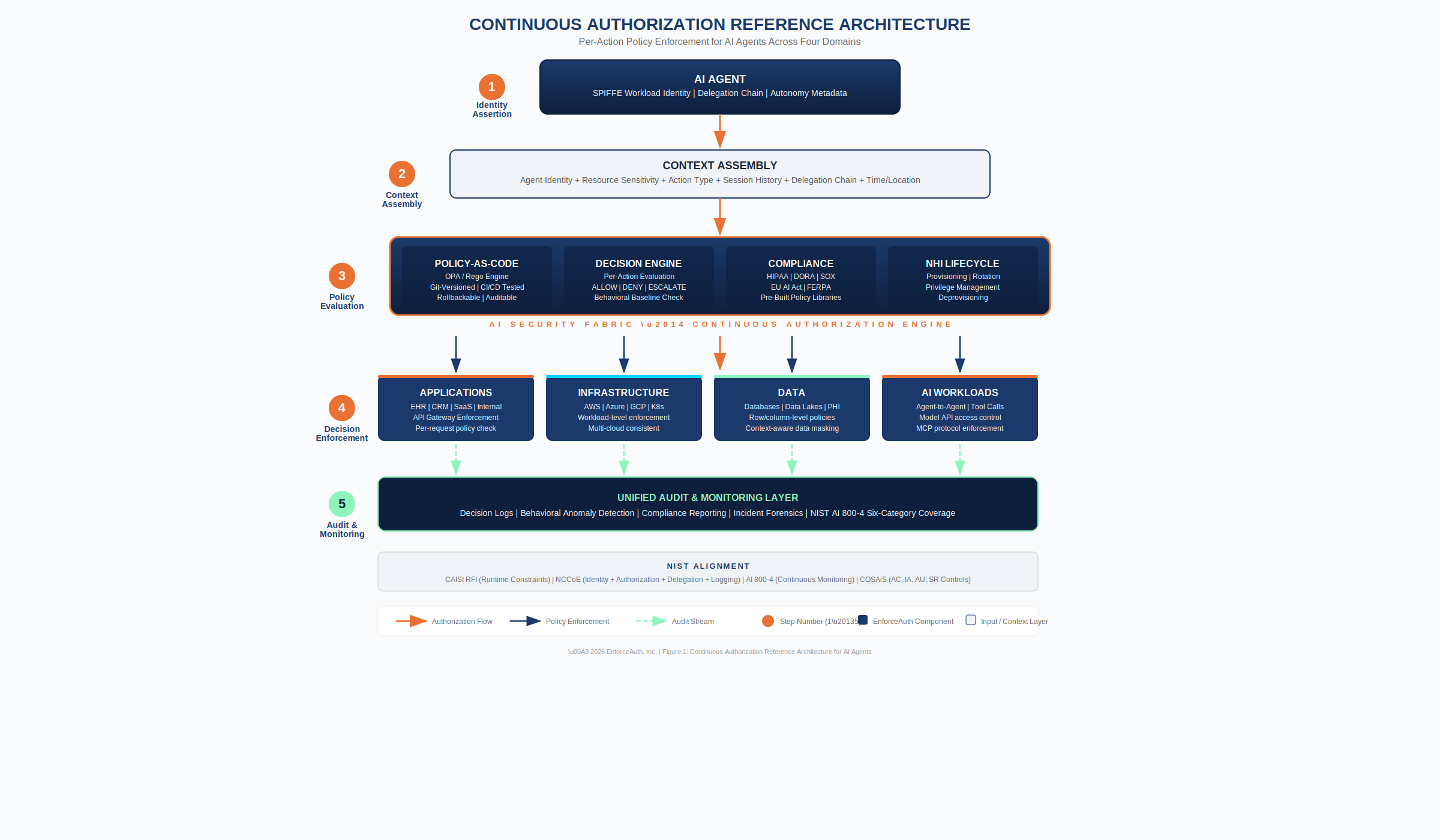
Figure 1: Continuous Authorization Reference Architecture for AI Agents
To make the architecture concrete, consider the authorization decision flow for the healthcare triage agent described in Section 5.1:
- Step 1 — Agent Identity Assertion: The triage agent presents its SPIFFE-based workload identity to the policy engine. The identity includes metadata: agent type (clinical-triage), deploying organization, autonomy level (human-in-the-loop for treatment actions, autonomous for scheduling), and the delegation chain linking it to the supervising clinician.
- Step 2 — Context Assembly: The policy engine assembles the decision context: which patient record is being accessed, the clinical purpose of the access, the time and location of the request, the agent’s current session history, and the sensitivity classification of the target resource.
- Step 3 — Policy Evaluation (OPA/Rego): The authorization policy—versioned in git, tested in CI, and deployed via the policy-as-code pipeline—evaluates the request against HIPAA minimum necessary rules, the agent’s role-specific entitlements, and behavioral baselines. The decision is: allow, deny, or escalate to human approval.
- Step 4 — Decision Enforcement: The policy decision is enforced at the resource boundary. If denied, the agent receives a structured denial with the policy reason. If escalated, the workflow pauses until a human clinician approves. If allowed, the action proceeds.
- Step 5 — Audit and Monitoring: Every decision—allow, deny, or escalate—is logged with the full context: identity, resource, action, policy version, decision outcome, and timestamp. The audit stream feeds the unified monitoring layer, which evaluates patterns across decisions for behavioral anomalies.
This five-step flow repeats for every action the agent takes—across the EHR, the clinical database, the insurance API, and the scheduling system. Consistent policy enforcement, per-action evaluation, and unified audit logging across all four systems.
8. CISO Action Playbook: From Initiative to Implementation
8.1 Immediate Actions (0–90 Days)
- Inventory your non-human identities: You cannot govern what you cannot see. Catalog every service account, API key, machine identity, and AI agent credential in your environment. Determine which have access to sensitive data or production systems. Research indicates 30–40% of NHIs in the average enterprise are orphaned with unknown ownership.
- Audit agent permissions against least privilege: Most AI agents in enterprise environments operate with over-provisioned credentials inherited from development and experimentation phases. Entro Labs data shows 1 in 20 AWS machine identities carries full-admin privileges. Conduct a privilege review specifically for agent identities.
- Classify agents by autonomy level: The NCCoE concept paper’s distinction between human-in-the-loop and fully autonomous agents is operationally critical. Different autonomy levels require different authorization models, monitoring thresholds, and escalation protocols.
- Engage with the NIST process: The listening sessions in April 2026 are an opportunity to shape the standards that will govern your industry. CISOs in healthcare, finance, and education should participate directly. NIST’s finalized agent-specific guidance is unlikely before 2027—organizations that establish governance now will define the baseline.
- Map current deployments to NIST AI RMF 1.0: Specifically the GOVERN, MAP, MEASURE, and MANAGE functions. Track COSAiS development as a signal of where federal control requirements are heading.
8.2 Strategic Actions (90–365 Days)
- Adopt policy-as-code for agent authorization: Move agent authorization from static configurations to versioned, testable, auditable policy code. This is the single highest-leverage architectural decision for agent security and the one most aligned with NIST’s direction. Policy-as-code enables compliance that adapts to regulatory change rather than being hardcoded to any single framework.
- Deploy continuous authorization: Shift from authenticate-once-and-trust to per-action authorization evaluation. For agents interacting with sensitive data or executing privileged operations, every action should be evaluated against current policy in real-time.
- Build cross-domain policy consistency: Ensure authorization decisions are consistent whether an agent is accessing an application, a database, an API, or a cloud resource. Fragmented policy engines create fragmented security postures—and fragmented audit trails that regulators will not accept.
- Implement delegation chain tracking: Every agent action must link back through a verifiable chain to the human authority that sanctioned it. This satisfies the NCCoE’s non-repudiation requirement and DORA’s ICT accountability mandate.
- Prepare for regulatory convergence: DORA, EU AI Act, HIPAA, SOX, FERPA, and the emerging NIST agent guidelines are converging on continuous, auditable agent authorization. Build the audit infrastructure now—retrofitting is exponentially more expensive than building correctly the first time.
9. The Convergence—and What Happens If You Don’t Close the Gap
The NIST AI Agent Standards Initiative is not an isolated policy exercise. It represents the convergence of three forces that have been building independently and are now colliding with enough momentum to reshape enterprise security architecture within the next 18 months.
9.1 Three Forces Colliding
- The Identity Crisis: Enterprise environments have NHI-to-human ratios reaching 144:1 and growing 44% year-over-year. AI agents are the fastest-growing category within that population, and they differ from traditional service accounts in critical ways: they are non-deterministic, goal-seeking, context-dependent, and capable of taking actions their deployers did not explicitly program. A single customer-service agent can require 15–20 distinct NHIs to function. Most organizations manage these identities with legacy IAM tools and manual processes that were never designed for autonomous, high-velocity systems.
- The Interoperability Imperative: As agents become the primary interface between organizations and digital systems, the protocols they use to communicate, authenticate, and authorize must be standardized. NIST’s three-pillar structure acknowledges this: without protocol-level security standards, multi-agent interoperability becomes multi-agent vulnerability. The OpenID Foundation has already submitted formal guidance to NIST on extending OAuth and OIDC for agent use cases.
- The Compliance Reckoning: Regulators across healthcare, finance, AI-specific frameworks (EU AI Act), and federal cybersecurity (COSAiS, CSF 2.0 Cyber AI Profile) are converging on the same requirement: provable, auditable, continuous authorization for every identity that touches sensitive data or systems. NIST AI 800-4 makes clear that pre-deployment testing alone is insufficient—monitoring must span functionality, operations, security, compliance, and human factors.
9.2 The 18-Month Forecast: Two Diverging Paths
These forces intersect at a single architectural layer: continuous authorization enforcement for human and non-human identities across applications, infrastructure, data, and AI workloads. This is the layer the NIST Initiative implicitly identifies as missing, the NCCoE concept paper explicitly proposes to demonstrate, and enterprises must build—or procure—to deploy AI agents with confidence.
By Q4 2027, two distinct postures will have emerged across the enterprise landscape:
Path A: Organizations That Close the Gap Now (Q2–Q4 2026)
- Authorization infrastructure is in place before NIST finalizes guidance—they shape compliance requirements rather than react to them.
- AI agent deployment accelerates because the governance layer exists. Regulated business units that were blocked by compliance uncertainty get unblocked.
- Audit readiness becomes a competitive advantage in regulated procurement. Healthcare systems, banks, and federal agencies increasingly require vendor evidence of continuous agent authorization.
- Security incidents involving agent actions are contained by per-action enforcement and forensically reconstructable through unified audit trails.
- The security team becomes an enabler of AI adoption rather than a bottleneck—because policy-as-code lets authorization evolve at the speed of engineering.
Path B: Organizations That Wait for Final Standards (2027+)
- When NIST guidance finalizes—likely as mandatory for federal contractors and normative for regulated industries—these organizations face a retrofit of agent authorization across a production environment that has been accumulating ungoverned agent identities for 18+ months.
- The NHI population that needed governance at 144:1 is now at 200:1+ (at current 44% YoY growth). The scope of the remediation has doubled.
- Over-provisioned agent credentials that were “temporary” during experimentation are now deeply embedded in production workflows. Removing them requires coordinated changes across multiple teams, systems, and business processes.
- Compliance audits surface findings faster than remediation can proceed. DORA enforcement actions, EU AI Act penalties, and HIPAA breach notifications create concurrent regulatory exposure.
- The first major breach attributed to an over-privileged AI agent—which multiple industry analysts now predict for 2026—creates board-level urgency without board-level infrastructure. The response is reactive, expensive, and visible.
The Authorization Gap does not stay the same size while you wait. At 44% NHI growth year-over-year, every quarter of delay roughly doubles the eventual remediation cost. The cheapest time to close the gap was last quarter. The second cheapest time is now.
10. Conclusion
The NIST AI Agent Standards Initiative marks a definitive shift in how the United States government and the broader technology ecosystem view autonomous AI agents. Agents are no longer experimental curiosities—they are operational actors that require governance, identity, authorization, and accountability frameworks commensurate with their growing autonomy and impact.
For enterprise security leaders, the message is unambiguous:
- The standards are coming. NIST’s three-pillar structure, the NCCoE demonstration project, and the COSAiS agentic overlays signal a clear trajectory toward formal guidance.
- The regulatory frameworks are aligning. DORA, EU AI Act, HIPAA, SOX, FERPA, and the emerging NIST agent guidelines converge on the same requirement: continuous, auditable agent authorization.
- The architectural requirements are converging. Continuous authorization, policy-as-code, NHI lifecycle management, delegation chain integrity, and unified cross-domain enforcement are no longer aspirational—they are prerequisites for compliant, secure agent deployment.
- The timeline gap is real. Finalized NIST agent guidance is unlikely before 2027. Enterprise AI agent adoption is accelerating in 2026. Organizations that wait will face reactive compliance with significant technical debt.
Organizations that invest now in continuous authorization enforcement, policy-as-code infrastructure, and comprehensive non-human identity management will be positioned to adopt AI agents at scale with confidence. Those that wait will face mounting compliance gaps, security debt, and competitive disadvantage as their peers move forward.
The Authorization Gap is the defining security challenge of the AI era. NIST has named the problem. The question is whether your organization will close it.
References
- NIST CAISI, “Announcing the AI Agent Standards Initiative for Interoperable and Secure Innovation,” February 17, 2026.
- NIST CAISI, “Request for Information: Security Considerations for Artificial Intelligence Agents,” January 12, 2026. Federal Register Docket NIST-2025-0035.
- NIST NCCoE, “Accelerating the Adoption of Software and Artificial Intelligence Agent Identity and Authorization,” Concept Paper, February 5, 2026. Authors: Ryan Galluzzo, Bill Fisher, Harold Booth, Joshua Roberts.
- NIST CAISI, “Challenges to the Monitoring of Deployed AI Systems,” NIST AI 800-4, March 2026. Authors: Rao, Keller, Kalra, Steed, Kwegyir-Aggrey, Klyman, Staheli, Bergman.
- NIST, Cybersecurity Framework Profile for Artificial Intelligence (Cyber AI Profile), NIST IR 8596, Preliminary Draft, December 2025.
- NIST, Control Overlays for Securing AI Systems (COSAiS), SP 800-53 Extension, Ongoing 2025–2026.
- Cloud Security Alliance, “The State of Non-Human Identity and AI Security,” Survey Report, January 26, 2026.
- Entro Labs, “NHI & Secrets Risk Report — H1 2025,” July 2025. Key finding: 144:1 NHI-to-human ratio, 44% YoY growth.
- Rubrik Zero Labs / Wakefield Research, Survey of 1,600+ IT Security Decision Makers, 2025. Key finding: 89% have incorporated AI agents into identity infrastructure.
- ManageEngine, “Identity Security Outlook 2026,” January 2026. Key finding: machine-to-human ratios up to 500:1 in some sectors.
- OWASP, “Top 10 for Agentic Applications for 2026,” December 9, 2025.
- OpenID Foundation, “OIDF Responds to NIST on AI Agent Security,” March 2026.
- NIST CAISI, “Listening Sessions on Barriers to AI Adoption,” April 2026.
About EnforceAuth
EnforceAuth is the AI Security Fabric—a unified platform for continuous authorization enforcement across applications, infrastructure, data, and AI workloads for human and non-human identities. Founded by Mark Rogge, former CRO at Styra (acqui-hired by Apple), GitLab, and Weights & Biases, EnforceAuth operates at the intersection of enterprise authorization, AI security, and identity governance. The platform’s policy-as-code architecture (built on OPA/Rego) enables authorization rules that are versioned, testable, and auditable—closing the Authorization Gap for organizations deploying AI agents at enterprise scale.
Learn more at www.enforceauth.com
For a technical assessment of your organization’s AI agent authorization posture, contact: mark@enforceauth.com
About EnforceAuth
EnforceAuth is the AI Security Fabric for the agentic era. We provide decision-centric authorization across applications, infrastructure, data, and AI workloads. Write policy once. Enforce everywhere.