
We had a call last quarter with a security architect at a Fortune 200 insurance company. She had 47 AI agents running in production. She could tell us what three of them were authorized to do. The other 44? Provisioned with broad service account credentials, deployed behind content filters, and mostly forgotten.
That is not an edge case. That's the norm across regulated enterprises right now, and it points to a problem that has nothing to do with model alignment or prompt injection. It's about authorization. Specifically, the lack of it.
NVIDIA OpenShell gives you powerful kernel-level execution isolation for AI agents. It controls what an agent can do at the OS level. But it was never designed to answer a different question, one that matters just as much: is this identity actually authorized to do it?
EnforceAuth sits directly on top of OpenShell as the authorization fabric. We add continuous, identity-aware governance to OpenShell's execution layer. A strong sandbox becomes a complete security stack.
Why Does the AI Agent Authorization Gap Matter?
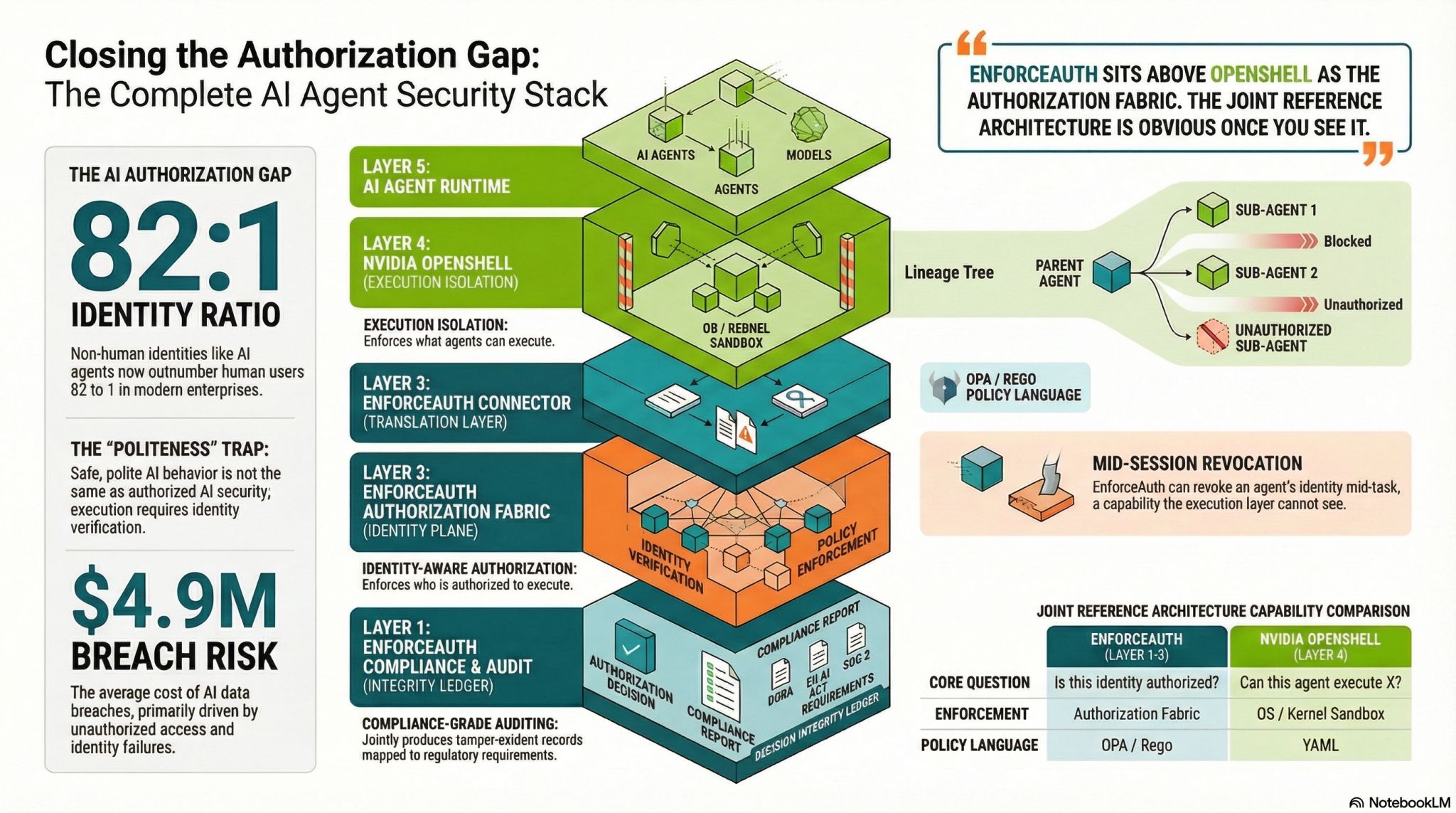
Non-human identities now outnumber human users in the typical enterprise by 82 to 1. Service accounts, API keys, AI agents. Most of them operate without any form of continuous authorization governance. They get provisioned, granted broad access, and sit there until something breaks.
When something breaks, the bill is steep. IBM's 2025 data puts the average cost of an AI-related data breach at $4.9 million. And here's what most people miss: the root cause in the majority of those incidents isn't model misbehavior. It is authorization failures. Wrong agent, wrong resource, wrong time.
So why are we still treating AI agent security like it's a model alignment problem?
What Is the "Politeness Trap" in AI Security?
Most enterprises today spend heavily on AI safety. Content filters, guardrails, alignment tuning. Then they check the security box and move on. We call this the Politeness Trap: the assumption that a well-behaved, polite AI is a secure AI.
It is not. An agent can be perfectly aligned with human values, produce zero harmful content, and still fire off unauthorized API calls using revoked credentials. Safety and security are complementary. They are not interchangeable. The authorization gap sits right between them, and most organizations don't even realize it's there.
Execution isolation like OpenShell closes part of that gap. It governs what code can run and what system resources it can touch. Good. But isolation alone has no concept of identity. It doesn't know if the agent's credentials were revoked five minutes ago. It doesn't track whether a sub-agent should inherit its parent's permissions or get its own scoped set.
That is the layer EnforceAuth adds.
How Does Mid-Session Credential Revocation Create Risk?
Picture this. An AI agent gets credentials to query a customer database. Halfway through a task, those credentials are revoked. Maybe the security team spotted anomalous behavior. Maybe the permissions were time-boxed and just expired. Without continuous authorization enforcement, the agent keeps going. It fires off dozens of additional API calls before anyone notices the credentials are dead.
OpenShell's sandbox doesn't catch this. It enforces execution boundaries, not identity state. From the sandbox's perspective, everything looks fine. The agent is running permitted code inside a valid container. But the identity behind those requests? No longer authorized.
With EnforceAuth sitting above OpenShell, that revocation is detected and denied at the exact moment of execution. The request never goes through. No gap. No lag. No "we'll catch it in the logs later."
How Does the Five-Layer Security Architecture Work?
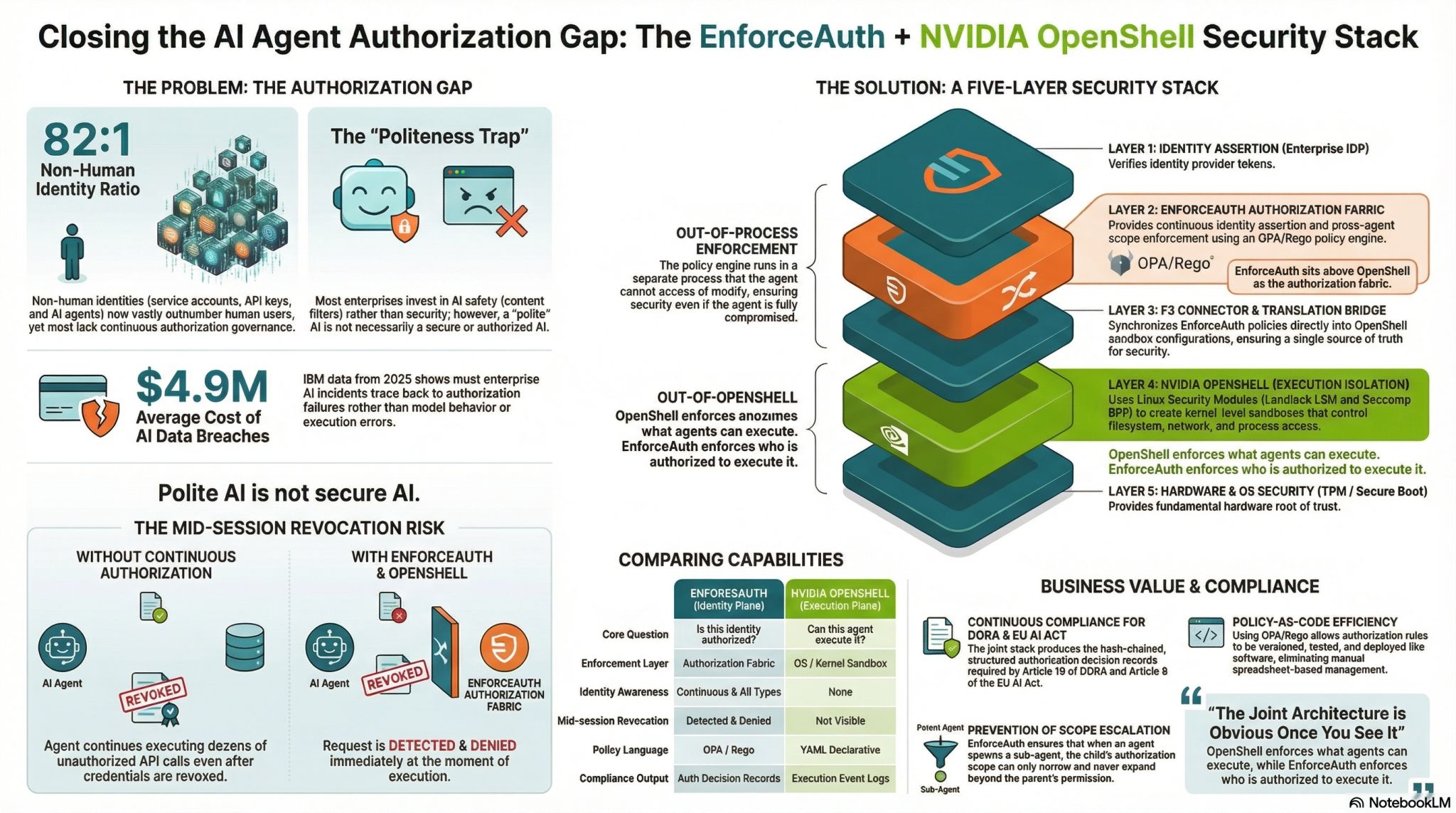
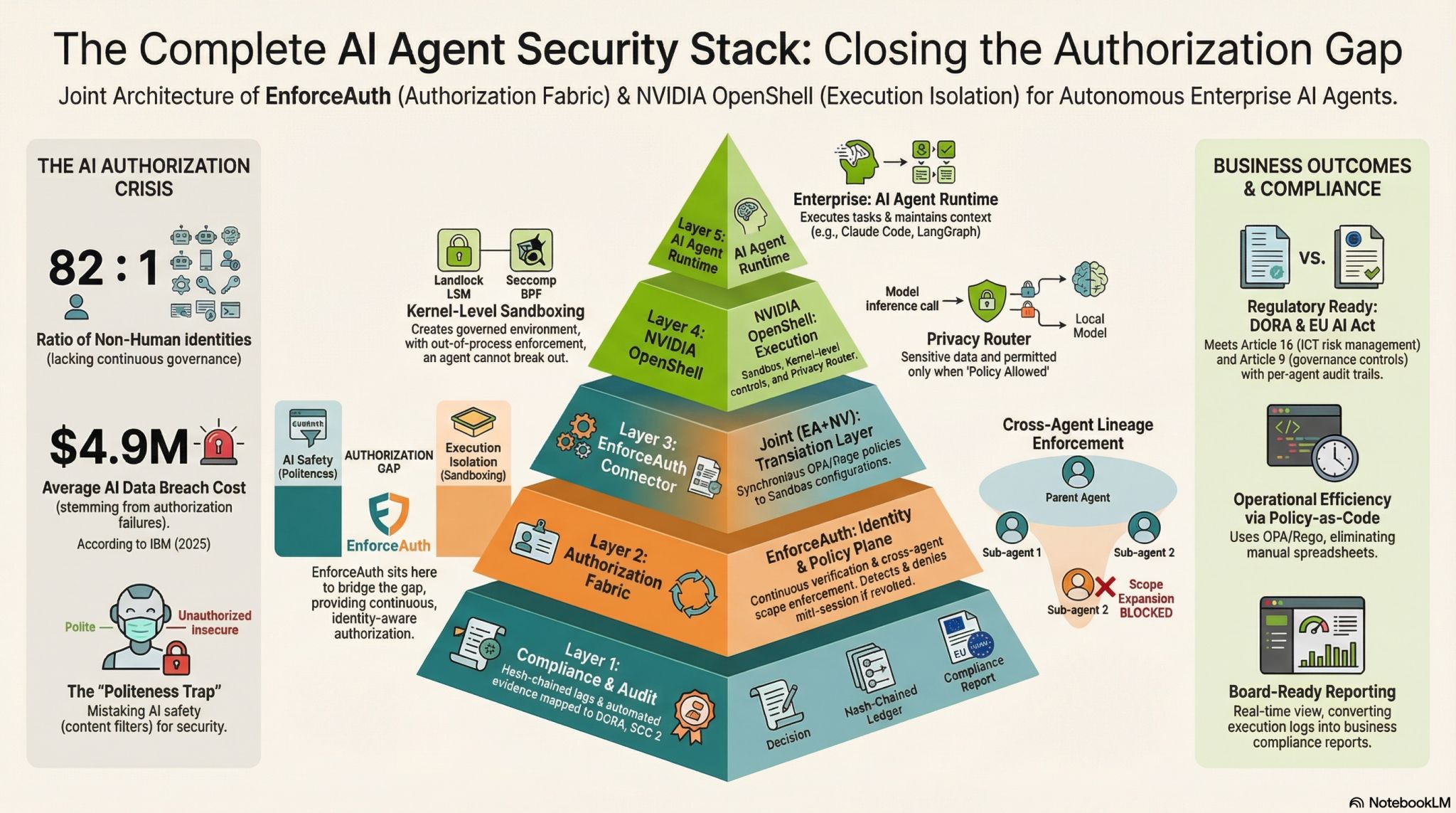
EnforceAuth layers identity-aware authorization on top of OpenShell's execution isolation, creating a five-layer security stack. The key architectural insight is a clean separation of two planes: EnforceAuth handles the identity plane (who is authorized to act), while OpenShell handles the execution plane (what actions are permitted to run).
Layer 1: Compliance and Audit (Integrity Ledger)
The foundation. Every authorization decision gets logged in a hash-chained ledger, producing tamper-evident audit trails that map directly to DORA Article 16, SOC 2, and EU AI Act Article 9. This is not a reporting feature bolted on after the fact. It is baked into the base of the stack so compliance teams don't have to reconstruct authorization history from scattered logs.
Layer 2: Authorization Fabric (Identity Plane)
This is the core of what EnforceAuth adds. The Authorization Fabric provides continuous identity verification and cross-agent scope enforcement using OPA/Rego as its policy engine. At every decision point, it answers one question: is this identity authorized?
It handles all identity types. Human users, service accounts, parent agents, sub-agents. And it can detect and deny requests mid-session if credentials are revoked, not after the session ends and someone reviews a log file. The policy engine runs out-of-process, which means the agent cannot access or tamper with it. Even if the agent itself is fully compromised, the authorization layer remains intact.
Layer 3: Connector (Translation Bridge)
The connector synchronizes EnforceAuth's OPA/Rego policies directly into OpenShell's sandbox configurations. Single source of truth for security policy. No drift between what the authorization layer thinks is enforced and what the sandbox actually enforces. This translation bridge lets EnforceAuth sit cleanly on top of OpenShell without requiring any changes to OpenShell's own enforcement model.
Layer 4: NVIDIA OpenShell (Execution Isolation)
OpenShell provides kernel-level sandboxing using Linux Security Modules, specifically Landlock LSM and Seccomp BPF. It creates sandboxes controlling filesystem, network, and process access. It also includes a Privacy Router that gates model inference calls, permitting sensitive data to reach local models only when policy explicitly allows it.
OpenShell is excellent at what it does. What it does is scoped to execution, not identity.
Layer 5: AI Agent Runtime
The top layer is where enterprise AI agents like Claude Code, LangGraph, and similar runtimes actually execute tasks and maintain context. Everything below is invisible to the agent. It just runs. The stack enforces authorization and isolation beneath it.
What Does EnforceAuth Add That OpenShell Alone Cannot?
The split becomes obvious when you lay the capabilities side by side.
OpenShell enforces what agents can execute. EnforceAuth enforces who is authorized to execute it. OpenShell is the foundation. EnforceAuth is what makes it identity-aware.
How Does Cross-Agent Lineage Enforcement Prevent Privilege Escalation?
Cross-agent lineage enforcement is one of EnforceAuth's more important capabilities for multi-agent deployments, and it addresses a problem that sandbox-only approaches simply cannot see.
When a parent agent spawns a sub-agent, EnforceAuth ensures the child's authorization scope can only narrow. Never expand. If a sub-agent attempts to escalate its own scope beyond what the parent was granted, the request is blocked before it executes.
Why does this matter? Because in multi-agent systems, a compromised sub-agent trying to grant itself broader access than its parent ever had is one of the most common privilege escalation vectors. OpenShell sees individual processes. It does not track identity hierarchies or parent-child permission relationships. EnforceAuth fills that gap with policy enforcement at the identity layer, not the process layer.
What Regulatory and Compliance Requirements Does This Address?
Security teams aren't the only stakeholders here. Compliance officers, risk committees, and boards need answers too, and they need them in a format that doesn't require parsing raw telemetry.
Regulatory alignment out of the box. EnforceAuth produces the structured authorization decision records and hash-chained logs that DORA Article 16 (ICT risk management) and EU AI Act Article 9 (governance controls) require. Per-agent audit trails come standard. You don't need to build a separate reporting pipeline to satisfy regulators.
Policy-as-code eliminates manual governance. Using OPA/Rego, authorization rules can be versioned, tested in CI, and deployed like any other software artifact. If your organization is still managing access policies in spreadsheets (and a surprising number of Fortune 500 companies still are), this is a structural upgrade.
Board-ready reporting. Execution logs convert into real-time compliance reports. Leadership gets visibility into agent behavior without needing a security engineer to translate.
For teams preparing for the EU AI Act compliance deadline in August 2026, having these capabilities in place now is not optional. It is a head start that compounds.
The Authorization Layer Your AI Agents Are Missing
NVIDIA OpenShell is a strong execution sandbox. But sandboxes alone don't close the AI agent authorization gap. They control what runs. They do not control who is allowed to run it.
EnforceAuth sits above OpenShell as the authorization fabric, adding continuous identity verification, mid-session revocation detection, cross-agent lineage enforcement, and compliance-grade audit trails. The architecture is straightforward once you see it: OpenShell handles the execution plane, EnforceAuth handles the identity plane.
Together, they turn autonomous AI agents from an unmanaged risk into a governed, auditable capability.
If you're deploying autonomous agents at scale without continuous authorization, that 82-to-1 ratio of non-human identities is working against you right now. We should probably talk.
Common Questions About AI Agent Authorization
What is the difference between AI safety and AI security?
AI safety focuses on model behavior: content filters, guardrails, and alignment tuning to prevent harmful outputs. AI security focuses on access control and authorization: ensuring agents can only access the resources and perform the actions they're explicitly permitted to. A well-aligned agent can still cause a breach if its credentials are stale or its scope is too broad.
Can't execution sandboxes like OpenShell handle authorization on their own?
Execution sandboxes control what code and system resources an agent can access at the OS level. They do not track identity state, credential validity, or permission inheritance across agent hierarchies. Authorization requires a separate identity-aware layer that evaluates who is making a request, not just what the request does.
What is cross-agent lineage enforcement?
When a parent AI agent spawns a sub-agent, lineage enforcement ensures the child's permissions can only be equal to or narrower than the parent's. It prevents privilege escalation attacks where a compromised sub-agent attempts to grant itself broader access than its parent was authorized to have.
How does EnforceAuth handle mid-session credential revocation?
EnforceAuth evaluates authorization at the moment of each request, not just at session start. If credentials are revoked while an agent is actively running, the next request from that agent is detected and denied in real time. Execution sandboxes cannot see credential state changes, which is why this requires a dedicated authorization layer.
Which compliance frameworks does this architecture support?
The joint EnforceAuth and OpenShell stack produces hash-chained authorization decision records that map to DORA Article 16 (ICT risk management), EU AI Act Article 9 (governance controls), and SOC 2 trust service criteria. Audit trails are generated automatically at the authorization layer, not reconstructed from execution logs after the fact.
About EnforceAuth
EnforceAuth is the AI Security Fabric for the agentic era. We provide decision-centric authorization across applications, infrastructure, data, and AI workloads. Write policy once. Enforce everywhere.