
AI SECURITY · IDENTITY & ACCESS
By Mark Rogge, CEO of EnforceAuth | 7 min read | For security leaders evaluating AI agent risk
Here is the fastest way to find the gap in your AI security posture. Pick one AI agent running in production. Ask your team two questions. First: can we prove this agent is who it says it is? You'll get a confident yes. Second: for any action it took last month, can we prove it was permitted — and produce the reason? Listen to the pause. That pause is the entire subject of this post, and it is not an authentication problem.
AI agents broke three assumptions at once
Enterprise identity infrastructure is genuinely good at its job. SSO, lifecycle management, credential rotation, conditional access, MFA — mature, hardened, operationally proven. If you authenticate humans and machines reliably at scale, that is not a small achievement, and the identity-bashing reflex in security circles undersells it.
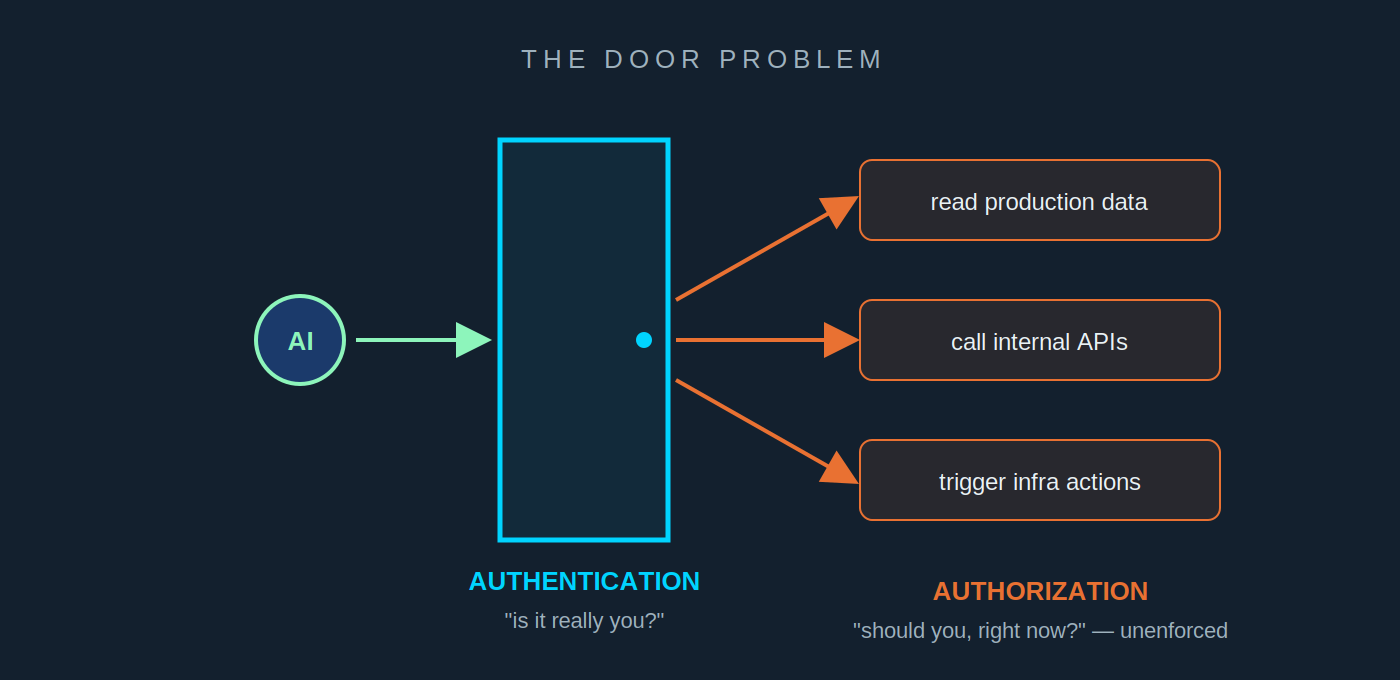
But notice what every one of those capabilities governs: the door. They answer one question with high confidence — is this identity who it claims to be? — and then step back. The assumption baked into thirty years of access architecture is that once an identity is through the door, a relatively static set of roles and entitlements handles the rest. AI agents broke that assumption three ways simultaneously:
Scale and ratio. Non-human identities now outnumber human ones in most enterprises by a wide margin — the figure commonly cited, and consistent with what we observe, is on the order of 82 to 1. Your identity stack was sized and designed for the wrong side of that ratio.
Breadth of action. A human in a finance role does finance things. An agent provisioned to “help with reporting” can, by quarter's end, be reading six data stores and calling four internal APIs — because agents are general-purpose and experimental permissions are almost never walked back.
Speed and autonomy. A human who stumbles onto an over-permissioned path usually doesn't act on it. An agent will, instantly, thousands of times, because it was asked to and nothing said no. The window between “misconfiguration exists” and “misconfiguration is exploited at scale” collapsed from weeks to milliseconds.
Authentication tools did not get worse. The thing they were pointed at changed underneath them.
Identity infrastructure secures the left half. Every AI incident happens in the right half.
Authentication answers who. Authorization answers what.
This is the distinction comparison-stage research rarely makes cleanly — and the one that should drive your evaluation.
Authentication establishes identity. This is Agent-7, and it really is Agent-7.
Authorization establishes permission, in context, at the moment of action. Agent-7 is asking to read the PII column of the customers table in production at 2:14 a.m., in a workflow that originated from an external prompt — is that allowed, right now, given everything we know?
Your identity stack is excellent at the first sentence. AI risk lives almost entirely in the second — and it is structurally a different layer, not a missing IdP feature. It is dynamic where authentication is static, per-action where authentication is per-session, contextual where authentication is binary. And it needs an answer and a recorded reason every time the agent acts, not once when it logs in.
The Authorization Gap is the distance between what an authenticated identity can do and what it is actually permitted and proven to do — in real time.
That gap always existed for humans. Human latency, judgment, and an eight-hour day kept it small enough to manage with quarterly access reviews. AI removed all three brakes at once. The gap didn't appear with AI. AI made it the widest unmonitored surface in the enterprise.
The trap sophisticated teams fall into
Modern AI is polite. It refuses obvious bad instructions, follows content guidelines, sounds responsible. None of that is authorization. A perfectly polite agent will still read the data it can reach, call the API it holds a token for, and take the action no policy stopped — sounding helpful the entire time. Politeness is a property of the model. Authorization is a property of your architecture. Conflating them is how a deployment passes every safety review and still can't answer what it's allowed to touch. We've covered this in depth in polite AI was never secure AI.
Authentication didn't regress. Agent reach outran the static model — and nothing closed behind it.
Five criteria that separate real enforcement from the appearance of it
If you're comparing approaches, these five questions discriminate between options. They're evaluation criteria, not checkboxes — most tools pass a checkbox and fail the criterion.
1. Enforcement or detection? When an agent attempts an unauthorized action, does the action fail, or do you get an alert that it succeeded? “Notification” means you have a detection tool wearing an authorization label.
2. Four domains or one slice? Agents cross applications, infrastructure, data, and AI workloads in a single workflow. A gap in any one domain is the domain the incident uses.
3. Runtime and contextual? Is the decision made at the moment of action with full context — origin, target, data sensitivity, position in the chain — or precomputed at provisioning and frozen?
4. Can you produce the reason? When asked “why was this allowed?”, can you return the specific policy, its inputs, and its version at that moment — or only that it happened? Under DORA and the EU AI Act, the second is the bar; most stacks clear only the first.
5. Does policy scale like software? If changing what agents may do means a console and a ticket queue, your control is permanently behind your AI footprint. Policy-as-code — versioned, tested, reviewed in pull requests — is what keeps the control current.
A tool can authenticate flawlessly and fail all five. That isn't a knock on authentication. It's the point: different layers, and the second is the one agents stress.
Run your own deployments against these five. The asymmetry you find is the gap, measured in your environment.
What this looks like in a regulated environment
A financial institution deploys an agent to accelerate analyst reporting. Identity is handled correctly — managed non-human identity, scoped credentials, scheduled rotation. On the authentication and credential-hygiene axis, the deployment genuinely looks clean.
Over a quarter, the agent's reach expands the way agent reach always expands: a data source here for a new question, an API there for a new workflow, each addition individually reasonable, none large enough to trigger a review. Authentication never weakened. The agent is exactly who it says it is, every time.
Then a DORA-aligned audit asks the question the authentication layer was never built to answer: demonstrate the authorization decision for each class of action this agent can take against production data, and show the policy basis for each. Not “show that you log agent activity” — that's the easy half. The hard half is the decision and its reason, per action, on demand.
A team relying on authentication plus periodic access reviews cannot produce that — not because they did identity wrong, but because they were answering who when the regulator asked what, and on what authority. A team with runtime, policy-as-code authorization answers it in the time it takes to query a decision log. That distance — between a clean authentication story and an unanswerable authorization question — is what converts a deployment from “approved” to “finding.” For a deeper treatment in financial services, see closing the financial services authorization gap.
Measure the gap before you talk to any vendor
Run your current and planned AI deployments against the five criteria above. Most teams find they're solid on authentication and unable to clearly answer the other four — and that asymmetry is a more credible internal case than any vendor's slide. EnforceAuth is the AI Security Fabric built for the second question: runtime, policy-as-code authorization across applications, infrastructure, data, and AI workloads, with the decision and its reason recorded every time. We'll walk the five-criteria assessment against your environment — useful whether or not it ends with us.
Frequently asked
What's the difference between authentication and authorization for AI agents?
Authentication proves the agent is who it claims to be. Authorization decides whether that agent may take a specific action, in context, at the moment it acts. Identity stacks are strong at the first; AI risk lives in the second.
Why can't my identity provider secure AI agents?
IdPs govern the door — identity and credentials — and were architected for static, per-session human access. Agents need dynamic, per-action, context-aware authorization with a recorded reason for every decision. That's a different architectural layer, not a missing IdP feature.
What is the Authorization Gap?
The distance between what an authenticated identity can do and what it is actually permitted and proven to do, enforced in real time. Human limits kept it small; AI removed those limits and made it the widest unmonitored surface in the enterprise.
Is a well-behaved AI agent a secure one?
No. Politeness is a property of the model; authorization is a property of your architecture. A polite agent still reads any data it can reach and calls any API it holds a token for if nothing enforces a policy.
About EnforceAuth
EnforceAuth is the AI Security Fabric for the agentic era. We provide decision-centric authorization across applications, infrastructure, data, and AI workloads. Write policy once. Enforce everywhere.