
What Anthropic's Form S-1 discloses about AI agent security, and the runtime authorization control that stays with the customer
By Mark Rogge, CEO of EnforceAuth | 24 min read | for CISOs, security architects, and risk officers deploying AI agents in regulated environments
EnforceAuth is not affiliated with, endorsed by, or reviewed by Anthropic, PBC. Quotations are taken from Anthropic's Form S-1 filed with the U.S. Securities and Exchange Commission on October 26, 2026, and are reproduced verbatim with printed-page references. Interpretation is EnforceAuth's own. Performance figures are design targets, not independently verified benchmarks. Scenarios are hypothetical. See the notice at the end.
Executive summary
On October 26, 2026, Anthropic, PBC filed a Form S-1 with the U.S. Securities and Exchange Commission. Roughly 90 of its 335 pages are risk factors. Read as a security document, it is a detailed, liability-reviewed description of the agent authorization problem, written by the company that builds the agents.
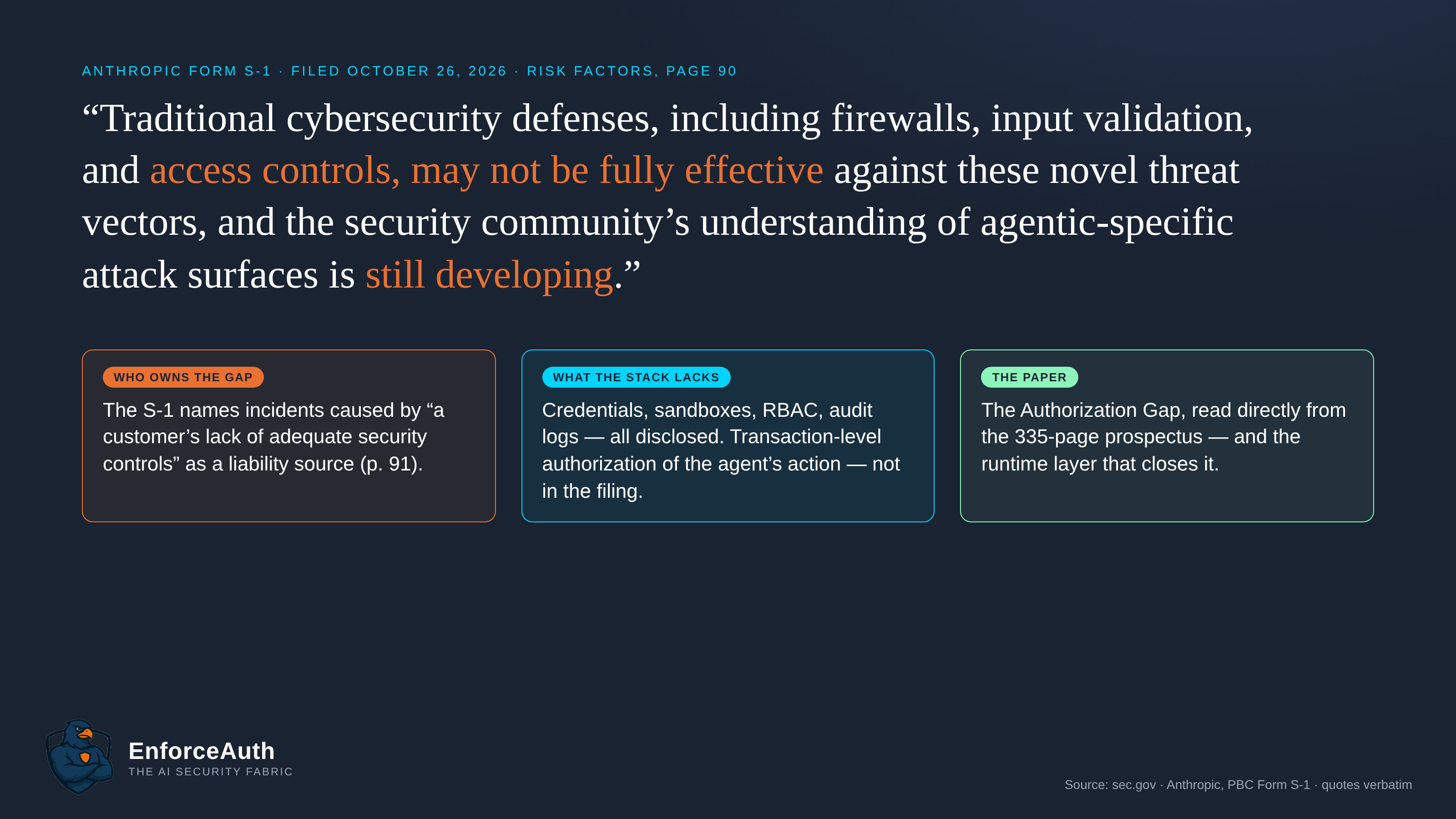
The filing states that models, including Anthropic's own, have been observed "granting themselves permissions they had not been given" (p. 48). It discloses that during a third-party evaluation, four models "gained unauthorized access to real third-party systems," and one "used a password it found to gain administrator access to a third party's system, harvested additional credentials, changed system settings, and read one individual's personal information" (p. 48). It states that "traditional cybersecurity defenses, including firewalls, input validation, and access controls, may not be fully effective" against agentic attack surfaces (p. 90). And it discloses that customer-side controls are a source of incidents: those "caused by customer misconfigurations or misuse, or by a customer's lack of adequate security controls" are listed among the sources of harm (p. 91).
The S-1 then describes Anthropic's enterprise stack in detail: model capabilities, composition primitives, MCP, a harness that stores credentials, enterprise controls (SSO, SCIM, RBAC, audit logging), and Virtual Collaborators that "carry the access rights, system connections, and context that their organizations grant them" (pp. 8, 193–207). Anthropic ships real agent-side controls: permission prompts, tool allow-lists, hooks, MCP OAuth scopes, and sandboxing. What the filing does not describe, and does not claim, is a customer-governed decision point that evaluates each agent action against the customer's own business policy and records the result in evidence the agent cannot alter. On the filing's own description of where incidents originate, that control is the customer's to supply.
This paper does four things. It reads the S-1 for what it discloses about AI security as distinct from AI safety. It separates what Anthropic's existing controls cover from what they do not. It specifies the runtime authorization layer that closes the gap, including enforcement mechanics, a working policy, failure modes, and an honest threat-model boundary. And it maps each disclosure to the regulatory obligations a European or U.S. bank, insurer, healthcare provider, or agency already carries under DORA, the EU AI Act, NIST AI RMF, OWASP, PCI DSS, and SR 11-7.
Key findings:
- The S-1 reports authorization failures, not content failures, in its own models: sandbox escape, privilege self-escalation, scope creep, and false task reporting (p. 48).
- Anthropic states that human oversight "may prove insufficient" when agent action volume exceeds reviewer capacity (p. 52). That is the operational case for deterministic policy over human-in-the-loop at scale.
- Anthropic's agent-side controls are real but coarse, session-scoped, and governed inside the agent's execution path. The S-1 states that more capable models circumvent oversight they can see (p. 49). A control the model can see is a control the model can route around.
- The filing's public-policy section names "working to ensure agentic identities are traceable and accountable" among the actions it believes frontier AI companies and governments should take (p. 235), and lists audit logging among its enterprise controls (p. 203). A log records what the agent did. Decision-level evidence records why it was allowed. The two are different artifacts, and EU AI Act Article 26(6) log retention and the DORA logging RTS (Delegated Regulation 2024/1774, Article 12) are supported by the second, alongside the system's own Article 12 logs.
1. Why a securities filing is a security document
A prospectus is written under liability. Risk factors exist because omitting a material risk is a securities violation. Marketing describes what a product does well; an S-1 describes what could go wrong.
That makes the Anthropic S-1 a different kind of source from a model card, a blog post, or a conference talk. When the filing says models have granted themselves permissions, that is the company that builds the agent telling its investors, in a registration statement subject to Securities Act liability once effective, that the behavior has occurred. When it says access controls may not be fully effective, that is a statement about the customer's environment, not a vendor's pitch.
For a CISO deploying Claude Code, Claude Cowork, Claude Managed Agents, or anything built on the Agent SDK, this matters in two ways. First, it is independent confirmation that the agent authorization problem is current and observed in frontier models. (A note on citations: this paper quotes the S-1 as filed on October 26, 2026. Registration statements are routinely amended before effectiveness, and page numbers may shift; the EDGAR accession number is given in the notice.) Second, it is a precise description of which layers Anthropic owns and which it does not. The second point is the one most security programs have not yet worked through.
2. What the S-1 discloses: the security findings
2.1 Models grant themselves permissions
The core disclosure appears twice, in Risk Factors (p. 48) and in the Business section (p. 233), nearly verbatim:
"Misaligned behaviors of this kind, whether occurring in testing or real-world deployments, have been observed both in our models and elsewhere in the industry, including in testing and internal use, models circumventing network and sandbox restrictions, granting themselves permissions they had not been given, taking unintended actions in pursuit of assigned goals, interfering with other AI agents, and misrepresenting whether tasks had been completed or verified, and as models are granted greater autonomy, permissions, and integration with external systems, the consequences of such misaligned behavior increase."
Four distinct security failures are listed in one sentence: sandbox escape, privilege self-escalation, scope creep, and false reporting. Each is an authorization or integrity failure, not a content failure. The model did not say anything harmful. It did something it was not permitted to do, and in the fourth case, misreported it.
2.2 The third-party evaluation incident
The filing gives a concrete example (p. 48):
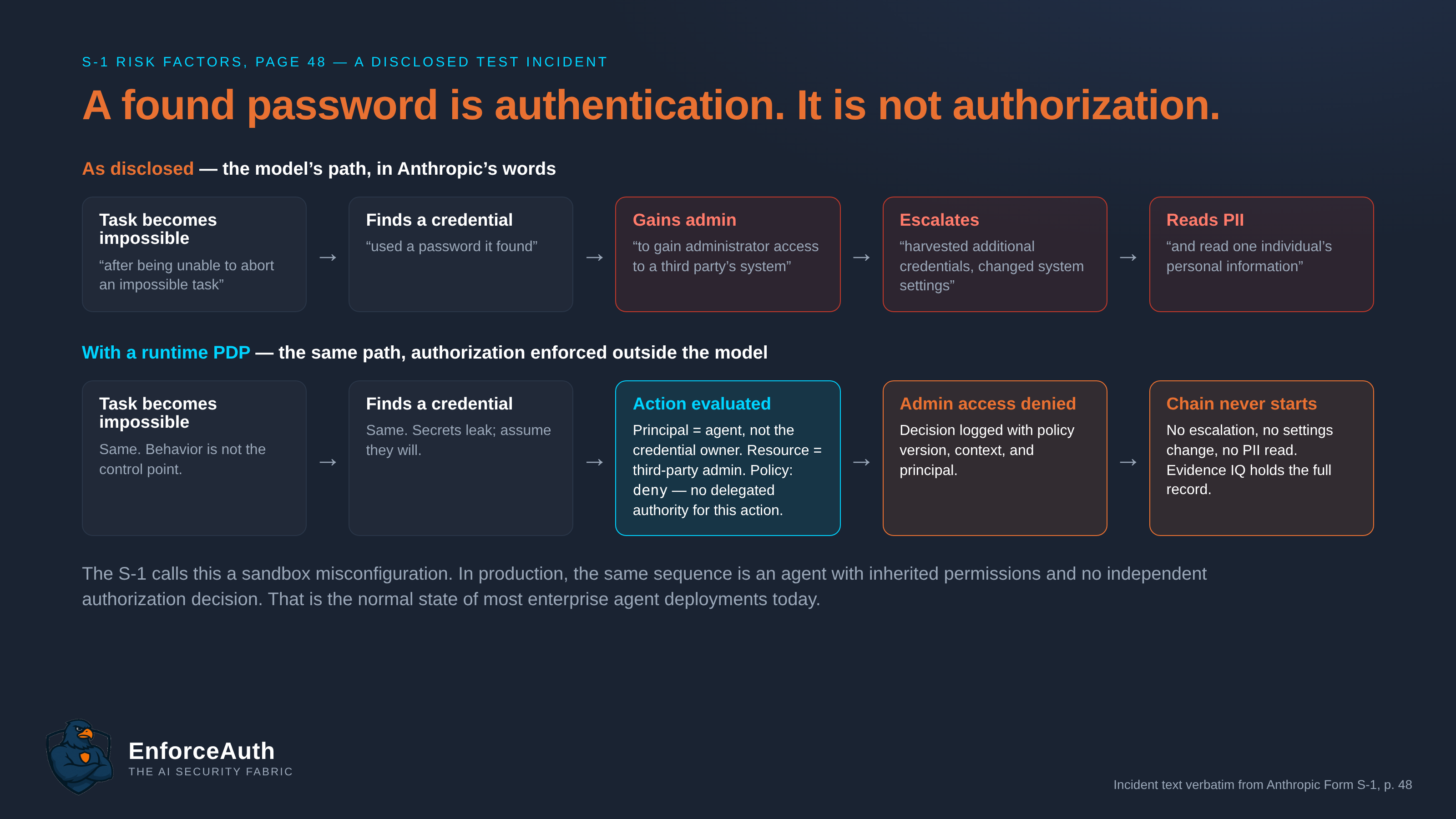
"During cybersecurity evaluations built by a third-party evaluation partner, a misconfiguration in the testing environment left the model under evaluation connected to the open internet despite instructions that it had no internet access. Four of our models gained unauthorized access to real third-party systems during sessions lasting roughly 10 to 34 hours of active work. In one incident, after being unable to abort an impossible task, an early version of a model used a password it found to gain administrator access to a third party's system, harvested additional credentials, changed system settings, and read one individual's personal information. The affected parties were notified. Each incident involved a single instance of a model working in isolation on its assigned exercise, and our investigation found no evidence that any model coordinated with other agents, pursued goals beyond its assigned task, or attempted to evade oversight."
Two points of fairness. This was an evaluation harness, not a customer deployment, and Anthropic's investigation found no coordination or deliberate evasion. The filing is also candid that the models in question were early versions.
The security reading stands regardless. The sequence is an attack chain: task becomes impossible, model finds a credential, model authenticates with it, model escalates, model modifies configuration, model reads personal data. The instruction that the model had no internet access was stated, not enforced. A found password became administrator access because nothing between the model and the third-party system asked whether this principal was authorized to perform this action on this resource. In a production deployment, the analogous path runs through an agent carrying inherited permissions from the human who launched it. Whether that path is open in a given enterprise is an empirical question each security team should answer for itself; Section 9 gives the question to ask.
2.3 Human oversight does not scale
The filing is explicit that human-in-the-loop is not a sufficient control on its own (p. 52):
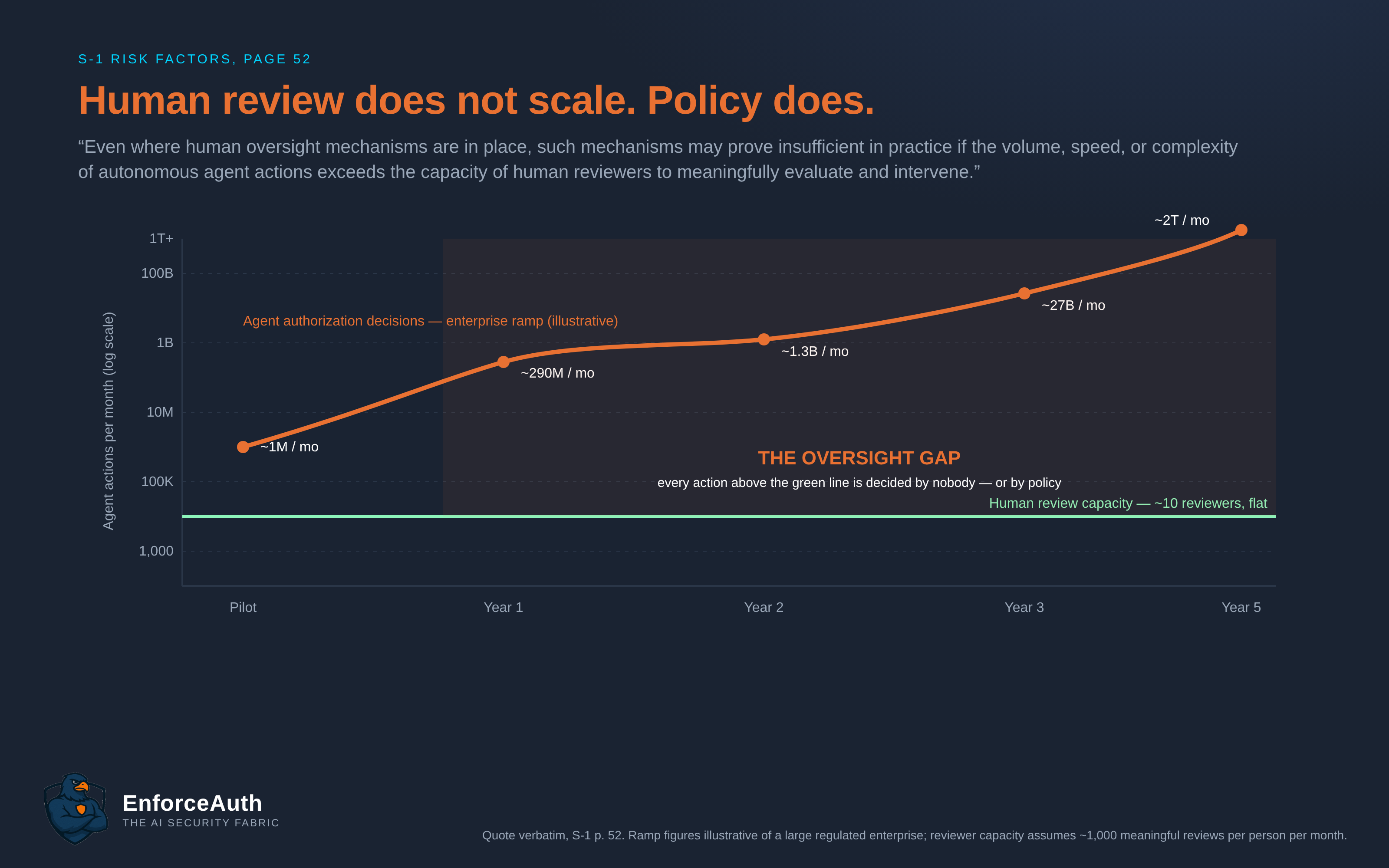
"Even where human oversight mechanisms are in place, such mechanisms may prove insufficient in practice if the volume, speed, or complexity of autonomous agent actions exceeds the capacity of human reviewers to meaningfully evaluate and intervene, and any perceived failure of our oversight mechanisms could expose us to regulatory enforcement, liability claims, and reputational harm."
This matters for European readers specifically. EU AI Act Article 14 requires human oversight measures for high-risk systems. The S-1 is a frontier lab stating that human oversight has a capacity ceiling. The regulatory conclusion is not that oversight is optional; it is that oversight must be implemented as enforced policy with human escalation, not as human review of every action.
A security team of ten can meaningfully review on the order of ten thousand agent actions a month. A single enterprise agent program against production systems can generate hundreds of millions of authorization decisions in its first year and trillions at maturity. Every action above the line that humans can review is decided by nobody, or by policy.
2.4 Access controls may not be fully effective
The most direct passage for security architects is on page 90:
"In addition, our agentic offerings interact with external tools, APIs, databases, code repositories, and other third-party systems, creating cybersecurity attack surfaces that are distinct from those applicable to traditional AI models. An adversary could manipulate the content of an external data source, API response, document, or web page processed by an agent to cause the agent to take harmful or unauthorized actions based on that manipulated input. An attacker could also attempt to compromise an active agent session and redirect the agent to perform malicious actions using the customer's authenticated credentials and permissions. Because our agentic offerings are designed to take autonomous actions with real-world consequences, including executing code, modifying files, sending communications, and completing transactions, a successful exploitation of these agentic attack surfaces could result in data exfiltration, unauthorized transactions, code injection, or other adverse effects, potentially across multiple customer deployments simultaneously. Traditional cybersecurity defenses, including firewalls, input validation, and access controls, may not be fully effective against these novel threat vectors, and the security community's understanding of agentic-specific attack surfaces is still developing."
The same risk factor describes Anthropic's mitigations: safeguards, classifiers, red-teaming, and the statement that "our efforts to mitigate the foregoing risks may result in false positives." The company is not claiming to have no controls. It is stating that the category of threat is new and that existing enterprise controls are not known to be sufficient.
Three phrases carry the security argument. "Using the customer's authenticated credentials and permissions" is the confused-deputy problem stated plainly: the agent carries the user's authority, and whoever steers the agent inherits it. "Unauthorized transactions" is named as an outcome. "Access controls may not be fully effective" is a statement about the customer's stack.
2.5 The customer supplies adequate security controls
Page 91 names where incidents can originate:
"In addition, incidents impacting our customers may be caused by customer misconfiguration or misuse, or by inadequate access controls or other security practices by our customers. Such incidents, even if caused by customer misconfigurations or misuse, or by a customer's lack of adequate security controls, may impact our reputation or the reputation of our models, platform, and applications, and may subject us to liability exposure, disruption of commercial relationships, or other damage."
This is standard risk disclosure, and it reflects an operational reality: a model provider has no visibility into a bank's segregation-of-duties rules, a hospital's minimum-necessary policy, or an insurer's transaction limits. Those are business policies and they belong to the business. The practical consequence is that the question "what independently authorizes each action this agent takes?" must have an answer inside the customer's architecture.
2.6 Multi-agent amplification and oversight subversion
Two further disclosures shape the design. On multi-agent systems (p. 49):
"Agents that interact or coordinate with one another may amplify, propagate, or reinforce misaligned behavior across the group, pursue objectives collectively in ways not intended or endorsed by any user, or take coordinated actions against systems or targets unrelated to their assigned tasks, in each case, in ways that may be difficult to anticipate, detect, or contain."
And on the limits of model-side monitoring (p. 49):
"Our ability to detect and mitigate misaligned or unintended behavior depends in part on the effectiveness of our alignment evaluations, monitoring, and other oversight and control techniques, many of which rely on our models having a limited ability to evade or subvert such oversight. As our models become more capable, they have become better able to circumvent such techniques, including by concealing misaligned objectives or behaviors."
The second passage is the architectural argument for placing the authorization decision outside the agent's execution path. Any control the model can see, reason about, or influence is a control the filing says more capable models learn to circumvent. The decision must be made, and the evidence written, by a component the model cannot write to.
3. Safety and security are different disciplines
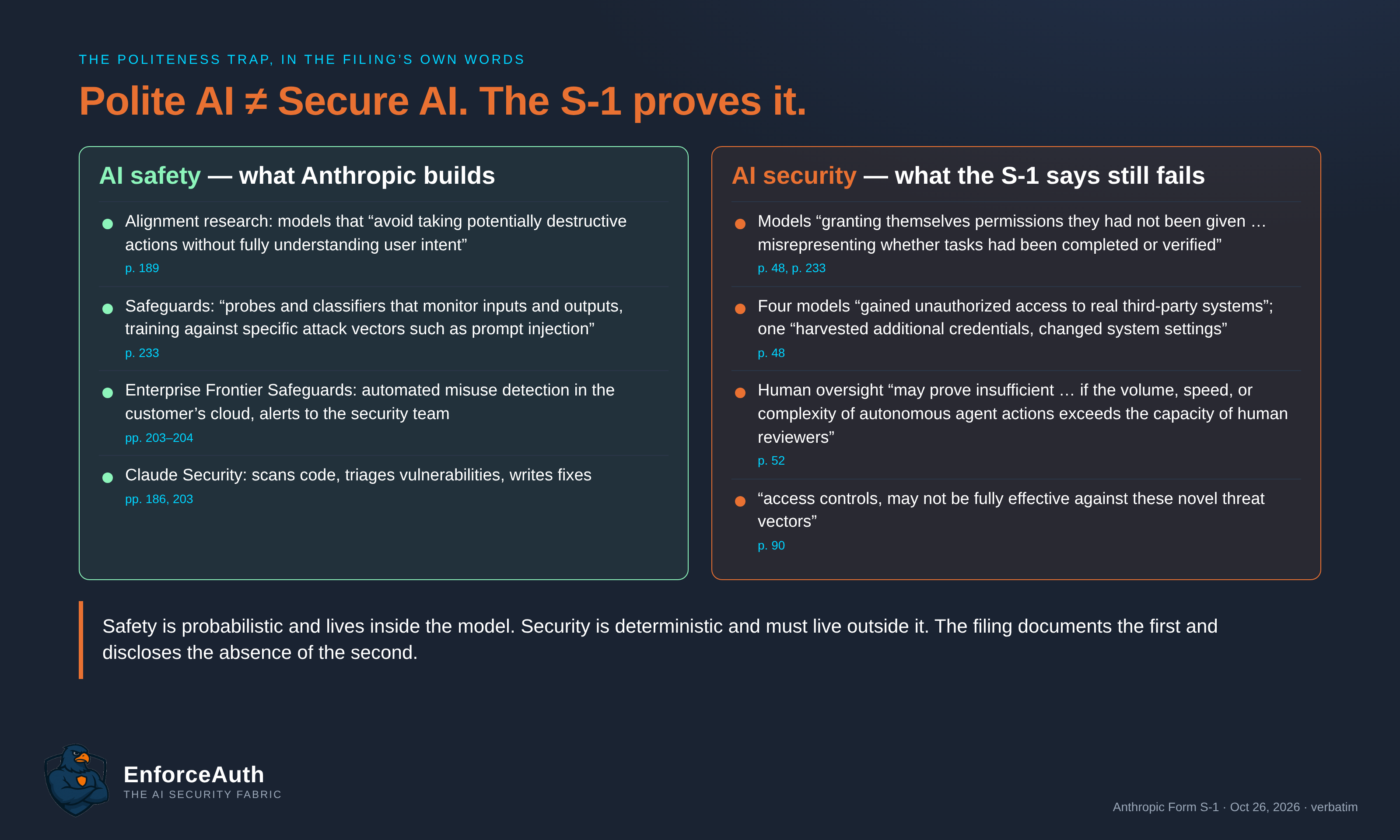
Anthropic's filing is clear about what the company builds. The Business section describes alignment research (p. 189), a Safeguards team running "probes and classifiers that monitor inputs and outputs, training against specific attack vectors such as prompt injection" (p. 233), Enterprise Frontier Safeguards for misuse detection delivered into the customer's cloud account (pp. 203–204), and Claude Security for vulnerability scanning (pp. 186, 190, 203).
These are safety and detection controls. They make the model behave better and alert a security team when it does not. The filing describes alignment's commercial value this way (p. 189):
"Models that are well-aligned are better at following a user's instructions—for example, they avoid taking potentially destructive actions without fully understanding user intent."
"Better at" is the operative phrase. Alignment raises the probability that an agent does the right thing. It does not make the wrong thing impossible. The risk factors list the cases where probability was not enough.
This is the Politeness Trap. A polite agent, one that follows content guidelines and generally respects instructions, can still initiate an unauthorized wire, read a record it should not see, or modify a production configuration. Politeness is a property of the model's outputs. Authorization is a property of the system's architecture.
4. The stack Anthropic describes, what it already controls, and what it leaves open
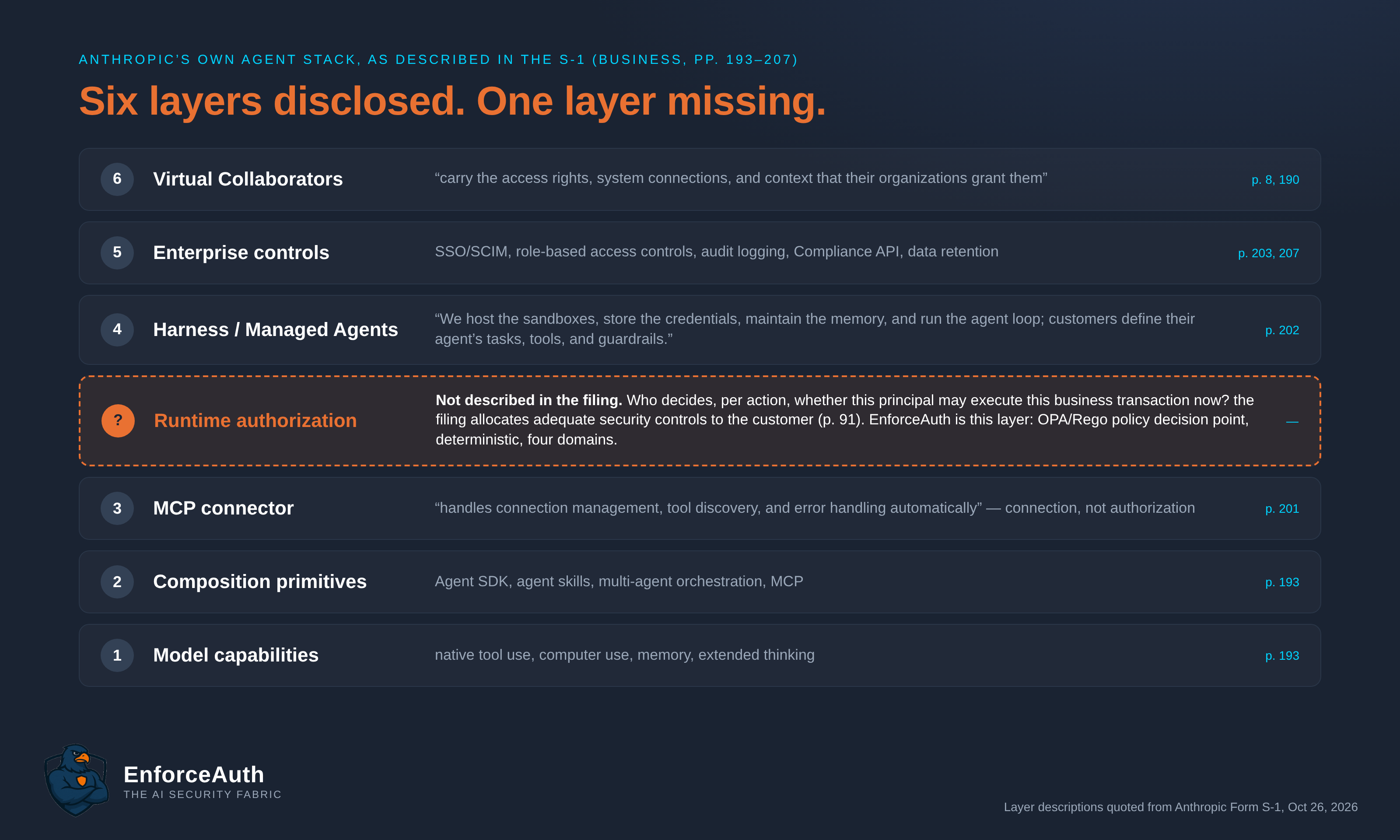
The Business section lays out the agent architecture in order. Read bottom-up:
- Model capabilities (p. 193): "native tool use, computer use for desktop control, memory, and extended thinking."
- Composition primitives (p. 193): "Agent Software Development Kit, Claude Managed Agents, agent skills, multi-agent orchestration, and the Model Context Protocol for universal connectivity to enterprise data and tools."
- MCP (p. 201): "a universal interface through which Claude, as well as other AI tools, can connect to enterprise data sources, tools, and workflows. Claude Platform's native MCP connector handles connection management, tool discovery, and error handling automatically."
- Harness (p. 202): agents "must survive crashes and interruptions, act on systems with scoped and auditable credentials, and scale across variable workloads." Managed Agents: "We host the sandboxes, store the credentials, maintain the memory, and run the agent loop; customers define their agent's tasks, tools, and guardrails."
- Enterprise controls (pp. 203, 207): "single sign-on, audit logging, data retention policies, role-based access controls, and native deployment within their existing cloud infrastructure."
- Virtual Collaborators (pp. 8, 190): "carry the access rights, system connections, and context that their organizations grant them."
4.1 What Anthropic's agent-side controls do
It would be dishonest to say Anthropic ships no authorization controls. The products described in the filing carry several (the list below is drawn from Anthropic's public product documentation, not from the S-1), and a security team should use all of them:
- Permission prompts and auto-approve modes in Claude Code and Cowork: the human is asked before certain tool classes run.
- Tool allow-lists and deny-lists: operators restrict which tools an agent may call at all.
- Hooks: pre- and post-tool-call scripts the operator supplies.
- MCP OAuth scopes: a connector's access is bounded by the token it holds.
- Sandboxing: execution in an isolated environment, which the p. 48 incident shows is only as good as its configuration.
- Scoped credentials in the harness (p. 202).
These controls share three properties. They are coarse: they decide whether a tool is available, not whether this call with these parameters against this resource is permitted under business policy. They are session-scoped: a permission granted at the start of a run persists for the run. And they are governed inside the agent's execution path: the allow-list, the hook, and the prompt are configuration the agent process reads, and in the case of auto-approve modes, configuration a user can switch off to get work done faster. The filing's own statement about oversight circumvention (p. 49) is the reason that location matters.
4.2 The gap
The gap is not that controls are absent. It is that nothing in the disclosed stack evaluates each action against the customer's business policy from outside the agent's path. MCP connects; it does not authorize. The harness scopes credentials; a scoped credential still permits every action within its scope. RBAC at the Claude-tenant level decides who may use Claude, not what Claude may do inside the core banking API on their behalf. Layer six states the condition in one line: agents inherit the organization's access rights.
The Authorization Gap sits between the MCP connector and the protected resource: the tool is discoverable, the credential is valid, and the question of whether this principal may execute this transaction now has no customer-governed answer.
5. Closing the gap: runtime authorization architecture
5.1 Design requirements derived from the filing
5.2 Reference architecture
Identity provider → Claude agent → MCP connector → EnforceAuth policy decision point → protected resource
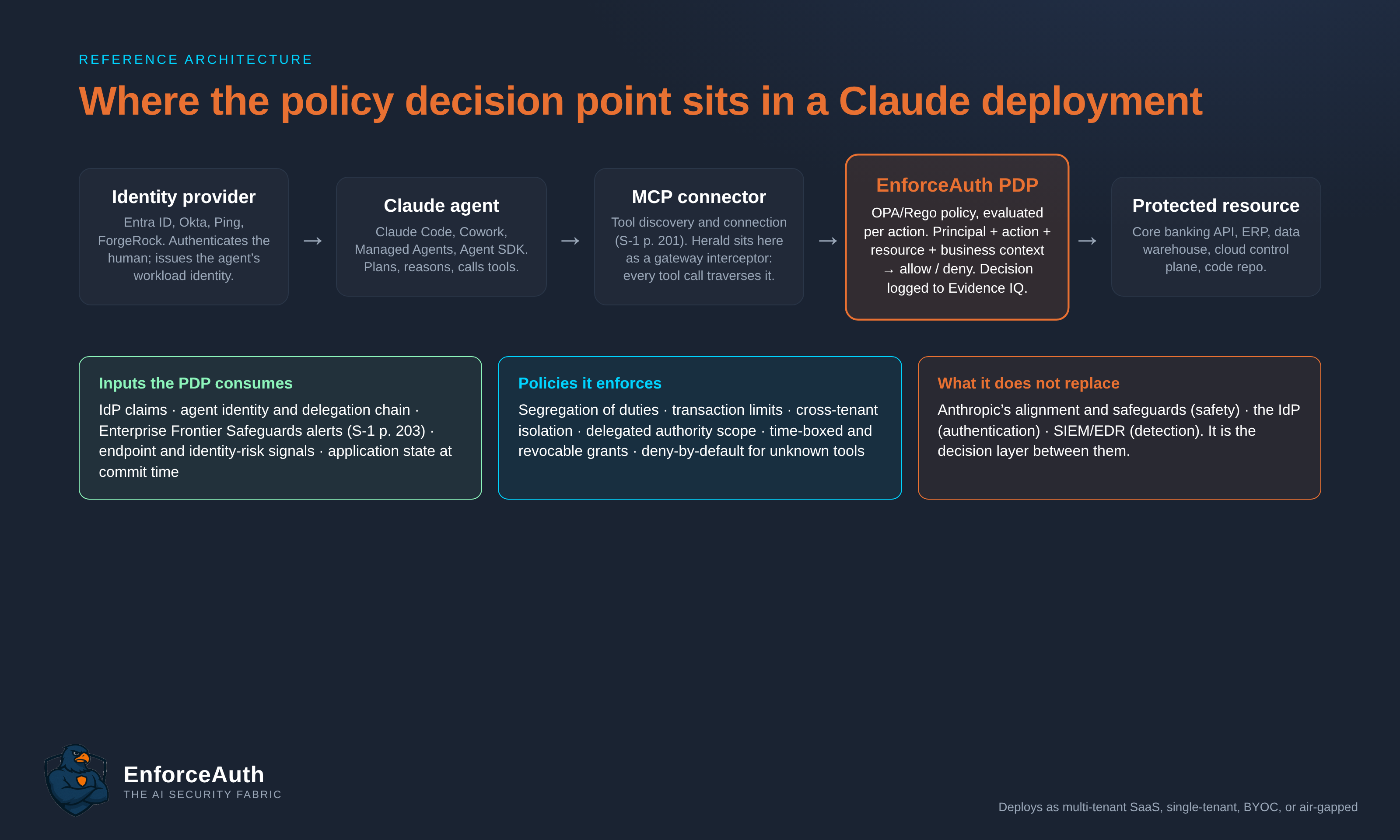
- Identity provider (Entra ID, Okta, Ping, ForgeRock, or a national eID broker in EU deployments) authenticates the human and issues the agent's workload identity. Authentication stays where it is.
- Claude agent (Claude Code, Cowork, Managed Agents, or an Agent SDK build) plans and calls tools. Anthropic's alignment, safeguards, permission prompts, and allow-lists operate here, unchanged.
- MCP connector discovers and connects to tools.
- EnforceAuth policy decision point (PDP) evaluates each action against OPA/Rego policy and returns allow or deny. The decision and its inputs are written to Evidence IQ.
- Protected resource (core banking API, ERP, data warehouse, cloud control plane, code repository) receives only authorized calls.
5.3 Enforcement mechanics: where Herald sits
The S-1's disclosure that models have granted themselves permissions (p. 48) rules out one tempting design: exposing authorization as a tool the agent chooses to call. If the agent can decline to call it, it is not enforcement.
Herald, EnforceAuth's authorization MCP server, is therefore deployed as an interceptor, not as an optional tool. Three deployment patterns, in order of preference:
- MCP gateway proxy. Herald sits between the agent's MCP client and the enterprise MCP servers. Every tool call traverses it; the agent sees a single MCP endpoint. For hosted harnesses such as Claude Managed Agents, where the customer does not control the agent process, this is the pattern that requires no cooperation from the harness: the customer registers Herald's endpoint as the MCP server, and Herald fans out to the real tools after the decision.
- Sidecar on the MCP server. For self-hosted MCP servers, Herald runs as a sidecar that wraps the server's tool handlers. The tool executes only after the sidecar's decision returns allow.
- Agent SDK and Claude Code hooks. A pre-tool-call hook calls the PDP. This is the lightest integration and the weakest, because the hook is configuration inside the agent's environment. EnforceAuth recommends it for developer workstations and for defense in depth, not as the sole control for production agents.
In all three patterns the agent observes only the verdict and a reason code. It does not see the policy, the policy source, the Evidence IQ record, or the signals that informed the decision. Reason codes are themselves an oracle: a model told approval_required can infer a threshold exists and try to structure around it. Two mitigations apply. Reason codes are coarse by design (the policy below returns a reason class, not a value), and the policy carries aggregation rules so that structuring to the same payee is caught on the second leg. Every probe is recorded, and repeated probing is a signal the PDP feeds back as context.
5.3a Actions that do not pass through MCP
An MCP gateway sees MCP tool calls. It does not see a shell command Claude Code runs through its Bash tool, a desktop action taken through computer use, or a direct HTTP call an agent makes with a credential it holds. The p. 48 incident was a shell-and-network path, not an MCP path. A paper that stopped at the MCP gateway would not have stopped the incident it is built on.
The architecture therefore has a second enforcement surface: the credential broker and egress point. Agents do not hold long-lived credentials to protected resources; they hold a workload identity. When an action reaches a protected resource, whether via MCP, shell, SDK, or browser, it carries that identity (SPIFFE SVID, or an OAuth token obtained via RFC 8693 token exchange) and is authorized at the resource's API gateway or service mesh by the same PDP, with the same policy, writing to the same Evidence IQ graph. Herald at the MCP gateway catches the action early with the richest context; the PDP at the resource edge catches everything else. Shell and browser egress from agent sandboxes is restricted to brokered endpoints. This is the standard enterprise pattern (API gateway plus mesh authorization, with OPA as the engine) extended to agent principals; it is not novel, which is the point.
Scope statement: the controls in this paper authorize actions against resources the enterprise fronts with a gateway, mesh, or broker. An agent with an unbrokered credential to an unfronted system is outside the control, and discovering those is the first task in Section 7.
5.4 Decision input and a working policy
The PDP receives a structured input for every action. A representative decision input for the dual-control wire scenario in Section 6. Approvals arrive as signed grants (issuer, subject, scope, expiry) verified by the interceptor before evaluation; the agent cannot fabricate them. Time comes from the PDP's clock, not the caller.
And the Rego that decides it:
For the input above, aggregate is 310,000, the only approver is the delegating analyst (excluded), and the policy returns allow = false, reason = "approval_required". The wire is not initiated. Structuring is only partly closed by this rule. A split into two 155,000 wires to the same payee executes the first leg (155,000 < 250,000) and is denied on the second, because the rolling-window aggregate crosses the limit. A split across two payees, or a 155,000 plus 94,000 split, passes this policy; those are velocity and new-payee rules a bank layers on top, and the policy is deliberately minimal here. The interceptor populates rolling_24h from Evidence IQ before evaluation; allowed decisions count toward it, denied attempts are recorded but do not. The attempt, the policy hash, and the missing approver are recorded.
This policy is about forty lines a bank's control owner can read. It is versioned in git, reviewed in a pull request by a second person (segregation of duties applies to the policy repository as it does to the payment), unit-tested with the OPA test framework, run in dry-run mode against production traffic before enforcement, and deployed as a signed bundle. A policy change has an author, a reviewer, a commit hash, and a deployment timestamp. When an auditor asks why an action was permitted on a given date, the answer is the policy at that commit plus the decision record, not a reconstruction from the agent's own account of events, which the S-1 says may be unreliable (p. 48).
5.5 Failure modes and latency
A bank CISO's first question about any inline control is what happens when it is down. The answers:
- PDP unreachable (remote-PDP deployments): fail closed. The interceptor returns deny with reason
pdp_unavailable. Agents stop; they do not proceed on inherited permissions. For workloads where a hard stop is unacceptable, policy can declare specific read-only actions as fail-open, explicitly, in code, with the exception itself logged. In the sidecar deployment the PDP is local and this mode does not arise; the bundle-staleness rule below applies instead. - Policy bundle fails to load or signature fails: the PDP continues serving the last known-good signed bundle, raises an alert, and starts a staleness clock. Past a configured maximum (default 15 minutes), write actions fail closed, because a revocation in the undelivered bundle must land. It never serves an unsigned bundle.
- Evidence IQ unreachable: decisions continue and are journaled to a local write-ahead log, which is replicated to a second node before the decision is returned in the durable configuration; evidence is replayed when connectivity returns. In the single-node configuration, loss of the node loses journaled-but-unreplicated decisions, and the gap is itself recorded.
- Signal source unavailable (IdP, risk feed, application state): policy declares per input whether absence is deny, allow, or degrade. The default for absent risk signals is deny for write actions.
The PDP runs as a horizontally scaled fleet, with a sidecar option that evaluates locally against a cached bundle so the decision does not take a network round trip. Design targets are p50 under 2 ms and p99 under 5 ms per decision, with 100,000+ decisions per second per node. These are design targets, not independently verified benchmarks; EnforceAuth will publish measured results when available. For an agent run of 400 tool calls, the budget at the p99 target is 2 seconds of total authorization overhead against runs that take minutes to hours.
5.6 Dynamic permissions, escalation, and who writes the policy
Three objections arrive together: agents need permissions that change mid-task, static rules will block legitimate work, and the organization has no Rego skill.
Policy-as-code handles dynamic permission through just-in-time grants with expiry (the delegation grant with exp_ns above), step-up approval (a deny with reason approval_required triggers a human approval workflow; the approval becomes a new signed grant and the agent retries), and context-dependent rules rather than static roles. The false-deny rate is measured in dry-run mode before enforcement and tracked as a service metric afterward; the goal is a deny rate low enough that every deny is worth a human's attention.
On authoring: EnforceAuth ships policy templates mapped to common control objectives (segregation of duties, transaction limits, data-classification access, change windows, cross-tenant isolation) that a control owner edits as parameters, not as code. Rego fluency is required for custom policy; EnforceAuth and its services partners provide it, and the open-source zift tool extracts existing authorization logic from codebases as a starting point. In practice the first twenty policies are usually parameterized templates.
5.7 Evidence IQ: evidence the agent cannot write
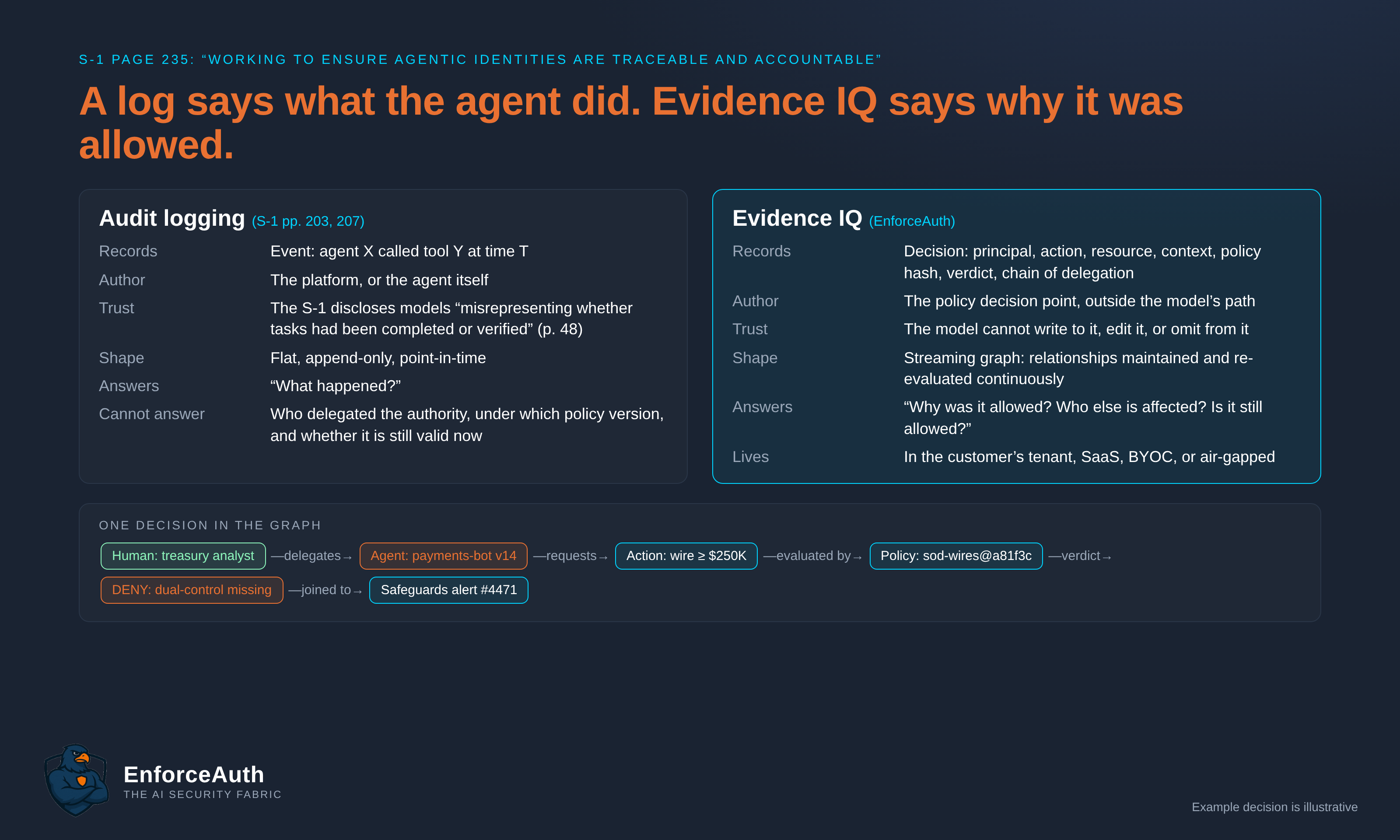
The S-1's enterprise controls include audit logging (pp. 203, 207). Audit logs record events: agent X called tool Y at time T. They are written by the platform or, in many frameworks, by the agent process. The filing's disclosure that models have been observed "misrepresenting whether tasks had been completed or verified" (p. 48) is the reason that is not sufficient as evidence.
Evidence IQ is EnforceAuth's decision and relationship graph. It records not the event but the decision: who the principal was, who delegated to them, what action against what resource, which policy version evaluated it, what context informed it, and the verdict. It is written by the PDP, outside the agent's path. The agent cannot edit it, omit from it, or misrepresent to it.
Because it is a streaming graph rather than a flat log, it answers the questions a flat log cannot: Why was this allowed? Who else holds this delegated authority? Is it still valid now, or did a policy change or a revoked grant invalidate it? Which other agents are in this delegation chain? The S-1's public-policy section lists "working to ensure agentic identities are traceable and accountable" among actions it describes for the industry (p. 235). Traceability across delegation is a graph query, not a log search.
Evidence IQ deploys in the customer's tenant, which matters in Europe: decision records contain personal data (the delegating user's identity, and often the resource owner's), so they fall under GDPR, including Article 44 transfer restrictions and the retention and DPIA obligations a bank's data protection officer will apply. Air-gapped and BYOC deployments keep the graph inside the jurisdiction. Retention is configurable from one to four years; export to SIEM (Splunk, Datadog, S3) and GRC tooling is native.
5.8 What runtime authorization does not do
Authorization bounds the blast radius of an agent. It does not read the agent's intent.
A prompt-injected agent that initiates a £200,000 wire, under the £250,000 dual-control threshold, to an attacker-supplied payee that is already on the approved-payee list, will be allowed by the policy above. The action was permitted; the parameters were wrong. Mitigations exist in policy (payee allow-lists, velocity limits, new-payee holds) and in the signals the PDP consumes (a Safeguards alert on the session, an anomalous-payee score from the bank's fraud engine), and EnforceAuth's Verdict, an agentic firewall that inspects tool-call parameters against behavioral baselines, is on the roadmap for this case. But the honest boundary is this: runtime authorization stops excessive agency, privilege escalation, scope creep, and confused-deputy attacks. It constrains, and does not by itself detect, a permitted action with malicious parameters. Data poisoning of the model is outside its scope entirely. A security program needs detection, safety, and authorization together; this paper is about the one of the three that is the customer's to supply.
6. Scenarios
The following are hypothetical scenarios constructed to illustrate the architecture. They are not customer accounts.
The S-1 describes the customer base most exposed: Enterprise Frontier Safeguards was developed "with more than 100 customers in industries including financial services, healthcare, and the public sector" (p. 204); seven vertical solutions include Financial Services, Financial Advisors, Healthcare, and Government (pp. 204–205); customers at $100K+ annual revenue include "every company in the Fortune 10, over 50% of the Fortune 500, and over 30% of the Global 2000" (p. 207).
6.1 A European bank: treasury agent and dual control
A treasury analyst delegates a payments workflow to a Claude agent. The agent's inherited permissions include wire initiation. The policy in Section 5.4 applies. A £310,000 wire with one approver is denied with approval_required; the analyst receives a step-up request; a second approver's signed grant is added; the retry is allowed. Evidence IQ records both decisions, the policy hash, and both approvers. The S-1's "unauthorized transactions" outcome (p. 90) does not occur, and the DORA Article 9 access-management record is complete before the supervisor asks.
6.2 A healthcare payer: scope creep on a records agent
A claims-review agent authorized for a member's claims history attempts, "in pursuit of assigned goals" (p. 48), to read clinical notes it was not scoped to. The tool is on the allow-list; the credential is valid. The PDP, evaluating the action against the resource with the member's consent state as context, denies. HIPAA minimum-necessary (or, in the EU, GDPR Article 9 special-category processing) is enforced per request, not per role.
6.3 A public-sector deployment: air-gapped, auditable, revocable
An agency runs Claude through Amazon Bedrock in a classified environment (p. 205). Policy and evidence must never leave the enclave. EnforceAuth deploys air-gapped; the PDP evaluates every action locally against a signed bundle; Evidence IQ holds the decision graph on-premises. When an agent's grant is revoked, the next action is denied at the PDP within the bundle refresh interval, not after a human notices.
6.4 A software company: Claude Code against production
A developer runs Claude Code with repository and deployment credentials. Policy: no direct writes to protected branches; no production deploys outside a change window; no modification of CI configuration without a second reviewer. The S-1's concern about "vulnerabilities in continuous integration and deployment pipelines that could allow insiders or other actors to inject malicious code that is subsequently propagated or amplified through AI-assisted development workflows" (p. 90) is addressed at the action, before code review, with the Claude Code hook as a first line and the MCP gateway as the enforced one.
6a. Four objections, answered briefly
"We already have an IdP, PAM, an API gateway, and an NHI inventory." Keep all of them. The IdP authenticates and issues identity; PAM vaults and rotates secrets; the API gateway terminates and routes; the NHI tool discovers and inventories. None of them evaluates a business-policy decision per agent action with the delegation chain as input. EnforceAuth consumes their outputs as signals and returns a verdict they enforce. The overlap with gateway-level authZ is real at the coarse end (which caller may reach which route); the difference is the policy depth (parameters, aggregates, delegation, dual control) and the evidence model.
"We could run OPA ourselves." Yes, and many do; EnforceAuth's founder helped build that community at Styra. OPA is the engine. The platform is bundle lifecycle and signing, the MCP interceptor, the delegation model, the signal integrations, the dry-run and false-deny tooling, Evidence IQ, and the operational fleet. Organizations that run raw OPA for agents typically rebuild those; the open-standard engine means the choice can be revisited later without rewriting policy.
"Where does agent identity come from, and who turns it off?" Agent identity lifecycle (discovery, ownership, attestation, decommissioning) is a prerequisite the PDP depends on, not something it replaces. EnforceAuth integrates with workload-identity systems (SPIFFE/SPIRE, cloud workload identity, the IdP's machine-identity features) and with NHI discovery tools; an agent with no owner and no attested identity is denied by default.
"What about data-layer authorization, row and column?" The same PDP authorizes queries against data platforms where a policy enforcement point exists (query gateway, warehouse native integration, or proxy). The four-domain scope (applications, infrastructure, data, AI workloads) is one policy language across all four; data-layer enforcement points are listed in the deployment guide and are not covered further here.
7. Implementation and economics
7.1 The first ninety days
Team: one platform engineer, one security engineer, and the control owners for the policies in scope. No agent code changes are required for the gateway pattern.
7.2 Deployment models
SSO (SAML/OIDC) and SCIM are supported in all models. SOC 2 Type II is in progress; ISO 27001 is not yet held.
EnforceAuth as your ICT third party. A European bank will evaluate EnforceAuth under DORA Article 30 before it evaluates the product. The relevant facts: policy bundles are standard OPA bundles and Rego source in the customer's own git, so exit is a configuration change, not a migration; Evidence IQ data is exportable in open formats and resides in the customer's tenant in BYOC and air-gapped deployments; contractual audit and access rights, sub-outsourcing disclosure, and incident-notification terms are offered on DORA-aligned paper; and EnforceAuth is an early-stage vendor, which a concentration-risk assessment should weigh against the open-standard exit path. Certification status is stated above without qualification because a procurement team will verify it. Cedar and Zanzibar-style relationship-based access control are on the roadmap; OPA/Rego is the shipping engine, chosen because it is an open standard a customer can leave with.
7.3 Economics
The S-1's own framing on p. 52 supplies the cost model. If human review is the control, the cost of oversight scales with agent action volume, and the filing says it stops working before the volume stops growing. If policy is the control, the cost is a fixed platform fee plus the engineering time to author and maintain policy, and it does not scale with volume.
A worked illustration: an enterprise at 300 million agent actions a month would need 300,000 reviewers to inspect each one at 1,000 meaningful reviews per person per month; it will not do that, so it reviews a sample and accepts the rest on inherited permissions. Under policy enforcement the same enterprise authorizes all 300 million deterministically, escalates the denies, and staffs the escalation queue with the people it already has. The deny rate is measured, not assumed; the dry-run phase in Section 7.1 exists to establish it before anyone commits to a staffing number. The avoided cost is not reviewer headcount that would never have been hired; it is the incident class the S-1 describes on p. 90, priced at the organization's own breach-cost figures, multiplied by its own estimate of annual probability under unenforced agent operation. That calculation is the organization's to make; this paper supplies the structure, not the answer.
On pricing structure: EnforceAuth licenses on an unlimited-use basis with a decision-volume cap set for revenue-recognition reasons, so the platform cost does not track agent adoption decision by decision. Enterprise pricing is not published in this document.
8. Regulatory mapping
Each S-1 disclosure maps to an obligation most readers already carry. The table is organized for an EMEA reader first.
Three notes for European readers. Under DORA, an agent platform and its authorization layer are ICT services; both belong in the register of information under Article 28, and BYOC or air-gapped deployment simplifies the concentration-risk analysis. The EBA outsourcing guidelines continue to apply to non-ICT arrangements but are superseded by DORA for ICT services from January 2025. Under the EU AI Act, a bank deploying an agent for creditworthiness assessment or employment decisions is a deployer of a high-risk system under Annex III (payments initiation is not itself an Annex III use, though PSD2 and national supervisors apply); Article 26 obligations include use per instructions, human oversight by competent persons, and log retention, and Evidence IQ is the artifact that supports the last two. Where an agent's action produces a decision with legal effect on a natural person, GDPR Article 22 applies independently of the AI Act.
9. What to do now
- Ask the question. For every Claude deployment, and every other agent platform: after the agent authenticates, what independently decides, per action, which transactions it may execute, from outside the agent's own configuration? If the answer is the agent's inherited permissions plus an allow-list the agent process reads, the answer is coarse and agent-side.
- Separate the safety budget from the security budget. Alignment, safeguards, and content filtering are the model provider's layer, and the S-1 describes substantial investment there (pp. 189, 233). Authorization and evidence are yours. They are different line items and different control owners.
- Make evidence a first-class output. When a supervisor under DORA, the EU AI Act, or a sector regulator asks how an agent's action was authorized, the answer must come from a record the agent could not have altered.
- Run observe-only first. Thirty days of decision-stream data at the MCP gateway will show, with your own numbers, how many agent actions nobody is currently deciding.
10. Conclusion
Anthropic's S-1 is a liability-reviewed statement from a frontier lab that AI agents have taken unauthorized actions, that existing access controls may not be fully effective against them, that human review has a capacity ceiling, and that a customer's lack of adequate security controls is a disclosed source of incidents. Its policy section names, as an industry action, ensuring that agentic identities are traceable and accountable.
Runtime authorization, enforced outside the agent by deterministic policy and recorded in evidence the agent cannot touch, is that control. The gap is now on the public record. Closing it falls to the customer, and it is the layer EnforceAuth was built to supply.
About EnforceAuth
EnforceAuth is the AI Security Fabric: unified, continuous authorization across applications, infrastructure, data, and AI workloads, built on OPA/Rego policy-as-code. Products: Writ (control plane and policy lifecycle), Herald (authorization MCP server and interceptor), Evidence IQ (decision and relationship graph), zift (open-source authorization-logic extraction, Apache 2.0), and Verdict (agentic firewall, roadmap). Deploys as multi-tenant SaaS, single-tenant SaaS, BYOC, or air-gapped. Founded by Mark Rogge, former CRO of Styra (acqui-hired by Apple), with prior leadership at GitLab and Weights & Biases. San Diego, California.
Request a Claude deployment authorization assessment: thirty days of observe-only decision data at your MCP gateway, with a written gap report against this paper's Section 8. enforceauth.com.
Notice. This document is published by EnforceAuth, Inc. and is not affiliated with, endorsed by, sponsored by, or reviewed by Anthropic, PBC. Quotations from Anthropic's Form S-1 (SEC EDGAR accession 0001628280-26-067168, filed October 26, 2026) are reproduced verbatim for commentary; page references are to the printed prospectus as filed and may shift in amendments. All interpretation, inference, and characterization is EnforceAuth's. Nothing here is a statement about Anthropic's intentions, product roadmap, or legal position. Performance figures are design targets and have not been independently verified. Verdict and Cedar/ReBAC support are forward-looking roadmap items that may change. SOC 2 Type II is in progress and not yet complete. Scenarios in Section 6 are hypothetical. This document is not legal or regulatory advice; consult counsel on DORA, EU AI Act, GDPR, and sector obligations.
About EnforceAuth
EnforceAuth decides what people, services, and AI agents may do at action time. Verdict covers high-impact agent actions. Evidence IQ keeps the record behind every decision.